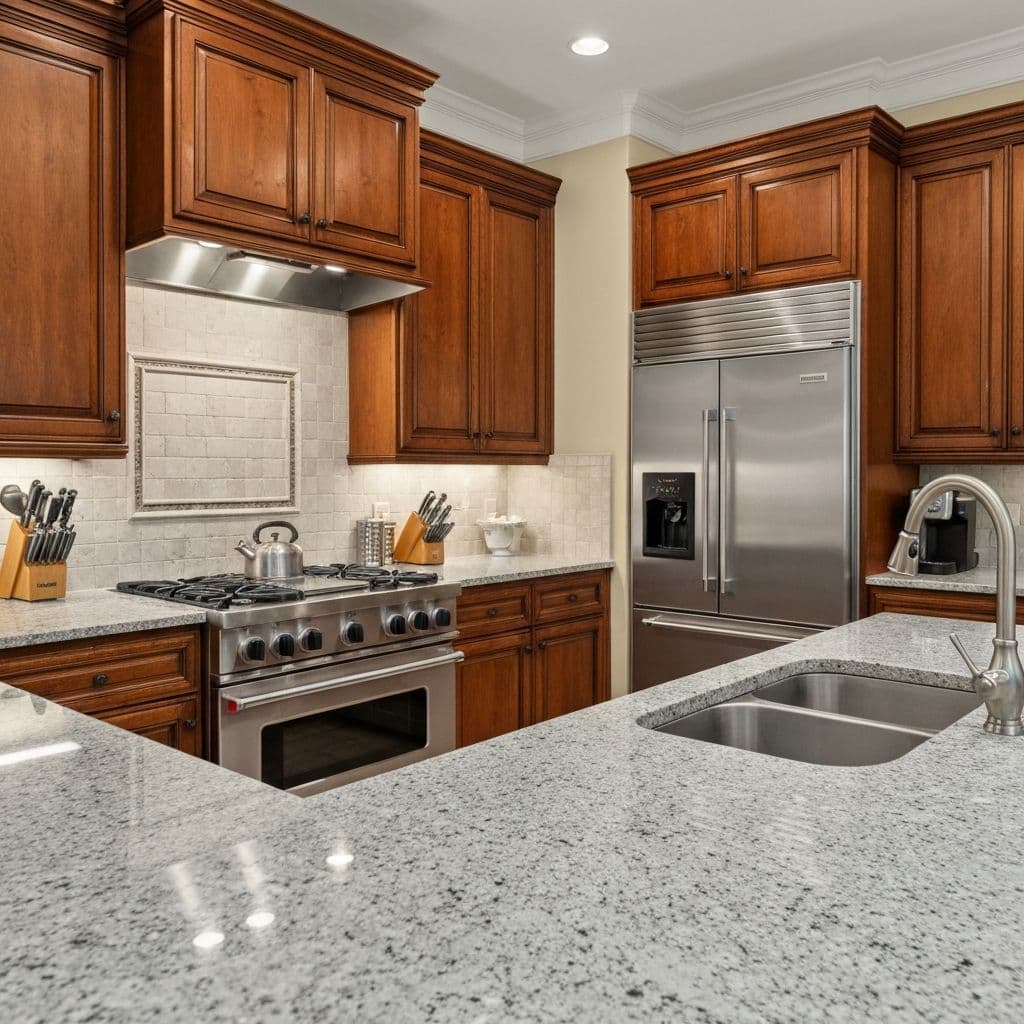
How much do countertops cost? It's the first question almost every homeowner asks us, and the honest answer is that it depends on a handful of variables that are easy to understand once someone lays them out. In the Raleigh-Durham area, most installed countertops land between roughly $45 and $150 per square foot, and most full kitchen projects fall between $2,500 and $7,500. That's a wide range — but it narrows quickly once you know your material, your kitchen's square footage, and a few details about layout and edges.
This guide is written by a family-owned fabricator that quotes and installs these projects every week in Durham, Raleigh, Cary, Chapel Hill, and the surrounding Triangle. We'll break down per-square-foot pricing for each major material, explain exactly what an installed price includes (and what sometimes isn't included), walk through the factors that move a quote up or down, and give you three sample kitchen budgets worked out from real ranges. Our pricing page carries the headline numbers; this guide is the longer explanation behind them.
One important caveat before we start: every number here is a typical range, not a quote. Slab selection, layout, and scope can move a real project above or below these figures, and the only way to get an exact number is to measure your kitchen and look at actual slabs. If you want that number quickly, EZ Quote turns your measurements and material preference into real figures, usually within one business day.
Countertop Prices Per Square Foot, by Material
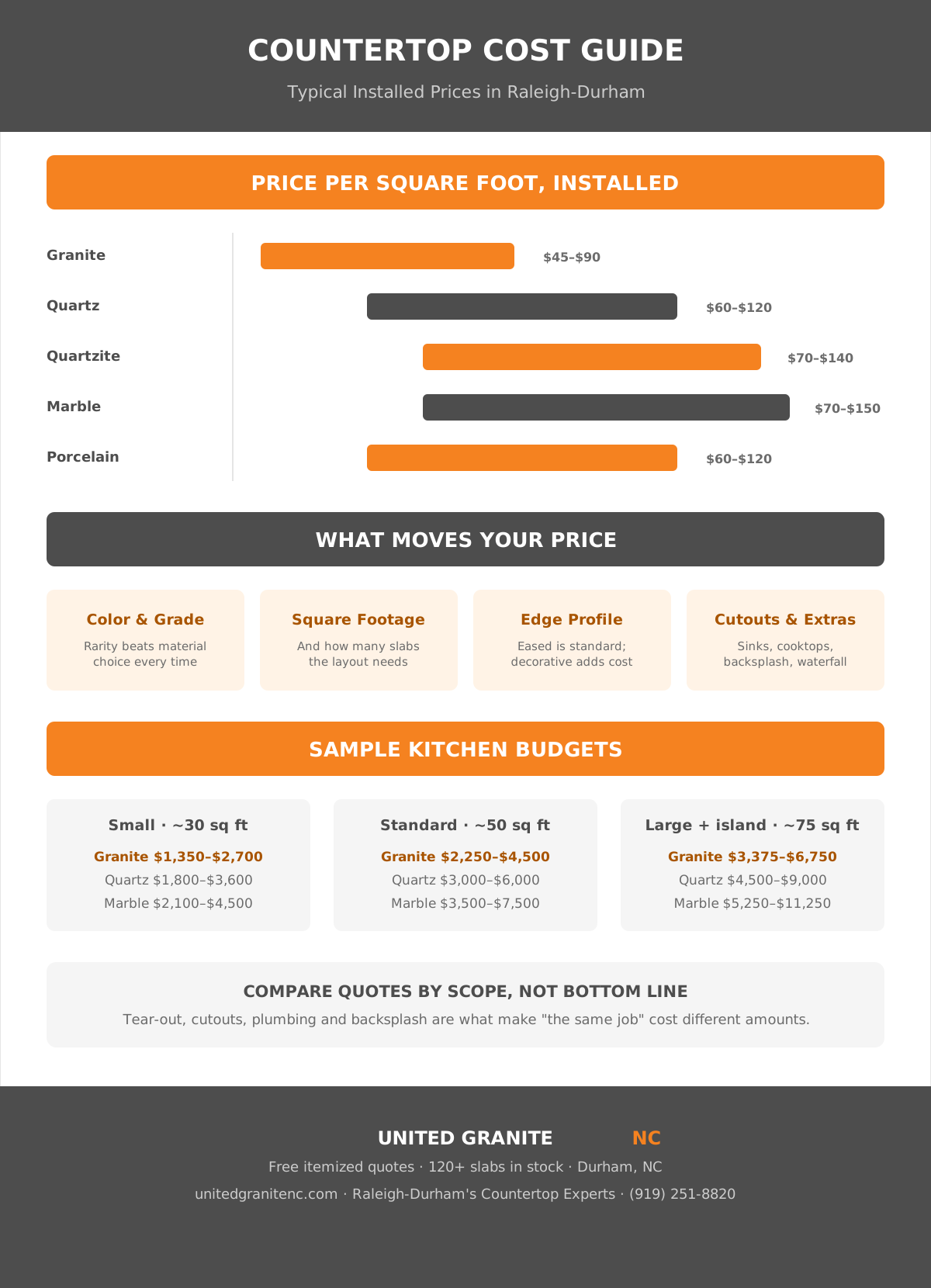
Here are the typical installed ranges we see in the Raleigh-Durham market. "Installed" means fabrication, delivery, installation, and a standard eased edge are included; we'll cover exactly what that means in the next section.
| Material | Typical Installed Price | Where It Fits |
|---|---|---|
| Granite | $45–$90 / sq ft | Best value for real natural stone; widest in-stock selection |
| Quartz (Cambria, Silestone, Caesarstone, MSI) | $60–$120 / sq ft | Low-maintenance; consistent patterns; brand and design tier drive price |
| Quartzite | $70–$140 / sq ft | Natural stone with marble-like looks and very high hardness |
| Marble | $70–$150 / sq ft | Classic look; needs more care and habits |
| Porcelain | $60–$120 / sq ft | Heat, UV, and stain performance; specialized fabrication |
Two things stand out in that table. First, the ranges overlap far more than most people expect — premium granite can cost more than mid-range quartz, and entry-level quartzite can land near mid-range marble. The best comparison is always slab to slab, not category to category. Second, the spread *within* each material is often bigger than the gap *between* materials, which is why choosing a specific color matters more to your final price than choosing granite over quartz.
What's Included in an Installed Price?
A countertop quote is rarely just "stone." At a reputable fabricator, an installed per-square-foot price typically bundles the slab itself, templating (the precise on-site measurement of your cabinets), fabrication in the shop, delivery, installation, and sealing where the material calls for it. A standard eased edge is normally included as well; decorative profiles are where pricing starts to diverge.
What varies from quote to quote is the scope *around* the stone. Tear-out and haul-away of the old countertop may or may not be included. Sink cutouts are sometimes included for one undermount sink and charged separately for cooktops or extra cutouts. Plumbing disconnect and reconnect is handled by some crews and left to a separate plumber by others. Backsplash is frequently quoted as its own line, and sinks and faucets are almost always separate unless you buy them through the fabricator.
This is the single most common reason two quotes for the "same" job differ by hundreds of dollars: they aren't actually the same job. When you compare quotes, line them up by scope, not by bottom line. Our guide to choosing a countertop fabricator covers exactly how to ask for an itemized quote and what to look for in one.
Granite Countertop Cost
Granite remains the value leader in natural stone. Typical installed pricing runs $45–$90 per square foot, with the final number driven mostly by color. Common, widely quarried colors such as Colonial White, Santa Cecilia, and Steel Gray sit at the accessible end because consistent global supply keeps costs down. Mid-tier colors with more distinctive movement, like Absolute Black and Black Galaxy, land in the middle. Exotic imports with limited quarry sources — Blue Pearl, Costa Esmeralda, and similar statement colors — can run well above that range. Our popular granite colors guide breaks down pricing by color family in more detail.
Granite also gives you the widest in-stock selection of any natural stone we carry, which has its own pricing benefit: a slab that's already in the Durham yard doesn't carry the shipping and lead-time costs of a special-order import. If you're price-sensitive, start your search with what's physically in stock.
Quartz Countertop Cost
Engineered quartz typically runs $60–$120 per square foot installed. The spread comes from brand and design tier: entry solid colors and builder-grade lines sit at the bottom, while premium marble-look designs with long veining and complex patterns price at the top. Cambria typically starts around the mid-$60s and climbs from there, Silestone and Caesarstone cover a broad band, and MSI Quartz is generally the most accessible entry point. Our quartz brand comparison puts the four side by side.
The reason many homeowners choose quartz despite the sometimes-higher sticker price is lifetime cost: it never needs sealing, resists staining without effort, and delivers a consistent look from slab to slab. If you value zero-maintenance over natural variation, the price premium often pays for itself in avoided upkeep. If you're still deciding between the two, our granite vs. quartz comparison walks through the tradeoffs.
Quartzite and Marble Cost
Quartzite typically runs $70–$140 per square foot installed and marble $70–$150. Both are natural stones with limited supply, and both are chosen primarily for their look: quartzite for its marble-like veining combined with exceptional hardness, marble for its unmistakable classic character. Exotic or rare slabs in either material can exceed these ranges. For a detailed breakdown of how the two perform, see our quartzite vs. quartz guide.
Marble's price is only part of its real cost. It etches from acidic foods and cleaners and needs a more careful routine than other surfaces, so be honest with yourself about whether you'll enjoy that routine before paying for it. Many homeowners get the marble look they want on a statement island or bathroom vanity while using a more forgiving material across the main kitchen perimeter.
Porcelain Countertop Cost
Porcelain slabs typically run $60–$120 per square foot installed. The material itself isn't always more expensive than quartz, but porcelain requires specialized cutting and handling, which is reflected in the fabrication portion of the price. In return you get outstanding heat, UV, and stain resistance, which is why it's a favorite for outdoor kitchens. Our porcelain pros and cons guide covers where it shines and where it doesn't.
The Factors That Move Your Price Most
Once you've picked a material, these are the variables that determine where in the range your project actually lands. We've listed them roughly in order of how much they tend to matter.
- Specific color and slab grade. Within any material, rarity and pattern complexity drive price more than anything else. A common granite and a rare one can differ by more than the gap between granite and quartz.
- Total square footage. More area means more slab, and it can also change how many slabs you need to buy. A project that just barely exceeds one slab's usable area can cost disproportionately more than one that fits cleanly inside it.
- Layout and seams. Efficient layouts that nest pieces well on a slab waste less stone. Long runs, large islands, and L-shaped corners affect both slab count and the number of seams.
- Edge profile. A standard eased edge is typically included; ogee, bullnose, mitered, and waterfall edges require more labor and often add to the price. See our edge profiles guide for the options.
- Cutouts. Undermount sinks, cooktops, and faucet holes each involve precise cutting and polishing. A kitchen with several cutouts costs more to fabricate than one with a single sink.
- Backsplash and waterfall panels. A full-height stone backsplash adds square footage; waterfall ends add both material and miter labor.
- Thickness. The common thicknesses are 2 cm and 3 cm. Thicker slabs cost more and weigh more, and some designs call for laminated edges to create a thicker visual profile.
- Demolition and site conditions. Removing an old countertop, dealing with out-of-level cabinets, or navigating a difficult delivery route can all add time and cost.
Notice that most of these are decisions you control. That's good news if you're trying to hit a budget: you can often adjust layout, edge, or cutouts to bring a quote down without changing the stone you love.
Sample Kitchen Budgets
To make the per-square-foot numbers concrete, here are three sample kitchens worked out from the ranges above. These multiply the typical installed ranges by square footage; they're meant as a planning starting point, not a quote, and they assume standard eased edges and a single sink cutout.
| Kitchen | Granite | Quartz | Quartzite or Marble |
|---|---|---|---|
| Small (about 30 sq ft) | $1,350–$2,700 | $1,800–$3,600 | $2,100–$4,500 |
| Standard (about 50 sq ft) | $2,250–$4,500 | $3,000–$6,000 | $3,500–$7,500 |
| Large with island (about 75 sq ft) | $3,375–$6,750 | $4,500–$9,000 | $5,250–$11,250 |
A typical Raleigh-Durham kitchen carries 40–60 square feet of counter space, which is why most full replacements land between $2,500 and $7,500. Premium slabs, waterfall edges, full-height backsplashes, and large islands push projects above that; entry granite in a compact kitchen can come in below it. If your project is replacing existing counters, our countertop replacement guide covers the extra steps and costs involved.
Bathrooms are a different scale entirely. A vanity typically runs 5–15 square feet, so even premium stone lands at friendlier totals — the price difference between a mid-range and a luxury slab shrinks to a few hundred dollars. Our bathroom vanity countertop guide has the full breakdown, and it's often the cheapest place to splurge on a statement material.
How to Read and Compare Countertop Quotes
Comparing quotes is where most people either save real money or accidentally choose the wrong one. The goal is to compare identical scopes of work, so use this checklist to normalize what you receive.
- Is it itemized? A single lump sum makes comparison impossible. You want material, fabrication, edge, cutouts, installation, and any extras listed separately.
- Is the exact slab identified? The quote should name the specific color, material, thickness, and ideally the slab or lot, not just a category like granite.
- What's the square footage? Different shops measure and round differently. Confirm the number used and whether waste and backsplash are included.
- Is tear-out included? If you're replacing existing counters, removal and disposal should be explicitly listed or explicitly excluded.
- Who handles plumbing and electrical? Disconnecting and reconnecting sinks and cooktops is often assumed and sometimes forgotten.
- What's the payment schedule? A deposit is normal; a large upfront payment before any work is a warning sign.
- What's the warranty on workmanship? Material warranties are common, but you want to know what's covered if a seam separates or a cutout cracks.
Be especially careful with a quote that comes in far below the others. A price well under market usually means a cut somewhere — thinner stone, subcontracted labor, minimal sealing, or exclusions that surface later as change orders. A good fabricator will happily explain exactly why their number is what it is.
Smart Ways to Save Without Cutting Corners
There's a difference between saving money and cutting corners. These approaches reduce what you pay without compromising the quality of fabrication or installation — the part of the job that actually determines whether your counters look great in ten years.
- Choose a color already in stock. Slabs in the yard avoid special-order shipping and lead times. We keep 120+ slabs in stock at our Durham location, so many projects can start without waiting on an import.
- Pick a mid-tier color within your favorite family. If you love black granite, compare Absolute Black against Black Galaxy and other options; the look can be similar while the price differs.
- Use a standard eased edge. It's included in the installed price, looks clean and modern, and is easy to maintain. Save decorative edges for the one spot where they make the biggest impact.
- Mix materials strategically. Use a premium slab on the island and a more affordable stone on the perimeter. It's a popular and attractive design approach.
- Ask about remnants. For small projects like vanities, bar tops, and laundry counters, leftover pieces from larger jobs can bring premium materials near entry pricing.
- Simplify the layout. Fewer cutouts, fewer corners, and a layout that nests efficiently on the slab can reduce both material and labor.
- Keep the existing sink if it's compatible. Reusing a quality undermount sink removes a line item, though your fabricator will need to confirm it can be cut and mounted correctly.
- Bundle projects. Doing the kitchen and bathrooms together can use leftover stone more efficiently and consolidate delivery and installation.
Where Not to Cut Corners
Some savings cost far more than they save. Templating accuracy determines whether your counter actually fits your cabinets. Seam quality determines whether a seam disappears or collects grime for years. Sink support and overhang bracing determine whether the stone stays intact around stress points. Sealing, for the stones that need it, determines how well a surface resists stains from day one. None of these show up as a headline line item, which is exactly why a low bid can quietly skip them.
Our consistent advice: spend your flexibility on material and layout decisions, and spend your due diligence on who is fabricating and installing the project. A well-fabricated entry-level granite will outperform a poorly fabricated premium slab every time.
Why Buying Local in the Triangle Matters
A local, in-house fabricator affects both price and outcome in ways that aren't obvious from a quote. Seeing the actual slab before it's cut removes the risk of a surprise when sample and slab don't match, which is especially important for natural stone where no two slabs are identical. In-house fabrication means fewer handoffs, fewer places for scheduling to slip, and one team accountable from templating through installation. And an in-stock inventory avoids the shipping costs and delays that accompany special orders.
If you're in Durham, Raleigh, Cary, Chapel Hill, or anywhere in the surrounding area, you can walk our yard, tag a slab, and see exactly what you're paying for. Browse our portfolio for finished projects, or visit our process page to see how a project moves from template to install. For timing expectations, see our installation timeline guide.
How to Get an Accurate Quote Quickly
The fastest path to a real number is to bring a few details with you. Rough measurements of your counter runs, a sense of the material and color family you're considering, a note on whether you're replacing existing counters, and any specific features you want — waterfall island, full-height backsplash, a particular edge profile — are enough to produce a useful estimate. A photo of your current kitchen helps too.
From there, EZ Quote turns your information into figures, usually within one business day, and a visit to the yard lets you compare actual slabs side by side. If you'd rather talk it through, call us at (919) 251-8820 or use our contact page. There's no cost and no obligation to get an estimate, and an itemized quote gives you everything you need to compare accurately. If you're still choosing materials, start with our best kitchen countertop materials guide and our countertop buying guide.
The Bottom Line
Countertop pricing in Raleigh-Durham isn't mysterious once you separate its parts: the material and specific slab, your square footage, a handful of fabrication details like edges and cutouts, and the scope of work around the stone. Granite delivers the most natural stone for the money, quartz trades a higher starting price for zero maintenance, and quartzite, marble, and porcelain command premiums for their looks and performance. Most kitchens land between $2,500 and $7,500, and nearly every variable that moves that number is a choice you can adjust.
Whatever you choose, compare quotes by scope rather than by bottom line, and put your effort into vetting the team that will fabricate and install the stone. That's where your counters are truly made or ruined. When you're ready to see real numbers, we're happy to measure, walk the yard with you, and put together an itemized quote.