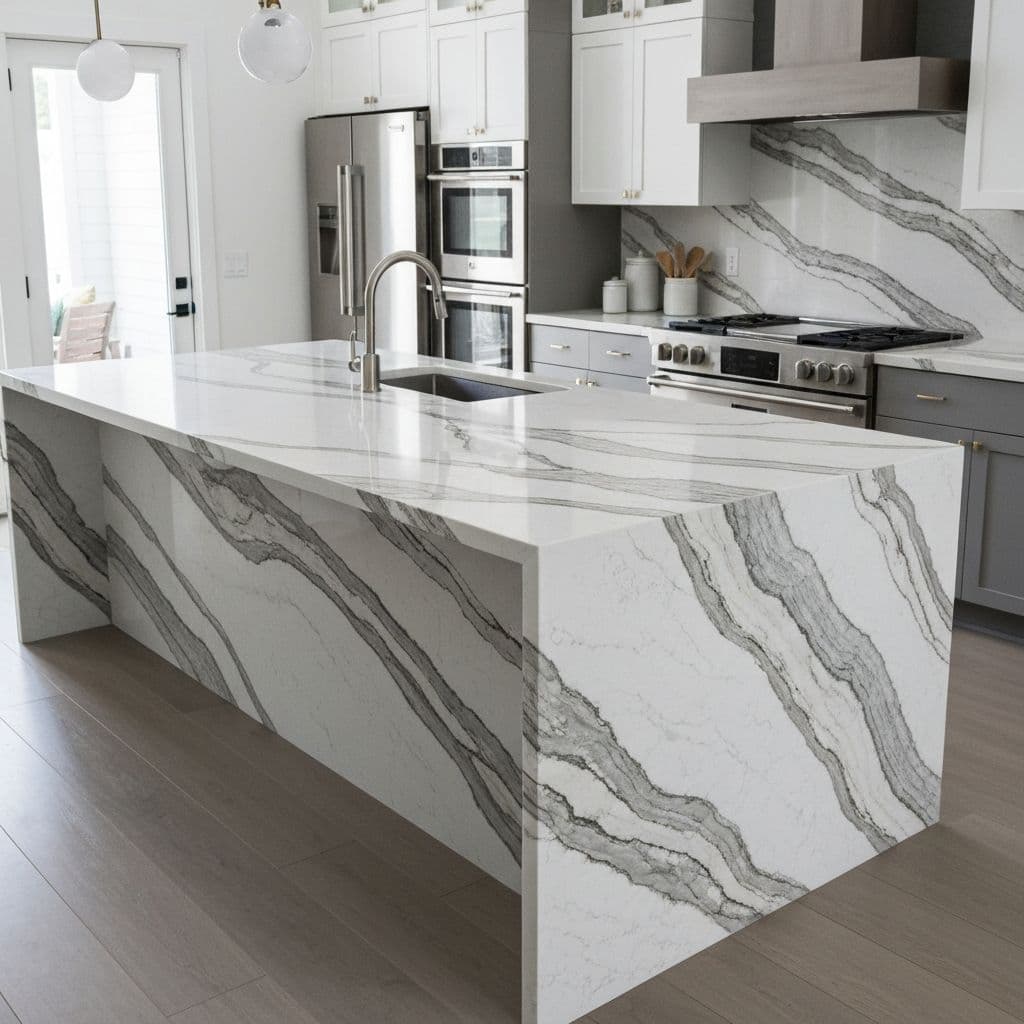
If you've been shopping for countertops in the Raleigh-Durham area, you've probably run into one of the most common points of confusion in the entire stone industry: quartzite and quartz are not the same material. The names are so similar that even experienced remodelers, real estate agents, and the occasional showroom salesperson mix them up. Yet the two materials could hardly be more different. One is a 100% natural stone quarried from mountainsides and formed over hundreds of millions of years. The other is an engineered product manufactured in a factory within a matter of hours.
Both make outstanding countertops — we fabricate and install thousands of square feet of each every year — but they behave very differently in a real kitchen. They differ in how they handle heat, how they resist stains, how much upkeep they demand, how they look, and what they cost. Choosing the wrong one for your lifestyle is an expensive mistake to live with, because a countertop is one of the few parts of a kitchen you'll touch every single day for the next twenty years.
In this guide we'll break down exactly what each material is, how the two compare on every factor that matters, and which one makes sense for your home and the way you actually live. If you're also weighing granite in your decision, our full Granite vs Quartz comparison pairs well with this article.
Why Everyone Confuses Quartzite and Quartz
The confusion starts with geology and ends with marketing. Quartz — the mineral — is one of the most abundant minerals on Earth. It's the primary ingredient in both materials, which is how they ended up with nearly identical names. Quartzite is a natural rock composed almost entirely of quartz grains fused together by heat and pressure. Engineered quartz, meanwhile, is a man-made slab in which ground quartz crystals are the main ingredient by weight. Same mineral, two radically different products.
The stone industry hasn't helped. Engineered quartz is marketed simply as "quartz," which implies a natural product to many shoppers. And for years, some suppliers labeled certain soft, marble-like stones as "quartzite" when they were actually dolomitic marbles — stones that etch and scratch far more easily than true quartzite. The result: homeowners walk into showrooms with understandable misconceptions in both directions. Some believe quartz counters are slabs of natural crystal; others believe quartzite is just a fancier name for the engineered product.
Here's the one-sentence version to keep in your back pocket: quartzite is a natural stone you quarry; quartz is an engineered stone you manufacture. Everything else in this article flows from that single distinction.
What Is Quartzite?
Quartzite begins its life as ordinary sandstone — beach and riverbed sand deposited in layers over millions of years. When tectonic activity buries that sandstone deep in the Earth's crust, intense heat and pressure fuse the individual sand grains into an extremely hard, dense, interlocking crystalline structure. Geologists call this process metamorphism, and it's the same family of transformation that turns limestone into marble. The critical difference is the starting material: sand is mostly quartz, and quartz is far harder than the calcite that makes up marble.
The result is one of the hardest natural stones ever used for countertops. On the Mohs hardness scale — the standard 1-to-10 measure of mineral hardness — quartzite registers around 7. For context, granite typically lands between 6 and 6.5, marble around 3 to 4, and a steel knife blade around 5.5. That means a kitchen knife literally cannot scratch true quartzite; the stone is harder than the blade. It's why quartzite has surged in popularity among serious cooks and busy families over the past decade.
Because it's quarried from the earth, every quartzite slab is one of a kind. Mineral impurities present during formation — iron oxides, clay, silica solutions — paint each slab with flowing veins, soft clouds, and dramatic movement that no factory can replicate. Most quartzites live in a sophisticated palette of whites, creams, grays, and warm taupes, which is exactly the marble aesthetic so many homeowners want without marble's fragility.
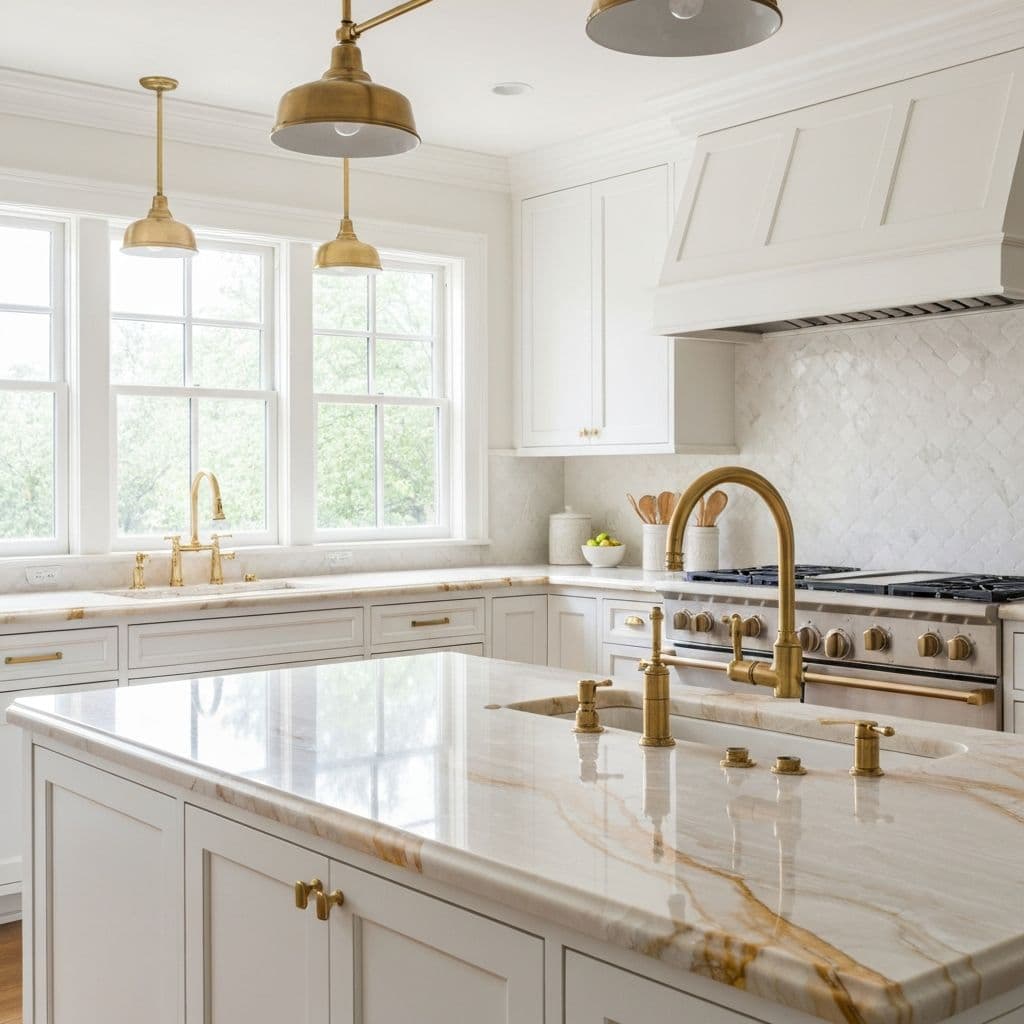
Popular quartzite varieties we install throughout the Triangle include Taj Mahal (creamy ivory with subtle golden veining — perennially our most requested), Sea Pearl (cool sea-glass greens and grays), White Macaubas (crisp white with linear gray striations), Super White, and Cristallo, a semi-precious translucent stone that can be dramatically backlit. You can see several of these in real Triangle-area kitchens in our portfolio.
One important buyer's note: because "quartzite" commands premium prices, some soft stones get mislabeled. True quartzite will not etch when lemon juice sits on it and cannot be scratched with a knife. A reputable fabricator will tell you honestly whether a slab is a true quartzite, a dolomite, or a marble — and each has its place — but you deserve to know what you're buying. This is one of the best reasons to work with an established local fabricator and see full slabs in person rather than ordering from small samples online.
What Is Quartz?
Quartz countertops are engineered stone: roughly 90–94% ground natural quartz crystals blended with polymer resins, pigments, and sometimes recycled glass or metallic flecks, then compacted under intense vibration, vacuum, and pressure into slabs. The process — originally patented as Bretonstone technology in Italy in the 1960s — cures the slab into a hard, completely non-porous surface that never needs sealing.
Manufacturing in controlled factory conditions gives quartz its superpower: consistency. Slab one and slab forty of a given color are essentially identical, which makes it dramatically easier to seam large islands, match a backsplash cut from the same material, or add more counter space in a future remodel and have it blend seamlessly. Natural stone can't promise that — the slab you fall in love with today won't exist again tomorrow.
Design range is the other big advantage. Because color and pattern are engineered rather than dug up, quartz offers looks nature simply doesn't produce: pure arctic whites, true blacks, warm concrete and cement looks, bold solid colors, and — most popular of all — marble-inspired designs with veining that's calibrated for consistency. Premium lines from Cambria, Silestone, Caesarstone, and MSI Q Quartz have become remarkably convincing, with full-body veining that flows through the slab's thickness the way real stone does.
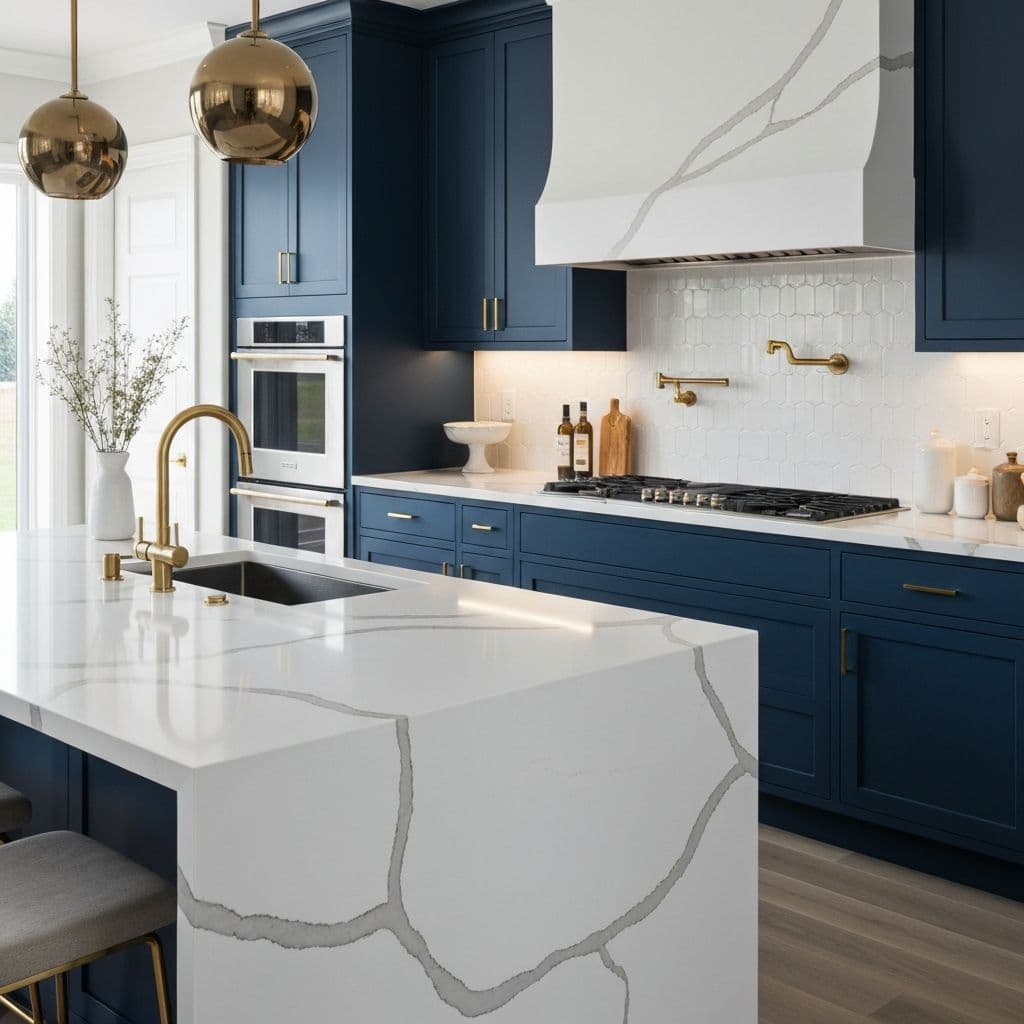
The trade-off hiding inside all that engineering is the resin. Those polymer binders are what make quartz non-porous and forgiving, but they're also plastic — and plastic doesn't love heat or ultraviolet light. Keep that in mind; it drives two of the most important differences in the sections ahead.
Quartzite vs Quartz: Side-by-Side Comparison
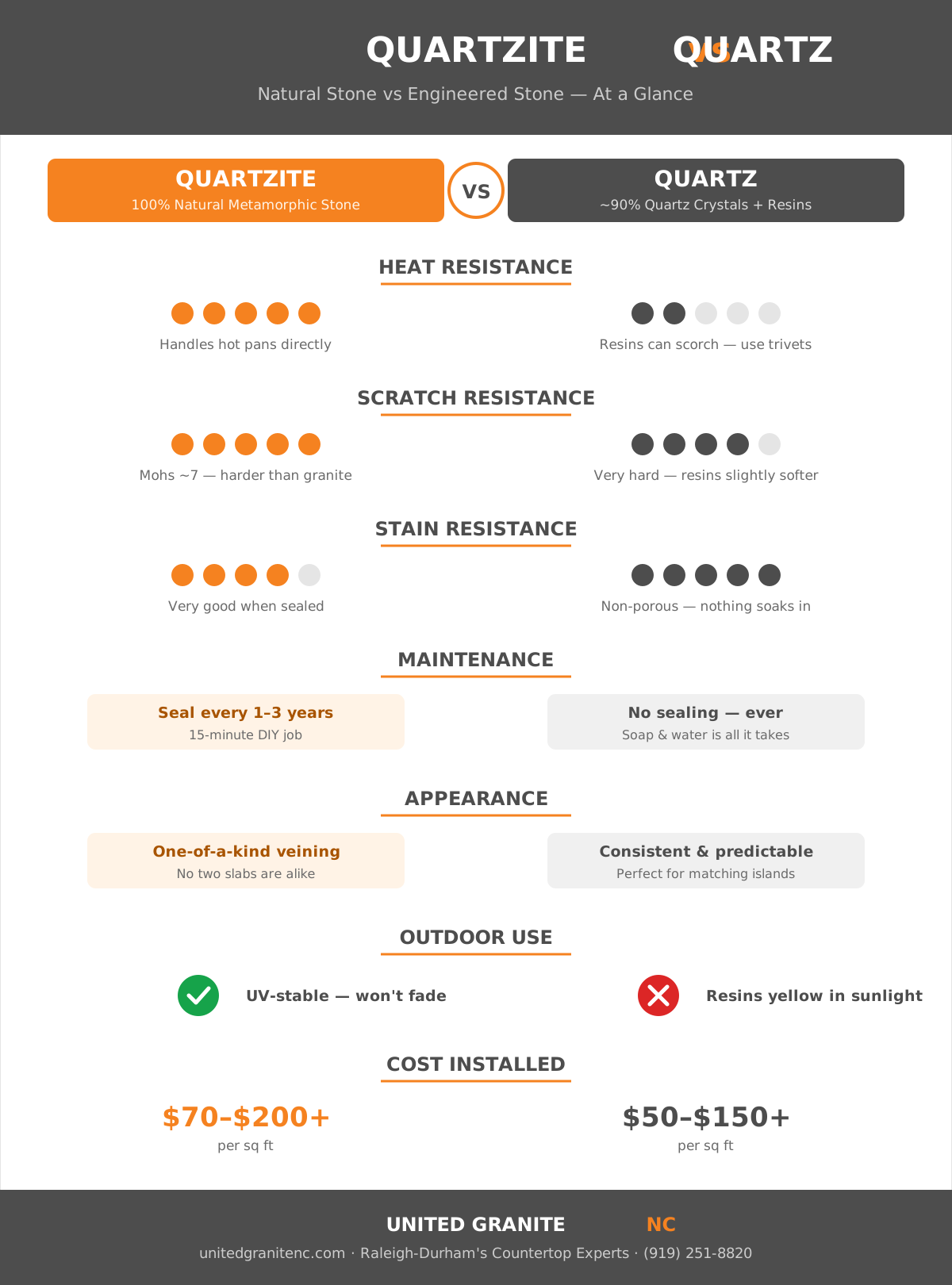
| Quartzite (Natural) | Quartz (Engineered) | |
|---|---|---|
| Material | 100% natural metamorphic stone | ~90% ground quartz + resins and pigments |
| Hardness | Extremely hard (Mohs ~7) | Hard (quartz content ~7; resins are softer) |
| Heat resistance | Excellent — handles hot pans | Moderate — resins can scorch; use trivets |
| Stain resistance | Very good when sealed | Excellent — non-porous, no sealing ever |
| Maintenance | Seal every 1–3 years | Virtually maintenance-free |
| Appearance | Unique, one-of-a-kind veining | Consistent, predictable patterns |
| UV / outdoor use | Won't fade outdoors | Not recommended — resins can yellow |
| Cost installed | $70–$200+ per sq ft | $50–$150+ per sq ft |
Durability: Scratches, Chips & Everyday Abuse
Let's start with the good news: both materials are among the most durable countertop surfaces money can buy. Either one will outlast the cabinets underneath it. But they earn their durability in different ways, and the differences show up in specific, predictable situations.
Scratch resistance goes to quartzite — barely. At Mohs 7, true quartzite is harder than knife blades, ceramic dishes, and nearly anything else that touches a kitchen counter. Quartz is also extremely scratch-resistant because its main ingredient is the same hard mineral, but the resin matrix between the quartz particles is softer. Dragging a cast-iron pot across a quartz counter can leave faint marks in the resin that you'd never see on quartzite. In practice, neither surface should ever meet your knife directly — not because the counter will lose, but because your knife edge will. Use a cutting board either way.
Chip resistance goes to quartz. Natural stone is rigid and crystalline; a heavy pot dropped squarely on an edge or a sink cutout corner can chip quartzite, just as it can granite. The resins in engineered quartz add a slight flexibility that absorbs impact, making edge chips noticeably less common. When chips do happen, both materials can usually be repaired in place by a pro with color-matched epoxy — quartzite repairs tend to blend even better because the stone's natural variation hides them.
Etching — a hidden win for both. Acidic foods like lemon juice, vinegar, tomato sauce, and wine chemically etch marble on contact, leaving dull spots no amount of scrubbing fixes. True quartzite doesn't etch because it contains virtually no calcite, and quartz's resin surface is likewise immune to household acids. If you love the marble look but cook with acid — which is to say, if you cook — both materials are dramatically safer choices than the real thing. This is exactly why marble-look quartzites and quartzes dominate today's kitchen designs.
Heat Resistance: The Biggest Practical Difference
If you remember one performance difference from this article, make it this one. Quartzite handles heat like the rock it is. It was formed at temperatures far beyond anything your kitchen can produce. A 400-degree pan set directly on a quartzite counter will not scorch, crack, or discolor it. For cooks who habitually move pots off the stove and onto the counter, or set a hot baking sheet down without thinking, that resilience is worth real money.
Quartz is a different story. The resin binders begin to soften and discolor around 300°F (150°C) — a temperature any skillet, Dutch oven, or air-fryer basket easily exceeds. Direct contact with hot cookware can leave a permanent white or yellowish scorch ring, and severe thermal shock can even crack the slab. Every quartz manufacturer's warranty excludes heat damage for exactly this reason. The fix is simple — trivets and hot pads, every time — but it's a habit your whole household has to keep, including teenagers and holiday guests. Be honest with yourself about whether that will actually happen in your kitchen.
This difference also matters around cooktops and behind ranges. For full-height stone backsplashes behind a gas range, or counters flanking a wall oven, quartzite's indifference to heat gives it an edge in high-output cooking spaces.
Stains, Porosity & Sealing
Here the tables turn completely, and quartz wins outright. Engineered quartz is non-porous — there are no microscopic channels for wine, coffee, oil, or beet juice to soak into. Spills sit on the surface until you wipe them, whether that's in ten seconds or the next morning. There is no sealing, ever. For a busy family kitchen, a rental property, or anyone who simply doesn't want to think about their countertop, this set-it-and-forget-it quality is quartz's single most compelling argument.
Quartzite, as a natural stone, is mildly porous — generally less porous than granite, but porous nonetheless, and porosity varies from one quartzite variety to another. Dense stones like Taj Mahal absorb very little; more open stones can drink in oil or dark liquids if left unsealed. The solution is a penetrating sealer applied at installation (we handle that) and reapplied periodically. Modern sealers are far better than they were a decade ago; premium formulations can protect for several years per application.
Resealing is genuinely easy — clean the counter, wipe on the sealer, let it penetrate, buff off the excess. Fifteen minutes for an average kitchen, no special skills required. To know when it's time, use the water test: pour a few tablespoons of water on the counter and wait fifteen minutes. If it beads up, your seal is intact. If the stone darkens where the water sat, it's absorbing and due for resealing. (The dark spot is just water; it evaporates harmlessly.) Our care & maintenance guide walks through the whole routine.
Daily Cleaning: What Living With Each Is Like
Day to day, the two materials live almost identically: warm water, a drop of dish soap, a soft cloth. Done. Neither needs special daily products, and both shrug off the mess of normal cooking. The differences are in the edge cases — the products you should keep away from each surface.
- Safe for both: dish soap and water, stone-safe daily spray cleaners, isopropyl alcohol diluted for disinfecting, glass cleaner on polished quartzite.
- Avoid on quartz: abrasive scouring powders and pads, oven cleaner, paint thinner, nail-polish remover with acetone, bleach at full strength, and anything with a pH at either extreme — harsh chemicals can dull or discolor the resin.
- Avoid on quartzite: acidic "natural" cleaners like straight vinegar or lemon-based sprays (they won't etch true quartzite, but they degrade the sealer over time), and abrasive pads that can wear a polished finish.
- Avoid on both: sitting or standing on the counter (stone is strong in compression, weak in flexion — especially over dishwashers and spans), and using the surface as a cutting board.
Appearance & Design: Nature's Art vs Engineered Perfection
Performance aside, most people ultimately choose with their eyes — and here the decision is philosophical as much as practical. Quartzite offers what no factory can: genuine geological artistry. The veining in a slab of Sea Pearl or Cristallo records actual events in Earth's history, and the way light plays across natural crystal has a depth that even excellent engineered products approximate rather than equal. When clients see their bookmatched quartzite island for the first time, the reaction is different in kind, not just degree. If you want a kitchen no one else has, quartzite is the answer by definition.
Quartz counters with a different kind of beauty: control. You choose a color from a sample, and the slabs that arrive look like the sample. Veining falls where designers intended, tone is uniform across the whole kitchen, and the material is available in aesthetics nature doesn't offer — true solid whites, charcoal concretes, terrazzo looks, warm minimalist creams. For contemporary designs built on consistency and clean lines, quartz is often the better design tool. It's also the safer choice when your kitchen needs multiple slabs and you want seams to disappear.
Both materials come in finish options beyond high polish. Honed (matte) finishes give a soft, contemporary look; leathered finishes add a subtle texture that hides fingerprints and water spots beautifully, especially on darker stones. Edge profiles — eased, bullnose, ogee, mitered waterfall — are available in both materials; see our edge profile guide for the full rundown. And if you want to preview how a specific stone looks in a kitchen setting, our online visualizer lets you experiment before you visit.
Cost Breakdown in the Raleigh-Durham Market
Let's talk numbers, because the price difference is real. In the Triangle market, engineered quartz typically runs $50–$150 per square foot installed, depending on brand and design tier. Builder-grade solid colors sit at the low end; premium marble-look designs from top brands occupy the high end. Quartzite generally starts around $70 per square foot installed and commonly runs $90–$200+, with rare and exotic slabs — Cristallo, certain blue and green stones — going higher still.
Why does quartzite cost more? Three reasons stack up. First, supply: true quartzite comes from a limited number of quarries, mostly in Brazil, and striking slabs are genuinely scarce. Second, fabrication: quartzite's hardness — the very quality you're buying — means slower cutting, more diamond-blade wear, and more skilled labor at the shop. Third, handling: natural slabs vary, so layout, seam planning, and vein matching take an experienced eye and extra time. Quartz, being uniform and slightly softer on tooling, moves through fabrication faster and with less waste.
Keep in mind that the slab is only part of your project cost. Final installed pricing depends on square footage, edge profile, cutouts for sinks and cooktops, backsplashes, tear-out of old counters, and layout complexity. A simple galley kitchen in entry-level quartz and a wraparound kitchen with a waterfall island in exotic quartzite are entirely different projects. For a full explanation of what drives pricing — with realistic ranges by material — see our countertop pricing guide, or skip straight to a personalized number with EZ Quote, our fast online estimate tool.
Resale Value: What Buyers Actually Notice
Both materials are premium surfaces that help a home show well and appraise well; neither will hurt you at resale. That said, they play slightly different roles. Quartz has become the default expectation in updated homes across Wake and Durham counties — listing agents lean on the word because buyers search for it. Quartzite plays at the luxury end: in higher-priced listings, a dramatic natural quartzite island photographs spectacularly and helps a kitchen stand out from a sea of similar white-quartz remodels. If you're renovating specifically to sell a mid-priced home, quartz is the efficient choice. If you're in a premium neighborhood or plan to stay a while, quartzite's wow factor earns its keep.
Outdoor Kitchens & Special Situations
Planning an outdoor kitchen, grill surround, or poolside bar? This one's simple: quartz is off the table. Ultraviolet light degrades the resins in engineered quartz, causing yellowing and fading — and every major manufacturer voids the warranty for outdoor installation. Quartzite, on the other hand, is one of the best outdoor countertop materials available: UV-stable, freeze-tolerant when properly sealed, and indifferent to the temperature swings of a North Carolina summer grilling station. Granite is the other great outdoor option if quartzite exceeds the budget.
A few other situations tilt the decision. Bathroom vanities are low-heat, low-abuse environments where quartz's zero maintenance and huge color range make it the practical favorite — though a bookmatched quartzite master-bath vanity is a showstopper. Laundry and utility rooms almost always call for quartz on cost and practicality. Fireplace surrounds favor quartzite for the same heat reasons as cooktop zones. And for commercial spaces — restaurant bars, reception desks — the right answer depends on traffic, lighting, and design intent; we're happy to advise on specific projects.
Common Mistakes to Avoid
- Buying "quartzite" that isn't. Soft dolomites and marbles sometimes wear the quartzite label. Ask your fabricator directly whether a slab is true quartzite, and test a sample with a knife scratch and lemon juice if in doubt.
- Choosing quartz for a household that won't use trivets. Be realistic about habits. One absent-minded hot pan can leave a permanent mark that no warranty covers.
- Ordering from a 3-inch sample. Both materials — quartzite especially — look dramatically different across a full slab. Always view and tag your actual slabs before fabrication.
- Skipping the sealing schedule on quartzite. It's fifteen minutes every couple of years. Set a reminder; your stone will look new for decades.
- Shopping on price per square foot alone. Fabrication quality — seam placement, edge polish, support spans, sink reveals — determines how your counter looks and lasts. A cheap install of an expensive slab is still a cheap install.
Which Should You Choose?
After all the geology and chemistry, the decision usually comes down to an honest look at how you live. Here's the shorthand we share with clients in our showroom:
- Choose quartzite if: you want a one-of-a-kind natural stone; you love the look of marble but need real-world durability; hot pans routinely land on your counters; you're building an outdoor kitchen; or your project sits at the luxury end where the natural-stone wow factor pays off.
- Choose quartz if: you want zero maintenance, ever; you need consistent color across a big kitchen, island, and backsplash; maximum stain-proofing for a busy family matters most; you're drawn to solid colors and contemporary looks nature doesn't make; or budget predictability is a priority.
There's genuinely no wrong answer here — both materials will outlast the typical kitchen remodel cycle and keep looking beautiful with minimal effort. It's a choice between nature's originality plus a small sealing habit, and engineered consistency plus a trivet habit. Every household weighs those differently, and that's exactly as it should be.
See Them Side by Side in Our Showroom
Photos — even good ones — only get you so far. The single most useful thing you can do is stand in front of full slabs and compare them in person: run your hand across leathered quartzite, hold a quartz sample against your cabinet door, see how veining reads from ten feet away. Our showroom serves the entire Triangle, from Raleigh and Durham to Cary, Apex, Chapel Hill, and beyond, and our team will walk you through options with zero pressure. You can also browse real local installations in our portfolio and learn what to expect from template to install in our process overview.
When you're ready for numbers, request a free quote — send us your layout measurements and the materials you're considering, and we'll give you a clear, itemized estimate, usually within one business day.