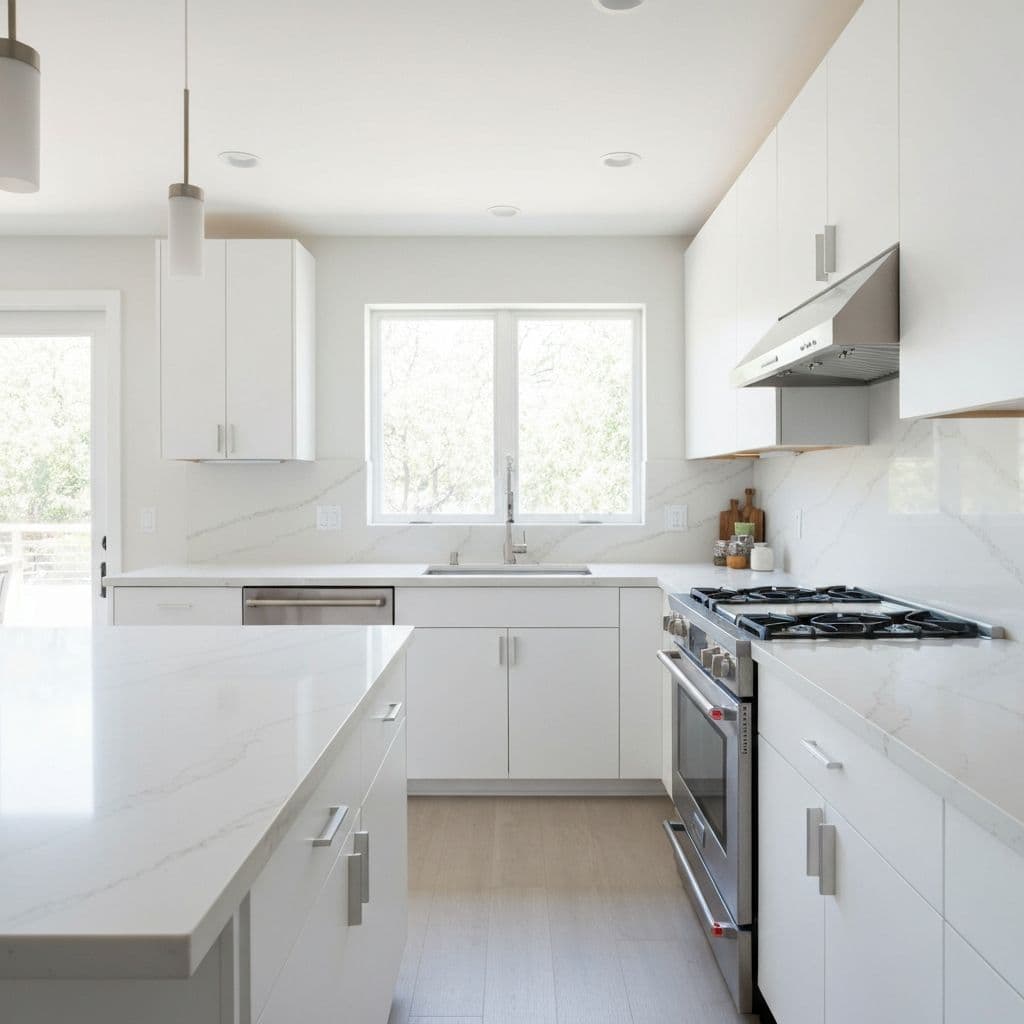
Type "best kitchen countertop material" into a search engine and you'll get a hundred confident answers — most of them written by someone selling exactly one material. The quartz manufacturer says quartz. The granite importer says granite. The porcelain brand says porcelain. Here's our advantage in answering honestly: we fabricate and install all of them. Granite, quartz, quartzite, marble, porcelain, soapstone — they all come through our shop, and we see how each one performs in real Triangle-area kitchens years after installation.
So let's give you the answer those hundred articles won't: there is no single best countertop material. There's a best material for a family of five that never wipes anything up immediately. A best material for a serious cook who moves cast iron straight from burner to counter. A best material for a forever-home kitchen, and a different one for a flip. In this guide we'll rank every major material across the factors that actually matter — durability, maintenance, heat, looks, and cost — then match each one to the kitchens where it wins.
How We Judge: The Five Factors That Matter
Every material in this guide is scored against the same five questions. Durability: how does it handle scratches, chips, and impacts over 15+ years? Maintenance: what does it demand of you — sealing schedules, special cleaners, careful habits? Heat: can it take a hot pan, or does it need trivets on duty at all times? Looks: what aesthetics can it deliver, and are they one-of-a-kind or predictable? Cost: what will you actually pay installed, here in the Raleigh-Durham market? Resale value rides along with all five — we'll flag it where it changes the answer.
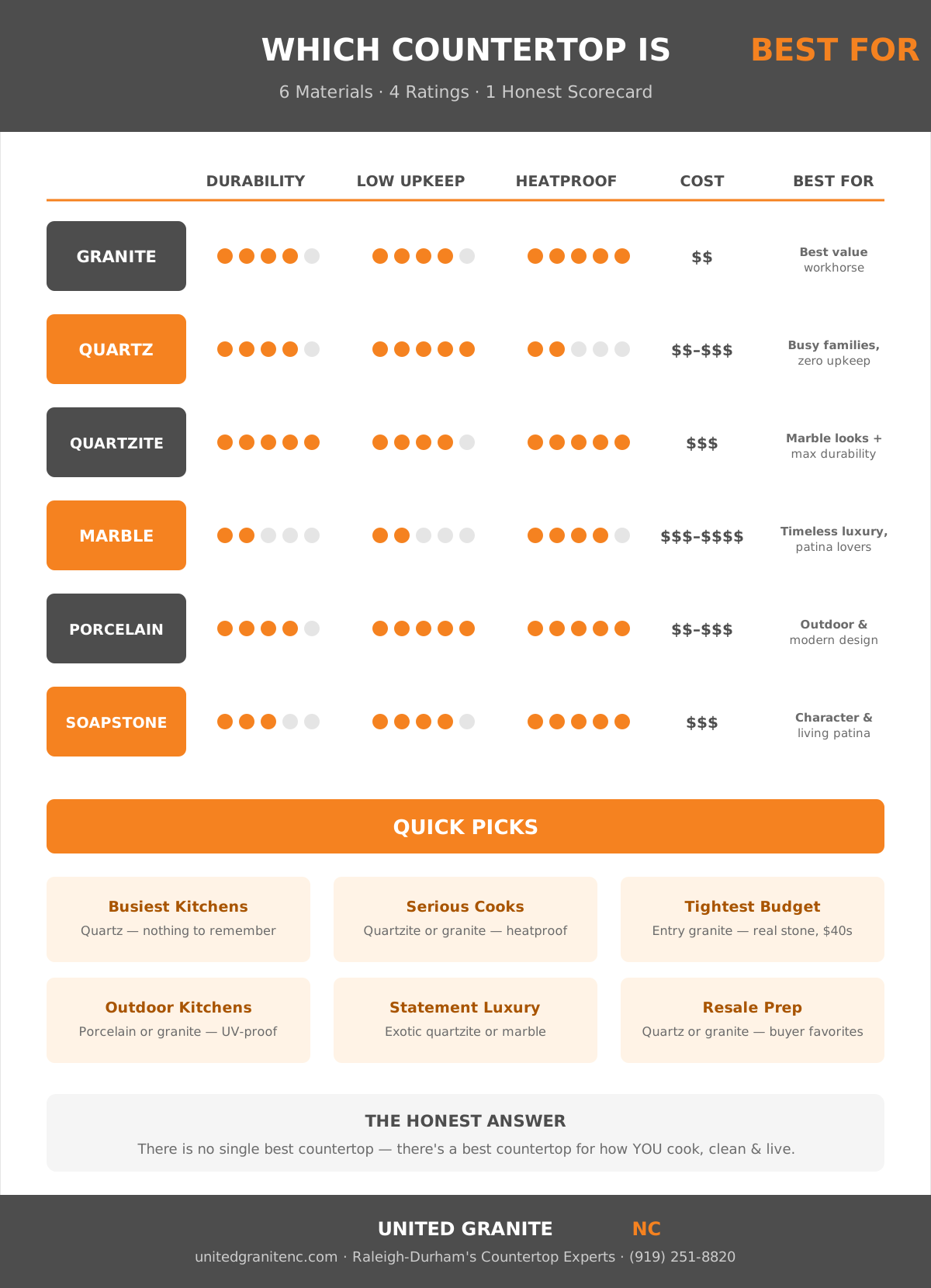
The Scorecard: All Six Materials Side by Side
| Material | Durability | Maintenance | Heat | Cost Installed |
|---|---|---|---|---|
| Granite | Excellent | Seal every 1–3 yrs | Excellent | $45–$100+ |
| Quartz | Excellent | None — ever | Moderate (trivets) | $50–$150+ |
| Quartzite | Outstanding | Seal every 1–3 yrs | Excellent | $70–$200+ |
| Marble | Fair (etches, scratches) | High — seal & babysit | Very good | $60–$200+ |
| Porcelain | Excellent (edges chip) | None — ever | Outstanding | $60–$120 |
| Soapstone | Good (soft, scratches) | Optional oiling | Outstanding | $70–$120 |
Granite: The Undefeated Value Champion
Granite built the modern countertop industry, and there's a reason it's still everywhere: nothing else delivers real natural stone, excellent durability, and full heat resistance at its price point. Entry-level granites start in the $40s per square foot installed — genuinely hard, genuinely beautiful igneous rock for less than most engineered products. It shrugs off hot pans, resists scratching, and with periodic sealing handles daily kitchen chaos for decades. With 200+ colors in stock, it also offers the widest in-stock selection of any natural stone we carry.
Granite's reputation problem is really a *pattern* problem. The busy, small-speckled brown-and-gold slabs installed by the acre in the 2000s now read dated — and they've unfairly dragged the whole category with them. Modern granite selections look nothing like that: flowing white-and-gray slabs like Colonial White, dramatic dark stones like Absolute Black and Steel Gray in leathered finishes, and warm creams that fit 2026's palette perfectly (see our trends report for what's current). Judged as stone rather than as a decade, granite remains the best value in the business.
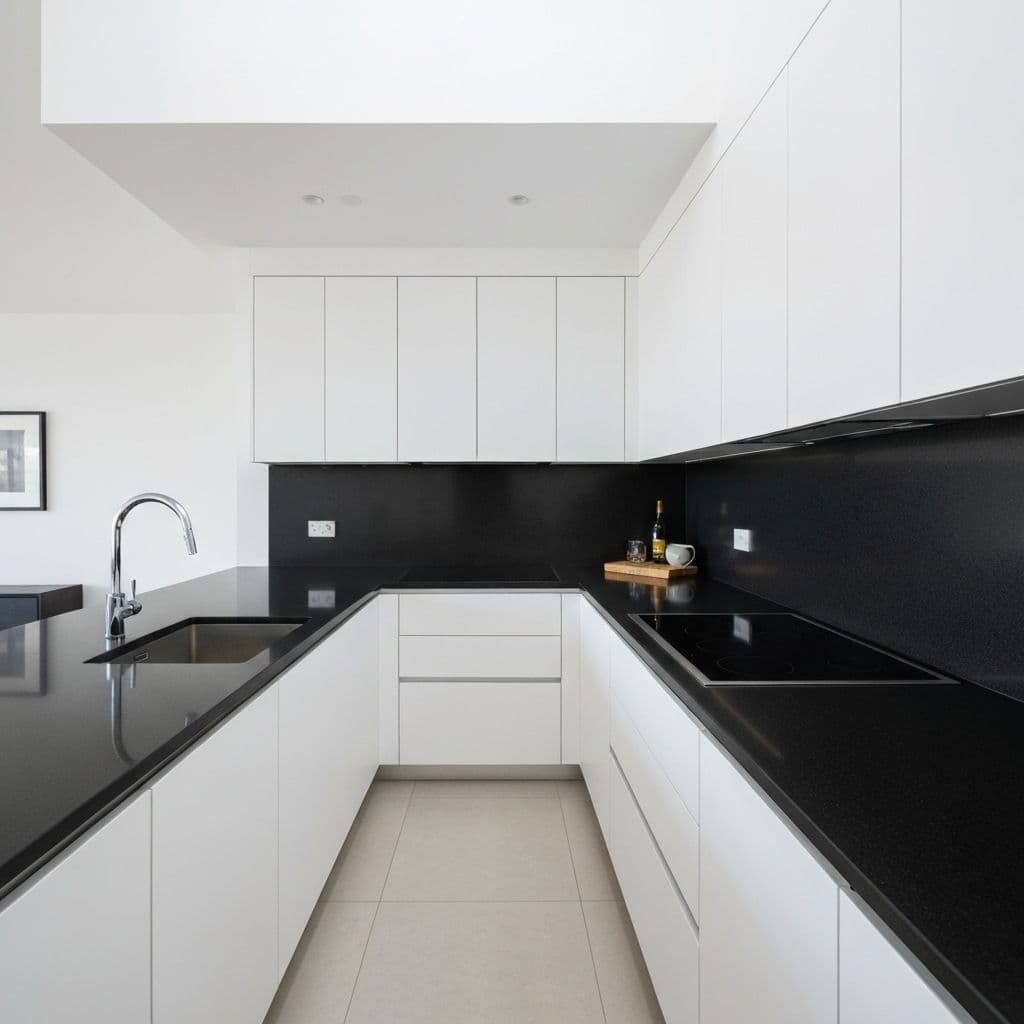
Choose granite if: you want maximum durability per dollar, real natural stone, full heat resistance, and don't mind a 15-minute sealing routine every couple of years. Skip it if: you need perfectly uniform color across a big kitchen or want zero maintenance of any kind.
Quartz: The Zero-Maintenance Favorite
Engineered quartz is the best-selling countertop material in America, and its winning formula is simple: stone-level durability with absolutely nothing to remember. Non-porous surface, no sealing ever, wine and coffee and turmeric wipe away whenever you get to them. For busy families, rental properties, and anyone whose eyes glaze over at the word "maintenance," quartz is the correct default answer — which is exactly why brands like Cambria, Silestone, and Caesarstone dominate showrooms.
Its two honest weaknesses: heat and sunlight. The polymer resins that make quartz non-porous can scorch under a hot pan (roughly 300°F is the danger line) and yellow under UV, which rules out outdoor use entirely. Design-wise, consistency is both its strength and its ceiling — you get exactly the sample you picked, but nothing more. Our Quartzite vs Quartz guide unpacks the trade-offs against its natural near-namesake in full detail.
Choose quartz if: low maintenance tops your list, you want predictable color across large surfaces, or you're prepping a home for sale (buyers know and search for the word). Skip it if: hot cookware routinely lands on your counters, or the kitchen is outdoors.
Quartzite: The Best of Both Worlds — at a Price
If budget were no object, quartzite would win this ranking for most kitchens outright. It's the hardest material here (Mohs ~7 — your knives will lose), fully heatproof, UV-stable for outdoor use, and it delivers the flowing marble aesthetic that drives today's design — in genuinely one-of-a-kind natural slabs. Designer surveys crown it 2026's material of the year, and stones like Taj Mahal and Sea Pearl are the most requested slabs in our showroom.
The price of all that: price. Quartzite starts around $70 per square foot installed and climbs past $200 for exotic lots, and as a natural stone it needs the same periodic sealing as granite. One buyer's warning worth repeating from our full quartzite guide: soft dolomites sometimes get mislabeled as quartzite. Work with a fabricator who'll tell you honestly what a slab is — the knife-scratch and lemon-juice tests don't lie.
Choose quartzite if: you want maximum durability *and* natural beauty and the budget stretches to it — especially for forever homes and statement islands. Skip it if: entry pricing matters most, or zero maintenance is non-negotiable.
Marble: Beautiful, Demanding, Worth It for the Right Owner
Let's be honest about marble, because so much marketing isn't. Marble is the most beautiful stone humans have ever built with — Bianco Carrara, Calacatta Gold, Statuario, names that have meant luxury for two thousand years. It's also, objectively, the most demanding kitchen surface in this guide. At Mohs 3–4 it scratches easily; its calcite chemistry means lemon juice, vinegar, and wine *etch* dull marks into the surface on contact — sealing can't prevent this, because etching is a chemical reaction, not absorption.
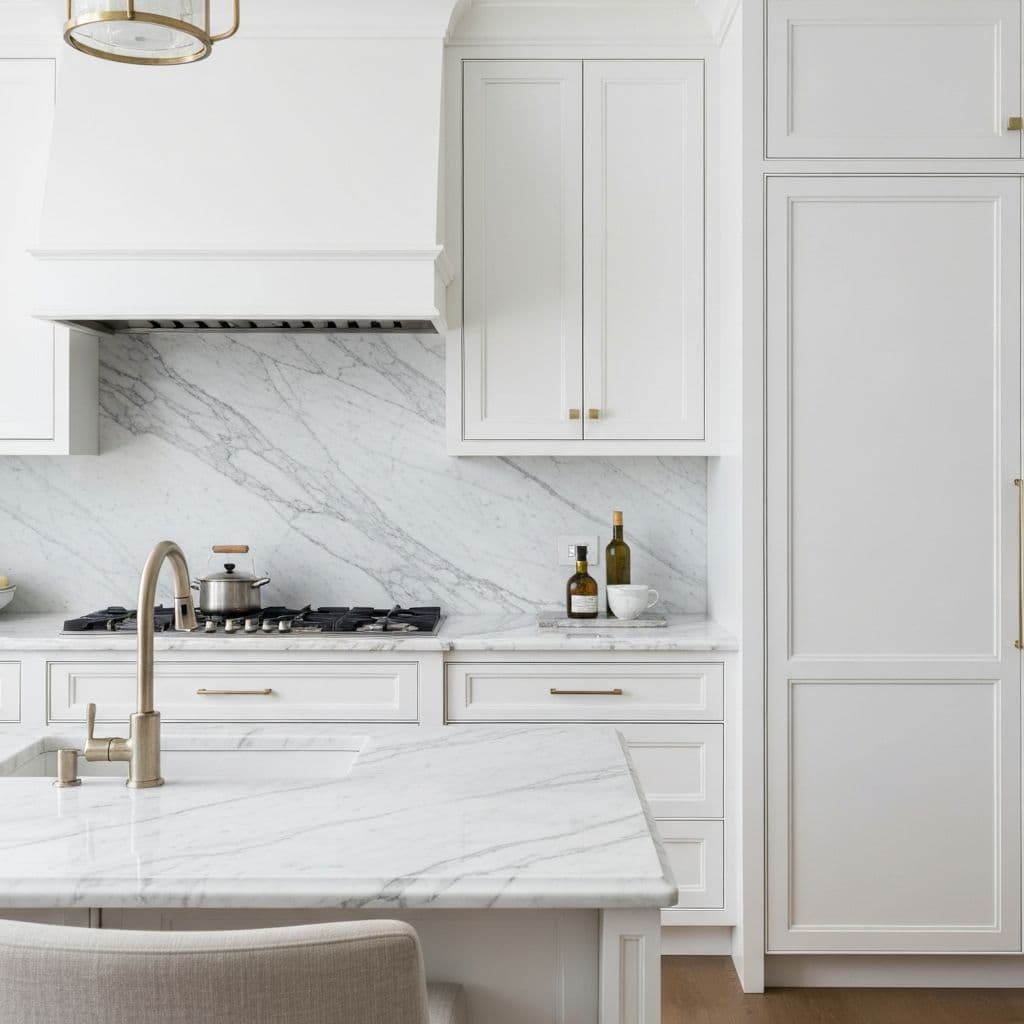
So why does marble persist in kitchens? Because for the right owner, the aging *is* the appeal. Etches, faint scratches, and softened polish merge into patina — the lived-in beauty of a Parisian bistro counter. If that romances you, marble delivers something no pristine surface can. If it horrifies you, choose the look-alikes instead: quartzite for natural stone, or marble-look quartz and porcelain for maintenance-free versions. Choose marble if: you love patina and accept the care. Skip it if: you'll mourn the first etch mark. (Bathroom vanities, though? Marble is wonderful almost anywhere that isn't a lemon-squeezing zone.)
Porcelain: The Performance Newcomer
Porcelain is the newest serious contender, and on raw surface performance it's arguably the best of all: fired at 1,200°C, so hot pans mean nothing; zero porosity, so nothing stains and nothing needs sealing; fully UV-stable, making it the premier outdoor countertop; and printable with any aesthetic from Calacatta marble to raw concrete. Thin 12 mm profiles and giant seamless slabs give it a modern architectural character nothing else matches.
Its caveats live at the edges — literally. Thin, ultra-hard material can chip at corners under sharp impact, most patterns are printed on the surface rather than running through the slab, and results depend heavily on fabricator experience. We covered every strength and weakness honestly in our complete porcelain guide. Choose porcelain if: you're building an outdoor kitchen, a heat-heavy cooking space, or a modern design built on seamless surfaces. Skip it if: your household is rough on counter edges or your design calls for decorative profiles.
Soapstone: The Character Actor
Soapstone is the connoisseur's pick — a dense, talc-rich stone in charcoals and deep greens with a soft, almost warm feel under the hand. Its party tricks: it's naturally non-porous (no sealing, rare among natural stones), completely heatproof, and chemically inert — even harsh acids don't faze it, which is why laboratory counters have been soapstone for a century. It fits 2026's matte, moody aesthetic perfectly.
The trade-off is softness: soapstone scratches and dents more easily than anything else here except marble. Owners either mind that or they don't — scratches sand out with fine paper, and most blend into the deepening patina that many soapstone lovers enhance deliberately with mineral oil. Choose soapstone if: you want character, patina, and a stone you can maintain yourself forever. Skip it if: you want your counter looking factory-new in year ten. And for pure drama, its cousin onyx — translucent, backlit-capable, definitely a specialty surface — deserves a mention for bars and powder rooms.
The Budget Materials We're Honest About
What about laminate, butcher block, tile, and concrete? We don't fabricate them, so take this as market observation rather than sales talk. Laminate is dramatically better-looking than a decade ago and remains the budget floor — but it can't take heat or knives and rarely helps resale. Butcher block is warm and repairable but demands oiling and vigilance around water. Tile counters have grout-line problems that never really go away. Poured concrete photographs beautifully and cracks predictably. Each has its place; none matches the durability-per-dollar of entry granite, which is why our honest budget advice is usually "granite in the $40s-per-foot range" rather than any of them. See our full buying guide for the complete decision framework.
Best Countertop by Kitchen Type: Quick Answers
- Busy family kitchen, minimal upkeep: Quartz, no contest. Nothing to remember, nothing to baby.
- Serious cook who uses the counter hard: Quartzite first, granite close second — heatproof, scratch-proof, worry-proof.
- Best value on a real budget: Entry-level granite. Real stone, full performance, lowest price of anything here.
- Forever-home statement kitchen: Exotic quartzite or bookmatched marble — materials you'll never tire of looking at.
- Outdoor kitchen or grill island: Porcelain or granite. Quartz is disqualified by UV; marble by everything.
- Rental property or flip: Quartz or granite — buyer-recognized names, durable, price-appropriate to the market.
- Bathroom vanities: Almost anything works in a low-abuse zone — this is where marble and onyx get to be gorgeous safely.
- Modern minimalist design: Porcelain's thin profiles and seamless slabs, or a honed solid-color quartz.
The Three Showdowns Buyers Actually Face
Granite vs quartz is the classic mid-market decision, and it reduces to one question: which chore do you prefer? Granite asks for a 15-minute sealing session every year or three and rewards you with total heat immunity and lower entry pricing. Quartz asks for permanent trivet discipline and rewards you with never thinking about your counter again. Households with reliable habits tend to be happy either way; households with teenagers tend to be happier with quartz. Our full granite vs quartz comparison goes deeper.
Quartzite vs marble is the luxury natural-stone decision, and it's really about patina tolerance. Both deliver breathtaking veined slabs; marble will visibly age with use while quartzite will not. If you want the stone at year fifteen to look like the stone at installation, quartzite. If you find perfect surfaces sterile and love the idea of a counter that records your family's life, marble — with open eyes about what that means.
Quartz vs porcelain is the emerging modern-kitchen decision. Both are non-porous and maintenance-free; the split is heat and edges. Porcelain laughs at hot pans but can chip at corners under hard impact; quartz forgives impacts but scars under heat. Indoors, pick by which risk your household is less likely to trigger. Outdoors, there is no decision — porcelain wins by forfeit, as we detailed in the porcelain guide.
What Each Material Really Costs Over Its Lifetime
Sticker price is only chapter one of the cost story. A fairer comparison spreads the installed price plus upkeep across a realistic 20-year ownership window. Granite's sealing habit costs perhaps $15 in sealer per application done yourself — call it $150 over two decades on top of the lowest entry price in the guide, which keeps granite's value crown secure. Quartz and porcelain add exactly zero upkeep dollars to their purchase price. Quartzite adds the same trivial sealing cost as granite atop a premium purchase. Marble is the outlier: beyond sealing, budget for occasional professional honing or polishing if you want etching erased rather than embraced.
Two more line items people forget. First, repairs: chips in granite and quartzite fix nearly invisibly with color-matched epoxy; quartz repairs are decent; porcelain and marble repairs are the hardest to hide. Second, the counter you *don't* replace: any of these surfaces properly installed will still be serving when a cheaper material would be on its second replacement — which is why the per-year math on premium surfaces is friendlier than the invoice suggests. For current installed ranges by material and what drives them, our pricing guide keeps real Triangle-market numbers.
The Mistakes That Outrank Material Choice
After thousands of installations, here's a truth that surprises people: fabrication quality affects your daily experience more than material choice does. A well-templated, well-seamed, properly supported entry-granite counter will outperform a sloppily installed exotic slab every single day. Seam placement, edge polish, sink reveals, overhang support — these are where countertops succeed or fail, and they're invisible on a price-per-square-foot quote.
- Comparing quotes on price alone. Ask where seams will fall, how sinks are mounted and supported, and who does the install — subcontracted or in-house.
- Choosing from a 3-inch sample. Full slabs tell the truth; samples flatter. Always tag your actual slabs, especially with natural stone.
- Ignoring your own habits. The best material for your kitchen is the one whose weaknesses you'll never trigger. Trivet-averse? Skip quartz. Sealing-averse? Skip natural stone.
- Forgetting the sink and faucet decisions. Undermount vs drop-in, workstation features, faucet placement — these get locked in at fabrication. Browse kitchen sinks and faucets before template day, not after.
- Skipping the edge and backsplash conversation. Edge profile and backsplash height change both the look and the bill — decide them early with our edge guide.
So What's the Actual Best? Our Final Answer
If we're forced off the fence: for the most kitchens and the most owners, quartz is the best all-around choice — its zero-maintenance non-porous surface fits how most households actually live, and its one real weakness is solved by a $10 trivet. The best natural stone is quartzite for those who'll invest in it, the best value is granite and it isn't close, the best outdoor and modern-design material is porcelain, and the most beautiful surfaces in the world are still marble — for owners who understand the relationship they're entering.
But the genuinely best answer is the one matched to your home, and that takes a conversation and a slab yard, not a search result. Visit our showroom — serving the entire Triangle from Raleigh and Durham to Cary, Apex, and beyond — and compare all six materials side by side in person. Browse real installations in our portfolio, test looks in the visualizer, check real numbers in our pricing guide, or go straight to a free quote. We'll help you find not the best countertop, but *your* best countertop.