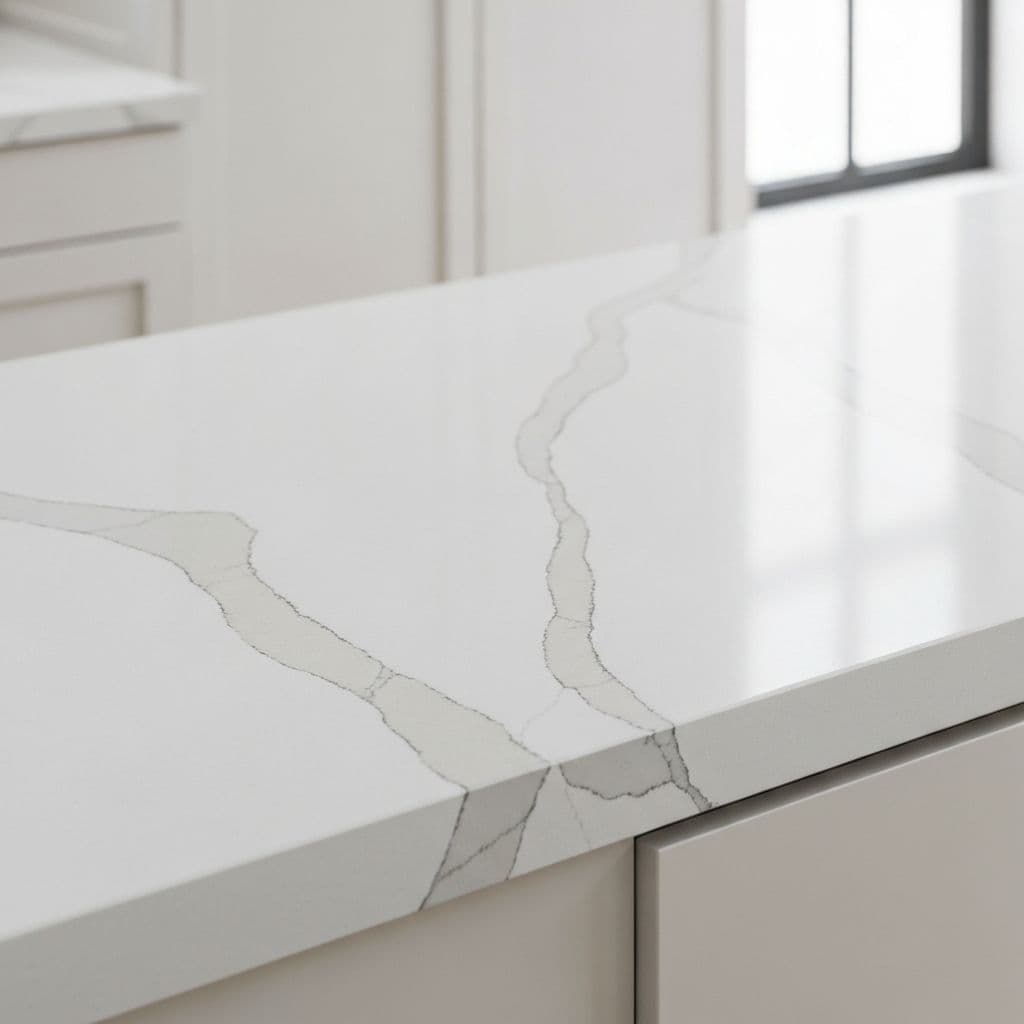
Walk into a high-end kitchen showroom in Milan or Barcelona and you'll see it everywhere: enormous, seamless slabs of porcelain covering countertops, islands, and entire walls. Porcelain has dominated European kitchen design for over a decade, and it's now one of the fastest-growing countertop categories in the United States — including here in the Raleigh-Durham market, where we've watched interest grow year after year at our showroom.
The appeal is easy to understand. Porcelain laughs at hot pans that would scar engineered quartz. It never fades in sunlight, making it one of the only premium surfaces you can confidently install outdoors. It's non-porous without ever needing sealer, and modern digital printing lets it wear virtually any face — Calacatta marble, raw concrete, weathered wood, even oxidized steel.
But porcelain is not a miracle material, and anyone who tells you otherwise is selling something. It has real limitations — around edges, repairs, and fabrication — that matter just as much as its strengths. In this guide we'll give you the complete, honest picture: what porcelain actually is, where it beats quartz, granite, and quartzite, where it falls short, what it costs in the Triangle, and how to decide whether it belongs in your project.
What Exactly Is a Porcelain Countertop?
Porcelain slabs start as a blend of refined natural clays — primarily kaolinite — mixed with feldspar, silica, and mineral pigments. The mixture is pressed into large-format sheets under enormous pressure, then fired in industrial kilns at over 1,200°C (about 2,200°F). At that temperature the particles vitrify — they fuse into a glass-like, fully densified body. The industry calls the result *sintered stone*, and you'll see the terms porcelain slab, sintered stone, and ultra-compact surface used almost interchangeably for closely related products.
That firing process is the key to nearly everything porcelain does well. The finished slab is harder than granite, absorbs essentially zero water (porosity below 0.1%, the lowest of any countertop material), and contains no resins or polymers at all — which is exactly why heat and ultraviolet light, the two natural enemies of engineered quartz, simply don't affect it.
The look comes from technology rather than geology. High-resolution digital printing applies the pattern — marble veining, stone texture, concrete mottling — onto the slab surface before glazing and firing. The best manufacturers print with remarkable realism and even add coordinated surface texture, so a marble-look porcelain doesn't just look like stone, it feels like it. Slabs come in huge formats (up to roughly 5 by 10 feet) and unusually thin profiles: 6 mm and 12 mm are the most common, versus the 20–30 mm typical of natural stone and quartz.
Porcelain vs Other Countertop Materials at a Glance
| Porcelain | Quartz | Granite / Quartzite | |
|---|---|---|---|
| Composition | Fired clay & minerals (sintered) | ~90% quartz + resins | 100% natural stone |
| Heat resistance | Outstanding — best in class | Moderate — resins scorch | Excellent |
| UV / outdoor use | Yes — fully UV-stable | No — resins yellow | Yes |
| Sealing needed | Never | Never | Every 1–3 years |
| Scratch resistance | Excellent (very hard surface) | Very good | Excellent |
| Edge durability | Weakest point — can chip | Very good | Good |
| Pattern depth | Usually printed on surface | Through the slab (varies) | Natural, all the way through |
| Typical cost installed | $60–$120 per sq ft | $50–$150 per sq ft | $45–$200+ per sq ft |
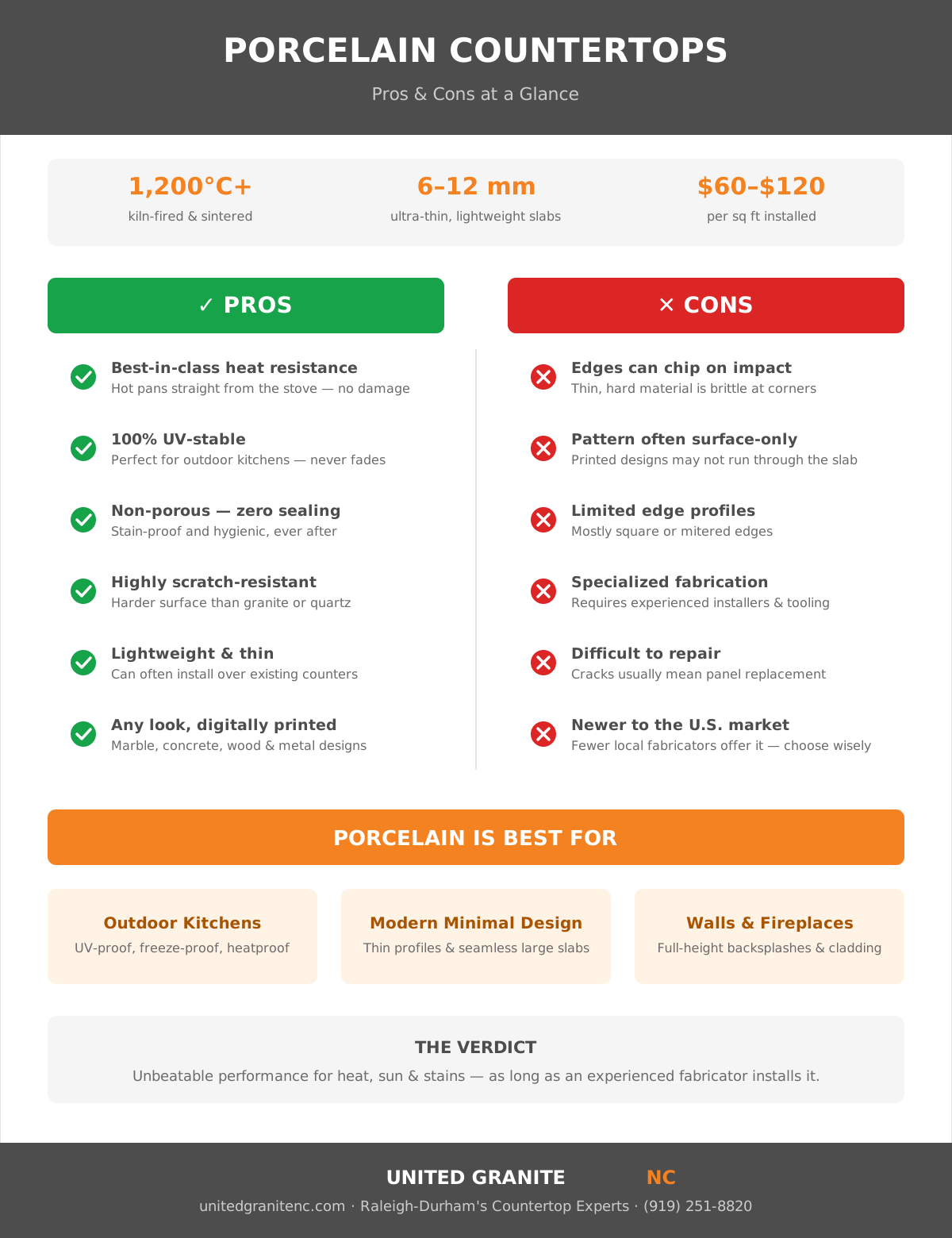
The Pros: Where Porcelain Genuinely Shines
Heat resistance without an asterisk. Porcelain was born in a 1,200-degree kiln; your 450-degree roasting pan doesn't impress it. You can set hot cookware directly on the surface with no scorching, discoloration, or thermal shock under normal kitchen conditions. Among mainstream countertop materials, only natural stone comes close, and even granite appreciates a trivet more than porcelain does. For serious cooks, this is the headline feature.
Total UV stability. Because there are no resins to yellow, porcelain is one of the very few premium surfaces rated for outdoor use. An outdoor kitchen, grill surround, or poolside bar in the North Carolina sun will look the same in year ten as on day one. If you've read our Quartzite vs Quartz guide, you know engineered quartz is disqualified outdoors — porcelain and natural stone are the only games in town, and porcelain is typically the lighter and often more affordable of the two.
Non-porous, stain-proof, and hygienic — forever, with no sealing. With water absorption effectively at zero, wine, coffee, turmeric, and oil have nowhere to go. There's no sealing schedule to remember, and the dense surface gives bacteria and mold no place to live, which is why porcelain is widely used in commercial food-service settings. Cleaning is soap and water; even harsh cleaners that would damage quartz resins generally won't hurt porcelain.
Serious scratch resistance. The fired surface is harder than granite. Everyday utensils, ceramic dishes, and pet claws won't mark it. As with every surface we sell, we still recommend a cutting board — mostly to protect your knives, which will lose the fight against porcelain every time.
Thin, light, and architectural. A 12 mm porcelain slab weighs roughly half of what a 30 mm granite counter weighs. That opens design doors: sleek thin-profile counters for modern kitchens, cladding for walls and fireplace surrounds where heavy stone would need structural support, and full-height backsplashes cut from the same slab as the counter for a seamless look. In some remodels, thin porcelain can even be installed directly over an existing counter, saving demolition time and cost.
Any aesthetic you can imagine. Digital printing frees porcelain from geology. Want the exact look of a rare Calacatta marble at a fraction of the price and none of the maintenance? A raw-concrete industrial slab without the cracking and curing issues of real concrete? A consistent wood-look surface that's waterproof? Porcelain manufacturers print them all, in matte, satin, and polished finishes. Browse our porcelain collection to see the range.
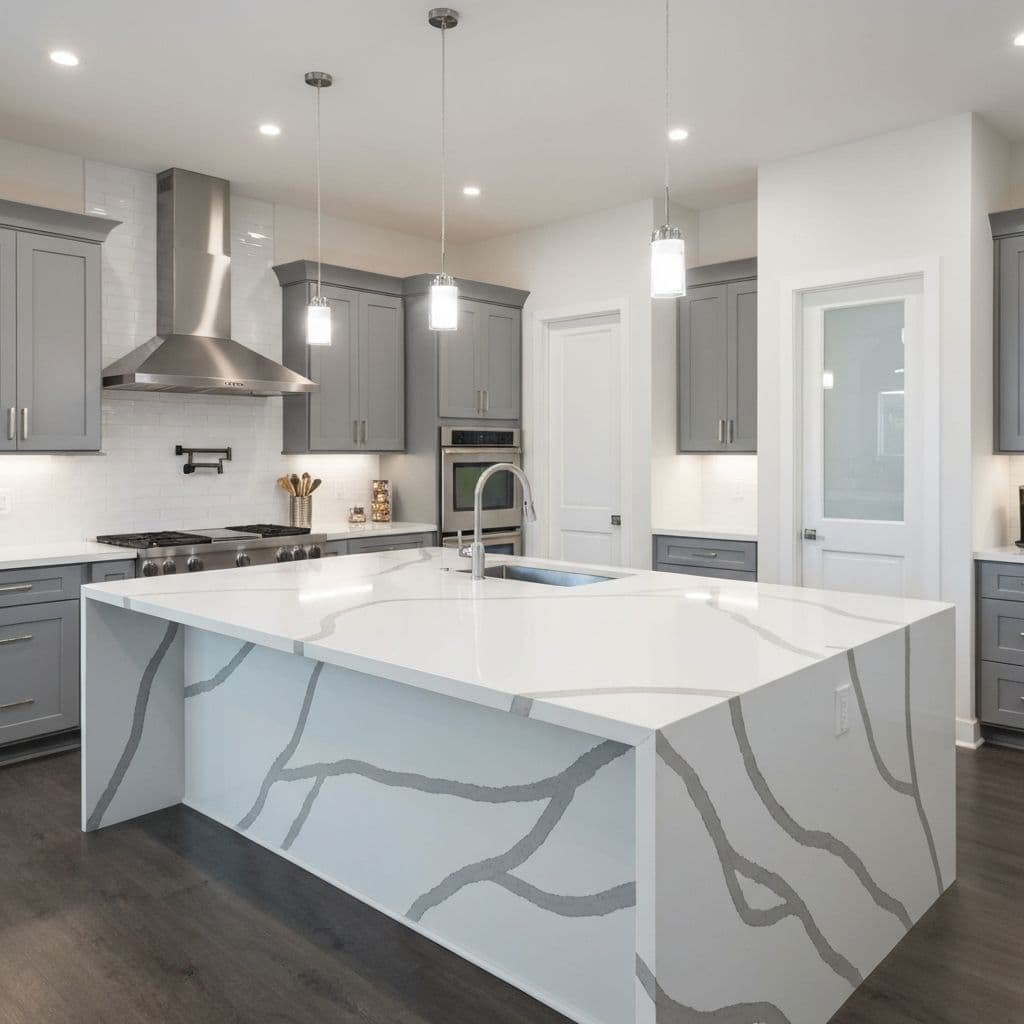
The Cons: What the Brochures Don't Emphasize
Edges and corners are the weak point. Here's the physics: extremely hard materials are also brittle, and thin slabs concentrate impact. A heavy cast-iron pot dropped squarely on a porcelain edge, or a hard knock against an outside corner, can chip or crack it — and this is porcelain's most common real-world failure mode. Good fabrication mitigates the risk substantially (mitered, built-up edges are both beautiful and stronger), but if your household is rough on counters, a thicker material like quartzite or granite is more forgiving at the edges.
The pattern usually doesn't go all the way through. On most porcelain slabs the marble veining is printed on the surface. Chip an edge or look closely at certain cut profiles, and you may see the slab's plain body color underneath — a small detail, but one that matters on exposed mitered edges and something natural stone never has to explain. The industry is improving here: premium "full-body" and "through-vein" porcelains carry the pattern deeper into the slab, and we can steer you toward those lines if edge aesthetics are critical to your design.
Edge profile options are limited. Ornate profiles like ogee and bullnose — routine in granite and quartz — generally aren't practical in thin porcelain. Most installations use a clean square edge or a mitered edge that folds the surface pattern around the corner to create the appearance of a thick slab. If your design vision leans traditional with decorative edges, porcelain will fight you; see our edge profile guide for what's possible in each material.
Fabrication is genuinely specialized. Cutting and handling large, thin, ultra-hard sheets without micro-fracturing them requires specific tooling, experience, and care in transport. This is not a knock on the material — it's a warning about installers. Porcelain's reputation in the U.S. has suffered mostly from inexperienced shops learning on customers' kitchens. Ask any fabricator how many porcelain installations they've completed, and ask to see photos. (We're happy to answer that question in detail — our process is built around getting exactly this right.)
Repairs are harder than with stone. A chip in granite or quartzite can usually be filled with color-matched epoxy nearly invisibly. Porcelain's glassy, printed surface makes repairs harder to disguise, and a significant crack in a slab typically means replacing that section. Combined with the edge-chip risk above, this is the trade-off you're accepting in exchange for porcelain's otherwise bulletproof surface performance.
It's newer to the U.S. market. Porcelain doesn't yet carry the universal name recognition of granite or quartz with homebuyers and appraisers, and color selections stocked locally are thinner than the enormous quartz ecosystem. Neither issue affects how the counter performs in your kitchen — and the trend line is clearly in porcelain's favor — but they're worth knowing if resale messaging matters to you.
Porcelain vs Quartz: The Decision Most Shoppers Face
In practice, most homeowners considering porcelain are cross-shopping it against engineered quartz, because both deliver marble looks with zero sealing. The cleanest way to frame it: quartz is the more forgiving material; porcelain is the more resilient surface. Quartz takes impacts better, chips less at edges, offers more edge profiles, and comes in a deeper local color selection. Porcelain wins decisively on heat, UV, and chemical resistance — the three things quartz's resins can't tolerate.
So the honest advice sounds like this: for a busy indoor family kitchen where pots get dropped and nobody uses trivets reliably... it's a genuine toss-up that depends on which risk you'd rather manage (heat marks on quartz vs edge chips on porcelain). For an outdoor kitchen, porcelain or natural stone — quartz is out. For a low-traffic modern kitchen where design leads, porcelain's thin profiles and seamless large formats are hard to beat. And for maximum worry-free durability indoors with a natural product, don't forget quartzite — our full quartzite vs quartz comparison covers that side of the triangle.
Porcelain vs Granite and Quartzite
Against natural stone, the conversation changes. Granite and quartzite match porcelain's heat resistance and outdoor credentials, so the decision turns on aesthetics, maintenance, and mass. Natural stone gives you genuine geological depth — pattern that runs through the full thickness of the slab, crystal structure that catches light, and the simple fact that no other kitchen on Earth has your exact slab. Porcelain gives you consistency, far lighter weight, and freedom from the sealing schedule that natural stone requires.
There's also a structural difference worth understanding. A 30 mm quartzite counter is a thick, monolithic piece of rock — enormously strong across its span and tolerant of imperfect support. A 12 mm porcelain counter relies more on proper substrate and skilled installation to achieve its strength. Neither approach is wrong; they're just different engineering philosophies, and they explain why fabricator experience matters so much more for porcelain. If the natural-stone side of this comparison appeals to you, our Quartzite vs Quartz guide digs deep into that material's strengths.
Price-wise, entry granite undercuts porcelain, premium quartzite exceeds it, and the middle ground overlaps heavily. In our showroom, the homeowners who choose porcelain over natural stone almost always do it for one of three reasons: the ultra-thin modern profile, a specific printed design nature doesn't offer, or an outdoor project where weight matters — a rooftop terrace kitchen, for example, where every pound counts.
Thickness, Formats & Finishes: A Quick Spec Guide
Thickness is the first spec to settle. 6 mm slabs are cladding material — superb for walls, backsplashes, fireplace surrounds, and furniture faces, and usable as countertops only over continuous substrate. 12 mm is the standard for kitchen countertops, balancing weight and strength. 20 mm porcelain exists and behaves most like traditional stone, though it sacrifices some of the weight advantage that makes porcelain special. When a design calls for the look of a chunky 6 cm slab edge, fabricators achieve it with a mitered apron — folding the thin material around a corner — rather than an actually thick slab.
Format is porcelain's quiet superpower. Slabs run up to roughly 63 by 126 inches — bigger than nearly any natural stone slab — which means a large island in one seamless piece, or a counter-plus-full-height-backsplash cut from a single design with the veining flowing uninterrupted from horizontal to vertical. Fewer seams isn't just aesthetics: seams are where counters collect grime and where weak points live.
Finish changes everything about the character. Polished porcelain delivers the glossy marble showroom look but shows fingerprints and reflects every light source; matte and satin finishes read more contemporary, hide smudges, and feel closer to honed natural stone under the hand. Many collections offer the same design in multiple finishes — one more reason to handle physical samples before deciding. Between thickness, format, and finish, the same printed design can produce three very different kitchens.
Daily Cleaning & Long-Term Care
Living with porcelain is about as low-effort as countertops get. Daily cleaning is warm water, a drop of dish soap, and a soft cloth or non-abrasive sponge. Because the surface is non-porous and glazed, it doesn't harbor odors or bacteria, dried spills release without soaking, and even notorious offenders like red wine, coffee, and curry wipe away completely. Unlike quartz, porcelain also tolerates stronger cleaners — diluted bleach for disinfecting, ammonia-based glass cleaner for shine — without damage to the surface.
- Do: use cutting boards (for your knives' sake), wipe spills at your convenience, use trivets out of habit if you also have quartz surfaces elsewhere — porcelain doesn't need them, but habits keep households consistent.
- Don't: strike edges and corners with heavy cookware, stand or sit on the counter (especially unsupported overhangs), use hydrofluoric-acid products (the one chemical family that attacks porcelain glaze), or drag rough-bottomed ceramic pots across a polished finish.
- Never needed: sealing, waxing, polishing compounds, or special stone soaps — the maintenance aisle simply isn't part of porcelain ownership.
Sustainability & Health Notes
If environmental footprint factors into your decision, porcelain has a good story. Slabs are made from abundant natural clays and minerals with no petroleum-based resins, contain zero VOCs, and emit nothing into your home — relevant for chemically sensitive households. Many manufacturers run closed-loop water systems and incorporate recycled material into slab bodies, and at end of life porcelain is inert and fully recyclable as aggregate. The energy-intensive kiln firing is the main environmental cost, which manufacturers increasingly offset with renewable energy commitments.
One more note for the research-minded: porcelain contains no crystalline silica risk for you as the homeowner in day-to-day use, and — unlike engineered quartz, whose high silica content has driven workplace-safety changes across the fabrication industry — porcelain slabs are typically lower in crystalline silica, an emerging consideration many buyers now weigh. As always, all fabrication risk sits in the workshop, not in your kitchen; certified shops with wet-cutting equipment handle both materials safely.
What Porcelain Costs in the Raleigh-Durham Market
Installed porcelain countertops in the Triangle typically run $60 to $120 per square foot, putting them squarely in premium-quartz and mid-granite territory. The slab itself is often no more expensive than comparable quartz; the difference is in fabrication, where specialized cutting, edge mitering, and careful handling add labor. Large-format applications — full-height backsplashes, waterfall islands, wall cladding — use more material but deliver the dramatic seamless looks porcelain is famous for.
As always, the per-square-foot number is only a starting point. Final pricing depends on your layout, cutouts, edge treatment, and whether you're pairing counters with matching vertical surfaces. Our countertop pricing guide explains every cost driver, and EZ Quote will turn your measurements into a real number, usually within one business day.
Where Porcelain Makes the Most Sense
- Outdoor kitchens and grill surrounds — UV-stable, freeze-thaw tolerant, and heatproof; arguably the single best outdoor countertop material available today.
- Modern, minimalist kitchens — thin 12 mm profiles, huge seamless slabs, and crisp square or mitered edges are exactly the contemporary European look.
- Full-height backsplashes and feature walls — lightweight sheets clad vertical surfaces beautifully, with counters and walls cut from the same design.
- Fireplace surrounds — the heat immunity that protects it from your cookware makes it ideal around fireboxes.
- Bathrooms and shower walls — waterproof, hygienic, and available in formats large enough to minimize grout lines.
- High-heat cooking zones — flanking a professional range or wall oven where quartz would live dangerously.
Common Mistakes to Avoid When Buying Porcelain
- Hiring a fabricator without porcelain experience. This is the #1 source of porcelain horror stories. Ask directly: how many porcelain jobs, what tooling, can you show completed installs?
- Ignoring pattern depth. If your design has exposed edges, ask whether the slab is surface-printed or full-body/through-vein, and look at an actual edge sample before committing.
- Choosing 6 mm where 12 mm belongs. Ultra-thin slabs are wonderful for cladding but need proper support as countertops; for kitchen worktops, 12 mm with appropriate substrate is the safer call.
- Expecting decorative edge profiles. Confirm the edge design early — square and mitered are the porcelain vocabulary; ogee and bullnose are not.
- Buying from a photo. Texture and finish (matte vs polished) change the material's character completely. Handle a full sample, ideally view a full slab, before you decide.
So — Should You Choose Porcelain?
Choose porcelain if your project plays to its strengths: an outdoor kitchen, a heat-heavy cooking space, a modern design built on thin profiles and seamless surfaces, or a maintenance-free marble look that will still be flawless in twenty years of sunlight. Skip it — or at least think twice — if your household is hard on counter edges, if your design demands traditional decorative profiles, or if no experienced porcelain fabricator serves your area. (That last one, at least in the Triangle, is solved.)
Porcelain rewards informed buyers more than perhaps any other countertop material: the difference between a spectacular result and a disappointing one usually comes down to slab selection and fabrication quality rather than the material itself. That's exactly where working with an established local shop pays off.
See Porcelain in Person
Photos genuinely undersell this material — the realism of modern printed surfaces has to be seen and touched. Visit our showroom to compare porcelain slabs side by side with quartz, granite, and quartzite, and talk through your project with our team. We serve the entire Triangle, from Raleigh and Durham to Cary, Apex, and beyond. Browse real local installations in our portfolio, preview looks in our visualizer, or go straight to a free quote — we'll give you a clear, itemized estimate, usually within one business day.