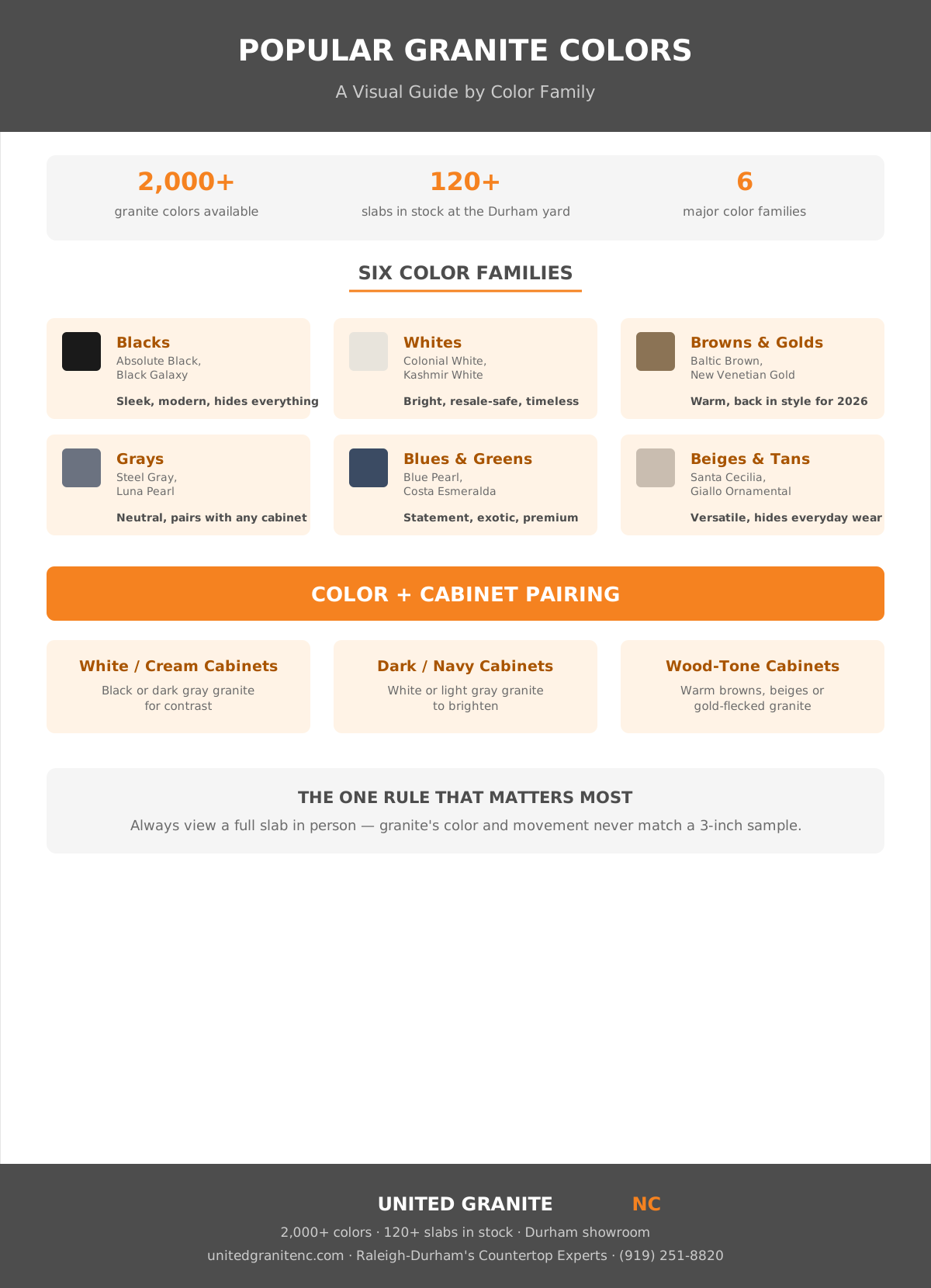
"What color granite should I get?" is the question we hear more than almost any other in the showroom, and it's a genuinely hard one to answer from a website alone — granite comes in over 2,000 documented colors worldwide, no two slabs of the same color are ever perfectly identical, and a swatch on a screen looks nothing like a slab under your kitchen's actual lighting. But the decision does break down into patterns that make it manageable: colors cluster into a handful of families, each family pairs predictably well with certain cabinet tones, and knowing those patterns turns an overwhelming catalog into a short list.
This guide organizes granite by color family — blacks, whites, browns and golds, grays, blues and greens, and beiges — with real color names you'll encounter while shopping, honest notes on how each family lives day to day, and cabinet-pairing guidance drawn from what we actually see work in Triangle kitchens. If you're still deciding between granite and other materials entirely, our complete materials comparison covers that broader decision first.
Why Granite Color Names Aren't Universal
One quirk worth understanding before diving into families: granite color names are quarry and importer conventions, not scientific classifications. The same visual stone might be sold under two or three different names by different suppliers, and conversely, two slabs both labeled "Black Galaxy" can show noticeably different speckle density depending on which block of the quarry they came from. This is exactly why we always recommend viewing and tagging your actual slab in person rather than ordering by name alone — a theme that runs through nearly everything we publish about natural stone, including our quartzite guide and materials comparison. Treat every color name in this guide as a starting point for your showroom visit, not a guarantee of an exact slab.
Black Granite: Sleek, Modern & Endlessly Practical
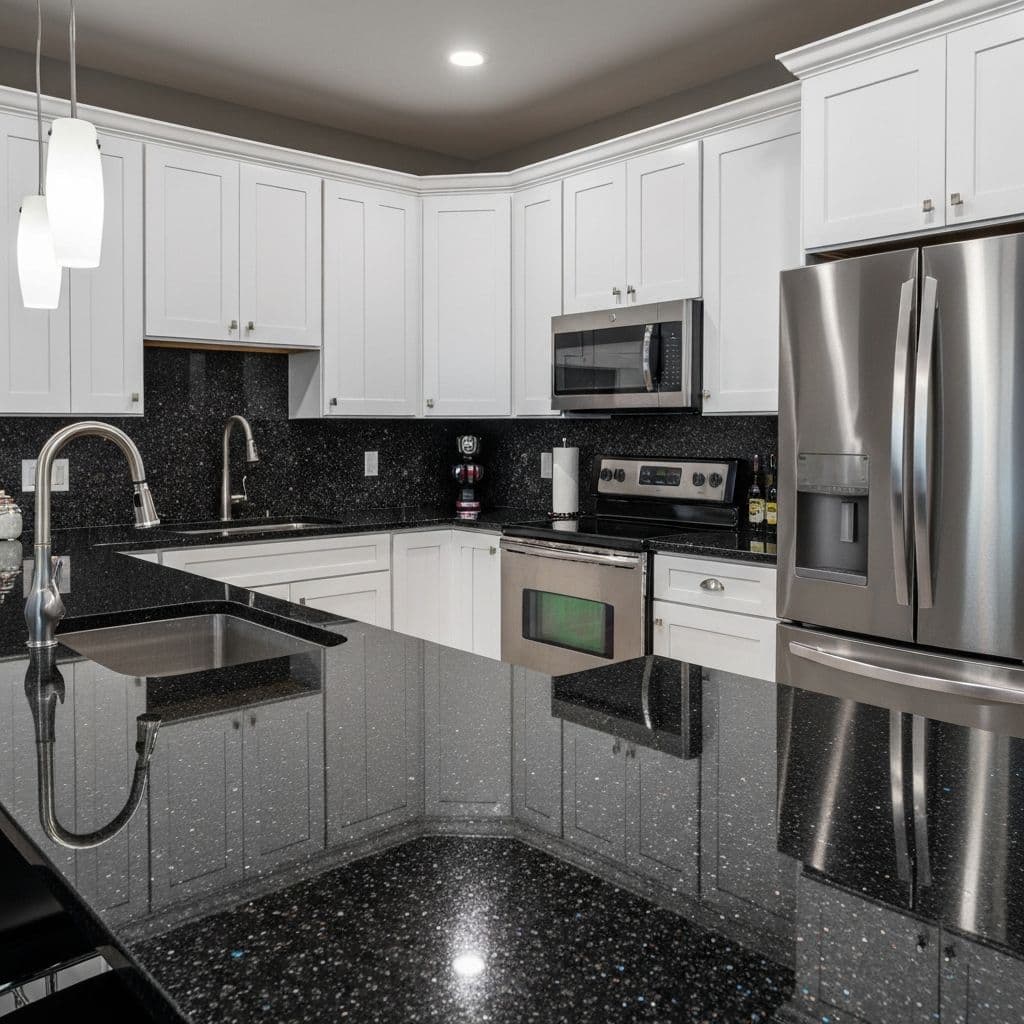
Black granite anchors more contemporary kitchens than any other color family, and its practical case is as strong as its looks. Absolute Black is the deepest, most uniform true black available in granite — so consistent it's sometimes mistaken for an engineered material — and it pairs with literally any cabinet color, which is exactly why it remains one of the most requested colors in our showroom year after year. Black Galaxy takes the opposite design approach: a rich black base flecked with fine golden-copper mineral specks that catch light and add genuine sparkle, a dramatic option for a kitchen that wants black without going flat.
The practical case for black granite deserves its own paragraph: it hides water spots, fingerprints, and everyday crumbs better than any other color family, which is exactly why it's the default recommendation for busy family kitchens and rental properties alike. The one honest caveat — dust and light-colored debris (flour, powdered sugar) show up more visibly against black than against a busy multi-tone stone, a minor trade-off most owners adjust to within a week.
White & Light Granite: Bright, Timeless & Resale-Safe
White and light granites solve the problem quartz spent a decade trying to solve — a bright, airy countertop with genuine mineral movement rather than a flat, uniform surface. Colonial White delivers a soft ivory-white base with gentle gray speckling throughout, a versatile, resale-friendly choice that reads clean without feeling sterile. Kashmir White takes the aesthetic further with dramatic burgundy and gray flecks scattered across a white field — more visual interest than Colonial White while staying in the same light, airy family.
White granite fits directly into the warm-neutral trend leading 2026 kitchens, and it's consistently one of the safest choices for anyone renovating with resale in mind — light, natural-stone counters photograph well in listing photos and read as a genuine upgrade to nearly every buyer. The honest trade-off versus black: light granite shows oil spots and coffee rings more readily day to day, which is exactly why sealing discipline matters more here than with darker stones — see our stain removal guide for the specific poultice method that lifts oil stains from lighter stone.
Brown & Gold Granite: The 2026 Comeback
Brown and gold granites dominated kitchens in the 2000s, fell out of favor for a decade of gray-and-white minimalism, and are now — genuinely — back in style, as we covered in our 2026 design trends report. Baltic Brown offers a dark chocolate-brown base with black and tan mineral crystals throughout, a warm, grounded look that pairs beautifully with the wood-tone cabinetry trending hard this year. New Venetian Gold brings warmer golden-tan tones with burgundy and black accents, softer and more traditional than Baltic Brown but part of the same warm family.
The 2026 version of this trend looks nothing like its 2000s predecessor, and the distinction matters: today's warm granites pair with cream and white oak cabinetry for a soft, "quiet luxury" aesthetic rather than the heavy, all-brown kitchens of two decades ago. If brown granite intimidates you based on memory alone, ask to see it against a modern cream or white-oak cabinet sample before ruling it out — the pairing looks genuinely different from what you might remember.
Gray Granite: The Neutral That Works With Everything
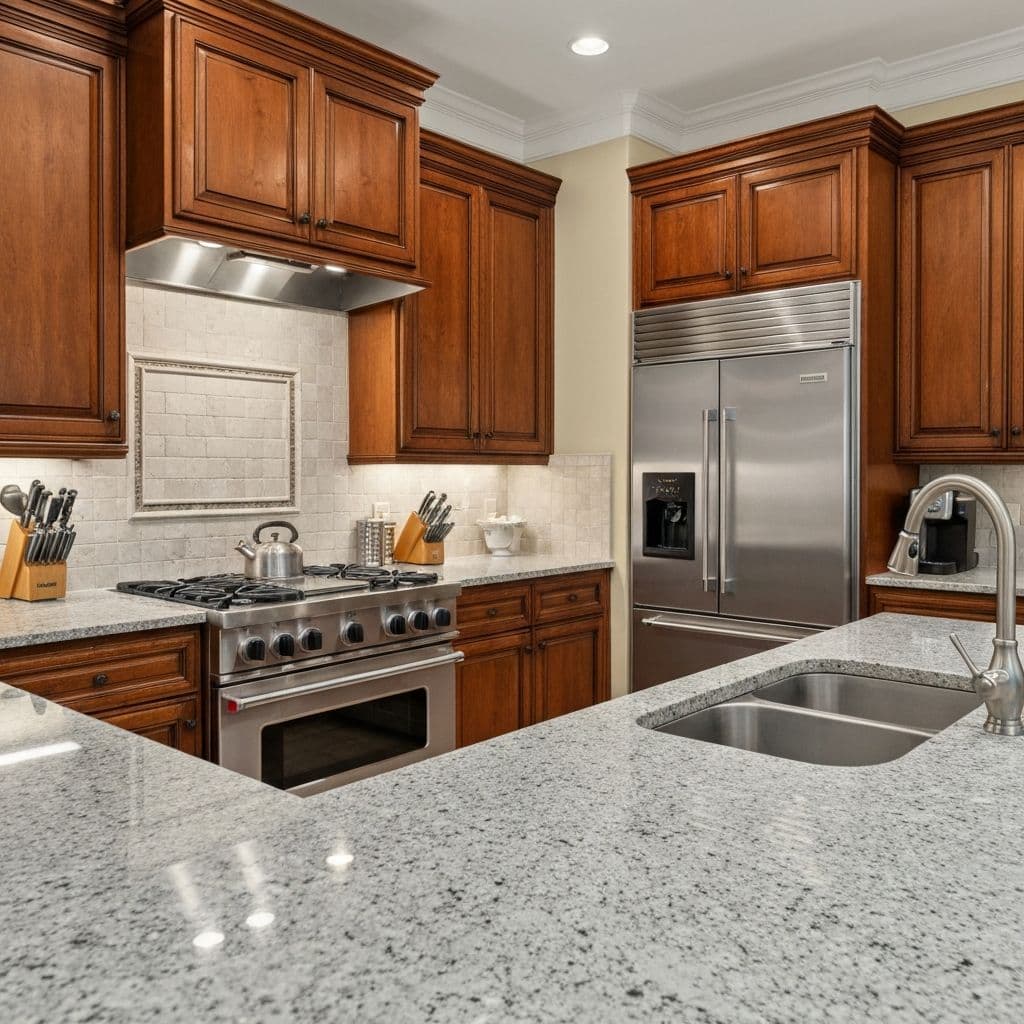
Gray granite occupies the middle ground between black's drama and white's brightness, and its neutrality is exactly why designers reach for it so often. Steel Gray delivers a consistent charcoal-gray base with fine, evenly distributed speckling — dense and modern, especially striking in a honed or leathered finish that leans into 2026's matte-finish trend. Luna Pearl offers a lighter silvery-gray base with white and black crystal movement throughout, a genuinely versatile middle-tone that photographs well against nearly any cabinet color.
Gray's real strength is flexibility: it doesn't force a kitchen's entire palette to react to it the way black or a bold color does, which makes it a low-risk choice for anyone renovating a kitchen they plan to live with for a long time, or anyone updating one element of a kitchen where other finishes (flooring, backsplash) are already fixed and need to be worked around rather than redesigned.
Blue & Green Granite: The Statement Choice
For homeowners who want a countertop that functions as art, blue and green granites are where the category gets genuinely exciting. Blue Pearl, quarried in Norway, displays a striking blue-gray base with labradorite crystals that shimmer and shift color depending on the angle of light — a phenomenon called labradorescence that photographs beautifully and looks even more dramatic in person. Costa Esmeralda brings deep emerald-green tones with white and gold veining, an increasingly popular exotic choice for islands and statement bars.
These colors sit at the premium end of granite pricing — genuinely rare quarrying sources drive both cost and exclusivity — which is exactly why we most often recommend them for a single island or bar top rather than an entire kitchen's worth of counter space, the same strategy we recommend for exotic quartzite in our materials guide. One dramatic slab does more design work than an entire kitchen of a merely-good color.
Beige & Tan Granite: The Practical Middle Ground
Beige and tan granites are the workhorses of the category — less discussed in design features than dramatic blacks or exotic blues, but reliably popular because they simply work in more kitchens than any other family. Santa Cecilia offers a warm golden-beige base with burgundy and black mineral flecks, one of the most consistently available and requested granite colors on the market for good reason: it hides everyday wear exceptionally well and pairs with nearly any wood tone. Giallo Ornamental brings a lighter cream-gold base with more subtle veining, a softer alternative in the same family.
If you're genuinely torn between several options and want the lowest-risk, most broadly compatible choice, a beige or tan granite is usually the right answer — it's the color family most likely to still look intentional a decade from now, regardless of which other finishes change around it.
Cabinet Pairing: The Rule That Actually Matters
Beyond family preference, one practical rule governs almost every successful granite-and-cabinet pairing: contrast reads as intentional; matching tones read as accidental. White or cream cabinets paired with black or dark gray granite create the classic, foolproof high-contrast look that dominates kitchen design for a reason — it works in nearly every architectural style. Dark or navy cabinets paired with white or light gray granite flips the same logic, brightening a moody palette without losing its drama. Wood-tone cabinets pair most naturally with warm granite families — browns, golds, and beiges — echoing rather than fighting the wood's undertone.
The pairing to approach carefully is same-tone-different-shade — a cream cabinet with a beige granite, for instance — which can work beautifully when undertones match, but reads as an accident when they don't (warm cream cabinets against a cool gray-beige granite is the classic mismatch we catch most often in consultations). Always bring an actual cabinet door or sample to the slab yard rather than relying on memory or a paint chip; undertone mismatches are nearly invisible in isolation and glaringly obvious side by side.
Finish Changes the Color: Polished vs Honed vs Leathered
The same granite color reads differently depending on its finish, a detail easy to overlook when browsing small samples. Polished finishes deepen color saturation and add reflective shine — black granites look their most dramatic polished, and light colors gain a bright, glassy quality. Honed finishes mute color slightly and add a soft, matte quality that's driving 2026's design direction — particularly flattering on grays and warm neutrals, where it creates a lived-in, sophisticated look rather than a showroom shine. Leathered finishes add subtle texture on top of the honed look, which does double duty hiding fingerprints and water spots on darker colors specifically — worth serious consideration for black or steel-gray granite in a high-traffic kitchen.
Always ask to see your chosen color in multiple finishes before committing, especially for darker colors where the difference between polished and honed is most dramatic. A finish sample takes thirty seconds to compare and can change your entire impression of a color.
Granite Color by Room: Beyond the Kitchen
Kitchen counters get most of the attention, but granite color decisions play out differently in other rooms of the house. Bathroom vanities, covered in depth in our vanity guide, benefit from lighter, brighter granites — Colonial White or Kashmir White — that make a smaller room feel more open, though a dramatic dark granite on a powder-room vanity can be a striking, low-cost statement given how little material a vanity requires. Outdoor kitchens, per our climate-specific guide, favor darker or busier granites that hide pollen dust and yard debris far better than a pristine white surface exposed to a North Carolina spring.
Fireplace surrounds are a granite application worth remembering — the same heat resistance that makes granite ideal for cooktops makes it equally suited to framing a firebox, and darker, warmer colors (Baltic Brown, Steel Gray) tend to suit a living room's typically warmer, cozier palette better than a stark kitchen white. Bar tops and wet bars are exactly where the exotic blues and greens earn their premium price — a small footprint, high visibility, and an entertaining-focused room where drama pays off more than in a utilitarian kitchen prep zone.
Matching Granite Color to Your Home's Overall Style
Beyond cabinets, a home's broader architectural style narrows the field further. Traditional and colonial homes throughout the Triangle's established neighborhoods tend to favor warmer, more classically patterned granites — Santa Cecilia, New Venetian Gold, Baltic Brown — that echo the wood tones and millwork already present. Modern and contemporary builds lean toward the cleaner, more uniform end of the spectrum: Absolute Black, Steel Gray, or a subtly patterned white, where the granite reads as a quiet backdrop rather than a competing pattern. Farmhouse and transitional styles, dominant in much of the newer Wake and Durham county construction, split the difference — warm whites and beiges with gentle movement fit the aesthetic without either extreme.
None of these are hard rules — plenty of stunning kitchens break the pattern deliberately — but they're a useful starting filter when 2,000 colors feels like too many to sort through alone. If your home's style is genuinely a blend, bring photos of your exterior and any existing interior finishes to your showroom visit; it gives our team the fastest path to a shortlist that actually fits.
How to Actually Choose: A Practical Process
- Start with your cabinets, not the granite. Bring an actual door or a large sample — undertone matching matters more than any color-family preference in isolation.
- Narrow to one family, not one slab. Decide black, white, warm, gray, or exotic first; the specific slab comes second, once you're in the right neighborhood.
- View full slabs, never just samples. A 3-inch chip cannot show movement, veining density, or how a busy pattern reads across an entire kitchen.
- Check lighting conditions that match your kitchen. Showroom lighting differs from your actual kitchen; ask to see a slab section near a window if your kitchen gets natural light.
- Compare finishes on your top choice. Polished, honed, and leathered can meaningfully change how a color reads — don't decide on finish as an afterthought.
- Tag your actual slab. For natural stone, the specific slab you view is the one you should request for fabrication — no two slabs of the same name are identical.
Living With Your Color Choice: What Nobody Mentions Upfront
A few practical realities become obvious only after a color has lived in a kitchen for a year or two, worth knowing before you commit rather than discovering afterward. Lighting changes everything, permanently, not just in the showroom. A granite that looks perfect under your kitchen's daytime window light can shift noticeably under warm evening pendant lighting or cool LED under-cabinet strips — if your kitchen relies heavily on artificial light after dark, view your final slab candidates under a bulb matching your actual fixtures, not just daylight.
Busy patterns age better than solid colors in a working kitchen. A perfectly uniform black or white surface shows every new mark as a change from its original state; a granite with natural movement and mineral variation simply absorbs new marks into its existing pattern, which is part of why heavily patterned stones remain popular in family kitchens specifically, beyond their practical stain-hiding case. And your first choice isn't always your last kitchen's choice — many homeowners who loved a bold, exotic color in their twenties gravitate toward calmer neutrals by their next renovation, worth keeping in mind since a countertop is genuinely a two-decade purchase. If you're planning to stay in the home that long, leaning slightly toward timeless over trendy has real merit, even for buyers who love a bold statement today.
What Granite Colors Cost in the Raleigh-Durham Market
Color availability drives price more than most homeowners expect. Common, widely quarried colors — Colonial White, Santa Cecilia, Steel Gray — sit at the accessible end of granite pricing, often starting in the $40s–$60s per square foot installed, since consistent global supply keeps costs down. Mid-tier colors with more distinctive character, including Absolute Black and Black Galaxy, typically run $50–$80 per square foot. Exotic and rare colors — Blue Pearl, Costa Esmeralda, and similar dramatic imports — climb to $80–$150+ per square foot, reflecting limited quarry sources and specialized shipping. Our complete pricing guide breaks down every factor beyond color that affects your final number, and EZ Quote turns your measurements and color preference into real figures, usually within one business day.
Common Granite Color Mistakes to Avoid
- Choosing from a photo alone. Screens shift color temperature unpredictably; the granite that looked perfect online can read completely differently in person.
- Ignoring undertone in favor of color-family matching. A "white" cabinet and a "white" granite can clash badly if one leans warm and the other cool — always compare physical samples together.
- Assuming a busy pattern hides all mess. Some homeowners over-correct toward extremely busy stone expecting it to hide everything; in practice, a moderate pattern in the right color family does the job without overwhelming a small kitchen.
- Skipping the finish conversation. Deciding on polish by default, without considering how honed or leathered would change a specific color, is a missed opportunity available at little to no added cost.
- Not asking about slab-to-slab variation. If your project needs multiple slabs (a large kitchen or matching island), ask specifically how consistent the color runs across the quarry's current lot before committing.
See Real Granite Colors in Person
Every distinction in this guide — undertone, movement, finish — is easiest to judge standing in front of an actual slab, which is exactly why we keep 120+ slabs in stock across 2,000+ available colors at our Durham showroom. We serve the entire Triangle, from Raleigh and Durham to Cary, Apex, Chapel Hill, and beyond. Browse real installations by color in our portfolio, preview a color against your own kitchen layout in our visualizer, or start with a free quote — tell us your cabinet color and style preference and we'll help you narrow the list before you even visit.