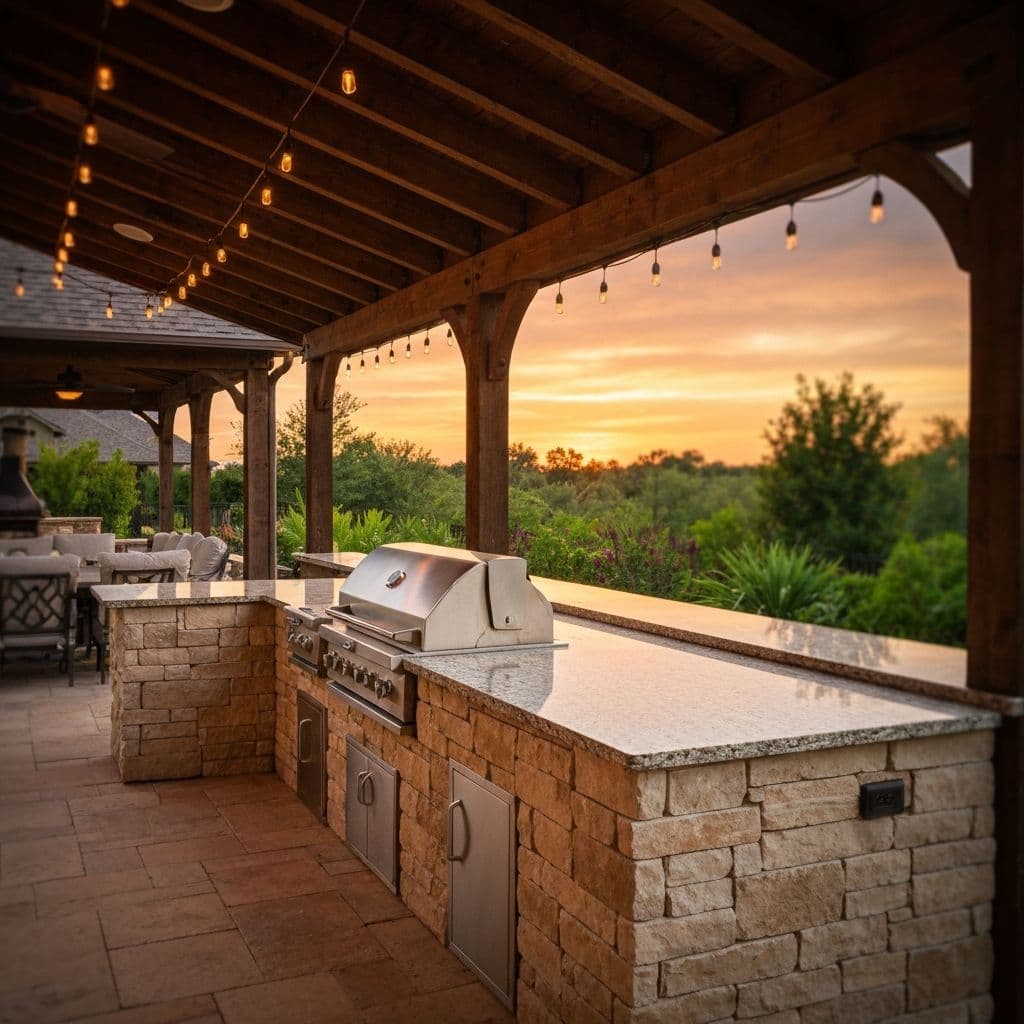
An indoor kitchen counter has a controlled life: steady temperature, no direct sun, no rain. An outdoor counter in the Raleigh-Durham Triangle faces none of those comforts. It bakes under a North Carolina summer sun that regularly pushes surface temperatures past 100°F, sits through humid, pollen-heavy springs, gets rained on repeatedly, and then survives a winter that swings above and below freezing more often than most homeowners expect. That combination — heat, UV, moisture, and freeze-thaw cycling — quietly disqualifies several countertop materials that perform beautifully indoors.
We get calls every year from homeowners whose outdoor quartz counters have yellowed, or whose budget stone has cracked after one winter, and the fix is almost always the same conversation we wish we'd had before installation. This guide covers exactly which materials belong outdoors in a North Carolina climate, which ones to avoid regardless of what a showroom sample suggests, and what a proper outdoor kitchen counter costs in the Triangle.
Why Outdoor Counters Fail Differently Than Indoor Ones
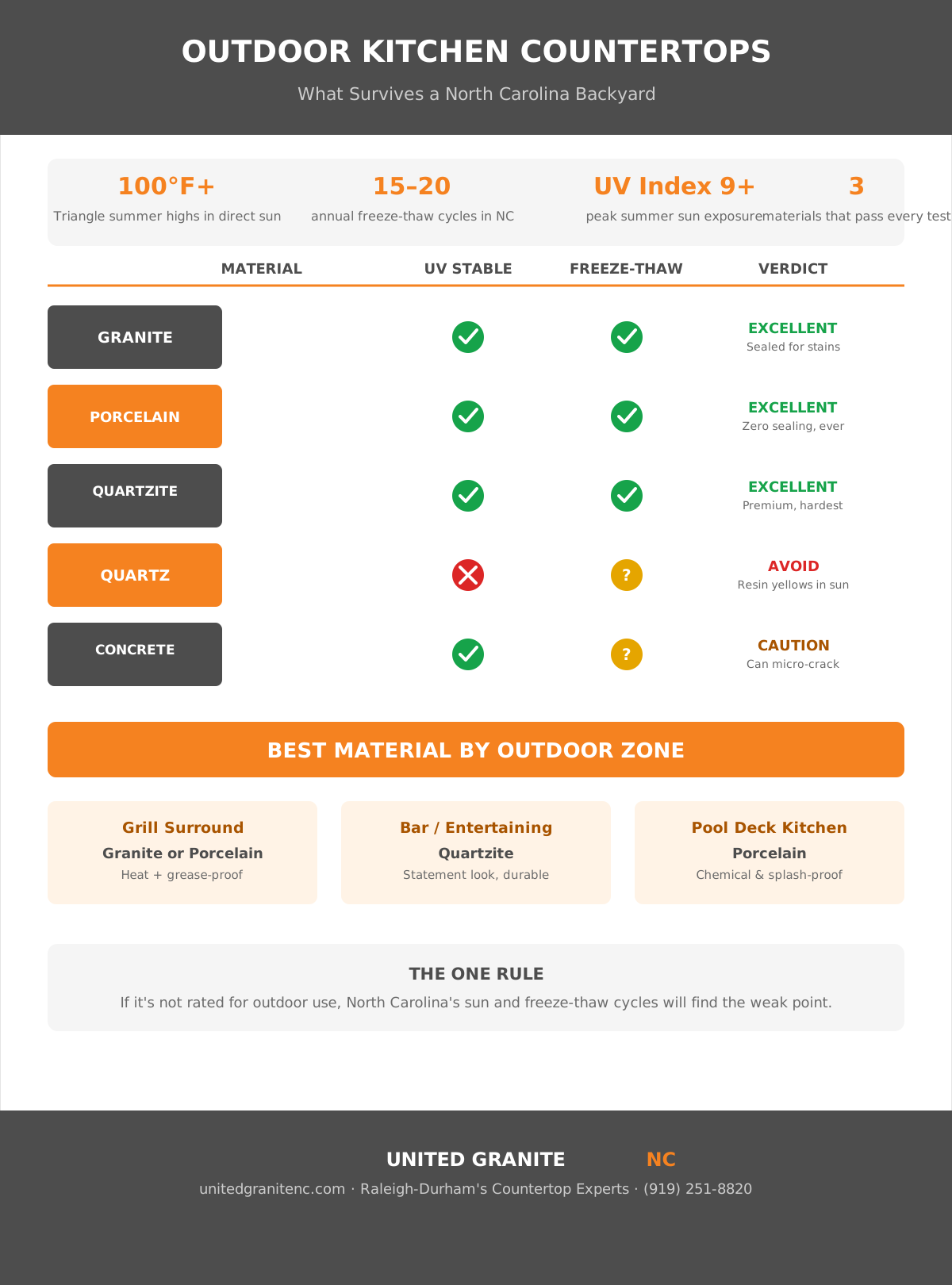
Three forces do the damage, and they rarely act alone. UV exposure breaks down polymer resins over months of direct sunlight — invisible at first, then a slow yellowing or chalky haze that no cleaning fixes. Thermal cycling stresses any material with trapped moisture or resin content: a slab that's fine at 40°F in the shade and fine at 95°F in full sun can develop stress fractures at the boundary between the two, especially with repeated daily swings. Freeze-thaw is the sneakiest of the three — water that gets into a porous or improperly sealed material expands roughly 9% when it freezes, and repeated cycles turn hairline issues into real cracks over one or two winters. North Carolina isn't the harshest freeze-thaw climate in the country, but the Triangle sees enough of the pattern (roughly 15–20 freeze-thaw transitions in a typical winter) that it matters for material selection.
Stack all three onto a grill surround that also handles direct radiant heat, grease, and the occasional forgotten hot pan, and you understand why outdoor kitchens are unforgiving of the wrong material choice in a way indoor kitchens simply aren't.
Granite: The Proven Outdoor Standard
Granite has been the default outdoor countertop material for decades, and it earns that position honestly. As an igneous rock formed under intense natural heat and pressure, it doesn't care about UV exposure at all — no resin to yellow, no color to fade. It handles North Carolina summer heat without complaint and shrugs off winter freeze-thaw as long as it's properly sealed, which prevents water absorption at the surface where freezing would otherwise cause damage. Grill heat, splashing marinade, citrus from cocktails at the bar — granite has seen it all for as long as outdoor kitchens have existed.
The one maintenance item that matters more outdoors than in: sealing discipline. An indoor granite counter tolerates a slightly overdue reseal without much consequence; an outdoor counter exposed to Triangle rain and winter freezing needs its seal maintained on schedule — check with the water test each spring and fall, and reseal proactively before winter if it's due. Granite also remains the best-value outdoor option, with entry colors starting well below premium quartzite or exotic stone, making it the default recommendation for straightforward grill surrounds and outdoor bars.
Porcelain: Purpose-Built for This Exact Job
If granite is the proven standard, porcelain is the material engineered specifically for conditions like a North Carolina backyard. Fired in kilns above 1,200°C during manufacturing, porcelain contains zero resin to degrade — it is genuinely, completely UV-stable, with water absorption near zero, meaning freeze-thaw cycling has essentially nothing to act on. Add grill-level heat resistance that outperforms every other material in this guide, and you have a surface with no real weakness for outdoor use.
The tradeoffs we cover honestly in our full porcelain guide — edge chip risk under sharp impact, fabrication that rewards an experienced shop — apply outdoors too, but neither is climate-related. For pool decks specifically, porcelain's total imperviousness to chlorine, sunscreen, and pool chemicals makes it our first recommendation; nothing else in this guide handles that specific chemical exposure as cleanly. Large-format porcelain slabs also let a grill surround, bar front, and even a full-height backsplash wall run in one continuous seamless design — a look increasingly common in high-end Triangle outdoor kitchens.
Quartzite: The Premium Choice for Statement Outdoor Bars
Quartzite brings the same natural, resin-free composition as granite but with even greater hardness — a genuinely bulletproof surface for outdoor entertaining spaces that also want to look spectacular. UV-stable by nature and freeze-thaw resistant when properly sealed, quartzite handles a North Carolina climate exactly as well as granite does, with the added appeal of dramatic natural veining that photographs beautifully around a pool or fire pit.
The honest caveat is price: as our quartzite guide details, premium and exotic quartzite slabs run well above granite, which is exactly why we recommend it most often for a statement outdoor bar or entertaining island rather than an entire outdoor kitchen footprint. Pair a dramatic quartzite bar top with a granite or porcelain grill surround, and the budget stretches further while every surface still performs identically in the weather.
Quartz: Why It Doesn't Belong Outside — Ever
This is the mistake we see most often, and it costs real money to fix: engineered [quartz](/products/quartz) is not rated for outdoor use, full stop. Every major manufacturer — Cambria, Silestone, Caesarstone, MSI — explicitly excludes outdoor installation from their warranties, for a straightforward reason: quartz is roughly 90% crushed stone bound with polymer resin, and that resin is the exact component UV light degrades. Months of direct North Carolina sun cause visible yellowing, and the same resin that makes quartz non-porous indoors becomes a liability outdoors, where thermal cycling between hot days and cold nights stresses the material differently than a temperature-stable kitchen ever would.
We understand the appeal — quartz slabs already sit in the showroom, the color might match an indoor kitchen, and the zero-sealing pitch sounds perfect for a low-maintenance patio. But the warranty exclusion exists because manufacturers have seen the failure pattern repeatedly. If a marble-look aesthetic is the goal, get it from porcelain or quartzite instead — both deliver the same visual family with genuine outdoor durability, a swap we walk every quartz-curious outdoor client through in our materials comparison.
Concrete: Popular, But Read This First
Poured concrete countertops show up constantly in outdoor kitchen inspiration photos, and the appeal is real: custom shapes, an industrial-modern look, and UV stability since there's no resin to yellow. The catch is freeze-thaw. Concrete is porous, and despite sealing, moisture that penetrates the surface can expand during a hard freeze and cause micro-cracking over successive winters — a slower failure mode than quartz's yellowing, but a real one in a climate that does freeze, even if not as harshly as the Midwest or Northeast. Quality concrete fabricators mitigate this with proper mix design, sealers, and control joints, but it remains the most maintenance-dependent option in this guide and the one most sensitive to fabrication quality. We don't fabricate concrete counters ourselves, so treat this as an honest market observation: if concrete's look is non-negotiable for your design, work with a specialist experienced in outdoor installations specifically, and budget for a diligent annual sealing routine.
Soapstone & Marble: Beautiful Indoors, Risky Outside
Two more materials worth a direct answer since they come up often. Soapstone is naturally non-porous and heatproof, which sounds outdoor-friendly, but it's also soft — outdoor debris, dropped tools, and general patio wear-and-tear mark it more readily than an indoor kitchen would, and while it survives weather chemically fine, the practical durability case is weaker than granite or porcelain for a high-traffic entertaining surface. Marble is a harder no: its porosity and acid sensitivity, already a care consideration indoors per our materials guide, become a genuine liability against rain, pollen acids, and freeze-thaw moisture cycling outdoors. Reserve marble for the primary bathroom vanity where it belongs, and let granite, porcelain, or quartzite handle the patio.
Matching Material to Your Outdoor Kitchen Zone
- Grill surround: Granite or porcelain — both handle radiant heat, grease, and direct sun without hesitation. Porcelain edges out granite here for zero-maintenance grease resistance.
- Entertaining bar / island: Quartzite for a statement centerpiece, or granite for the same durability at a friendlier price if the budget is tighter.
- Pool deck kitchen: Porcelain, specifically for its total resistance to pool chemicals, sunscreen, and chlorine splash that other materials tolerate less gracefully over years of exposure.
- Covered outdoor kitchen (roofed, no direct rain/sun): Any of the three top materials work well; a covered structure reduces UV and moisture exposure, which even widens what's reasonably viable, though we'd still steer away from quartz given temperature swings.
- Fire pit / lounge surround: Granite or quartzite for direct heat tolerance if the surface sits near open flame.
Fabrication Details That Matter Outdoors
A few choices at the design stage protect an outdoor counter for decades rather than years. Edge and joint sealant matters more outside — use flexible, weather-rated silicone rather than rigid caulk at every seam and wall junction, since building movement from temperature swings is more pronounced outdoors than in a climate-controlled kitchen. Drainage slope is worth discussing for any counter section exposed to direct rain; a barely perceptible slope away from the house prevents standing water from ever testing your sealer's limits. Support structure should account for outdoor-grade materials throughout — a beautiful granite counter on an inadequate or non-weatherproof cabinet base undermines the whole investment, so confirm the base structure (masonry, stainless steel frame, or weather-treated material) matches the stone's outdoor rating.
Sealing frequency deserves a tighter schedule than indoor stone: check natural stone (granite, quartzite) each spring after pollen season and again before the first hard freeze in late fall, rather than the indoor one-to-three-year default from our cleaning guide. It's a fifteen-minute check twice a year, and it's the difference between a counter that looks the same in ten years and one that shows its age in three.
Covered vs. Fully Exposed: How Structure Changes the Calculation
Not every outdoor kitchen faces the same exposure, and the structure above it genuinely changes the material conversation. A fully covered outdoor kitchen — under a solid roof, pergola with dense coverage, or screened porch — sees dramatically reduced direct UV and rain exposure. This doesn't make quartz suddenly safe (temperature swings and humidity still apply, and the warranty exclusion doesn't distinguish covered from open), but it does widen the margin for materials like soapstone or even well-sealed marble in a genuinely sheltered nook, such as a covered wet bar. Partially covered spaces — a roof over the grill but an open bar area — sometimes call for zone-specific material choices: porcelain or granite under the roofline where rain still blows in at an angle, with more design freedom in the fully sheltered sections.
Fully exposed kitchens — open patios, pool decks, anything under open sky — get no exceptions. This is where the granite, porcelain, and quartzite recommendation is absolute, and where cutting corners shows up fastest, sometimes within a single summer. If you're unsure which category your project falls into, err toward the fully-exposed material list; a covered structure can always be added later, but a degraded countertop under an already-built pergola is a much more expensive fix.
Color & Finish Choices That Perform Better Outdoors
Beyond base material, a few finish decisions measurably improve how an outdoor counter ages. Honed and leathered finishes, increasingly popular per our 2026 trends report, hide water spots, pollen dust, and light scratching far better outdoors than a high polish does — a practical win layered on top of the aesthetic one, since outdoor surfaces collect far more airborne debris than indoor counters ever will. Darker colors show less staining from tree pollen, leaf tannins, and general yard dust, while very light colors demand more frequent cleaning to stay looking fresh through a Carolina pollen season. And consistent color across sun and shade zones matters more outdoors than in — a slab with dramatic light-to-dark variation can appear to fade unevenly simply because one section bakes in full sun while another sits shaded under a pergola beam, so ask to see how a specific slab's pattern reads across both conditions before committing.
Insects, Mold & the Maintenance Nobody Mentions
One outdoor-specific issue rarely covered in material comparisons: biological growth. Humid North Carolina summers create ideal conditions for mold and mildew on any surface that stays damp, including countertops in shaded, poorly ventilated corners. Non-porous materials — porcelain and quartz-family surfaces — resist this well since there's no pore structure for spores to colonize, while natural stone's microscopic porosity (even when sealed) can host surface growth in persistently damp, shaded spots if not wiped down regularly. The fix is simple and material-independent: ensure water doesn't pool anywhere on the counter, wipe down shaded zones after extended wet weather, and treat any dark, powdery spots promptly with a stone-safe mold treatment rather than letting them establish. This is a maintenance habit, not a reason to avoid natural stone — but it's worth building into your outdoor kitchen's care routine from day one, alongside the seasonal sealing check.
What Outdoor Kitchen Countertops Cost in the Triangle
Outdoor counters follow the same per-square-foot logic as indoor projects, detailed fully in our pricing guide, with a few climate-driven adjustments. Granite typically installs from the $45–$100 per square foot range, the most budget-friendly proven outdoor option. Porcelain runs $60–$120, reflecting its specialized fabrication. Quartzite spans $70–$200+, with exotic statement slabs at the top of that range. A typical outdoor kitchen — grill surround plus a modest bar or island — runs 20–40 square feet, putting most straightforward projects in the $1,500–$4,500 range for material and fabrication, before structural cabinetry, appliances, and plumbing.
One cost-saving strategy specific to outdoor projects: since outdoor footprints tend to be smaller than full indoor kitchens, they're excellent candidates for remnant slabs — the leftover sections from larger indoor jobs, mentioned in our vanity guide — which can bring premium quartzite pricing down meaningfully for a modest grill surround or bar top. Always ask what's available before assuming exotic stone is out of budget for a smaller outdoor footprint.
Common Outdoor Countertop Mistakes We See
- Installing quartz outdoors because it matches the indoor kitchen. The warranty exclusion is universal across every major brand — swap to matching-look porcelain or quartzite instead, covered in our materials guide.
- Skipping the seasonal sealing check on natural stone. Twice-yearly is the outdoor standard, not the indoor one-to-three-year default.
- Using rigid caulk at seams and walls. Outdoor temperature swings demand flexible, weather-rated silicone that can move with the material.
- Ignoring drainage. Standing water anywhere on an outdoor counter, even briefly after rain, stresses sealant and grout lines over years of repetition.
- Choosing concrete without vetting the fabricator's outdoor experience specifically. Indoor concrete-counter skill doesn't automatically transfer to freeze-thaw-resistant outdoor mix design.
- Underestimating grill heat radius. Confirm any counter material directly adjacent to a grill's heat output — even heat-tolerant stone benefits from a few inches of buffer or a heat-deflecting design detail near the burners.
Building the Rest of Your Outdoor Kitchen
The countertop is the surface everyone touches, but it's one piece of a working outdoor kitchen. Sinks and faucets rated for outdoor and freeze conditions need the same climate scrutiny as the counter itself — confirm freeze-proof plumbing before winter arrives. Cabinetry beneath the stone should be stainless steel, marine-grade polymer, or another weatherproof material; wood cabinet boxes built for indoor kitchens don't belong under an outdoor counter regardless of how well the stone performs above them. And electrical and gas lines for grills, side burners, and lighting are a licensed-trade job that should be planned before template day, since utility penetrations through the counter are cut into the stone permanently.
The process itself follows the same rhythm as any countertop replacement or new build: quote, material selection, template, fabrication, and installation — outdoor projects simply add a conversation about structural base, drainage, and utility coordination up front. Our showroom serves the entire Triangle, from Raleigh and Durham to Cary, Apex, Chapel Hill, and beyond; browse real outdoor installations in our portfolio, or start with a free quote — tell us your outdoor layout and material preference and we'll have real numbers back, usually within one business day.