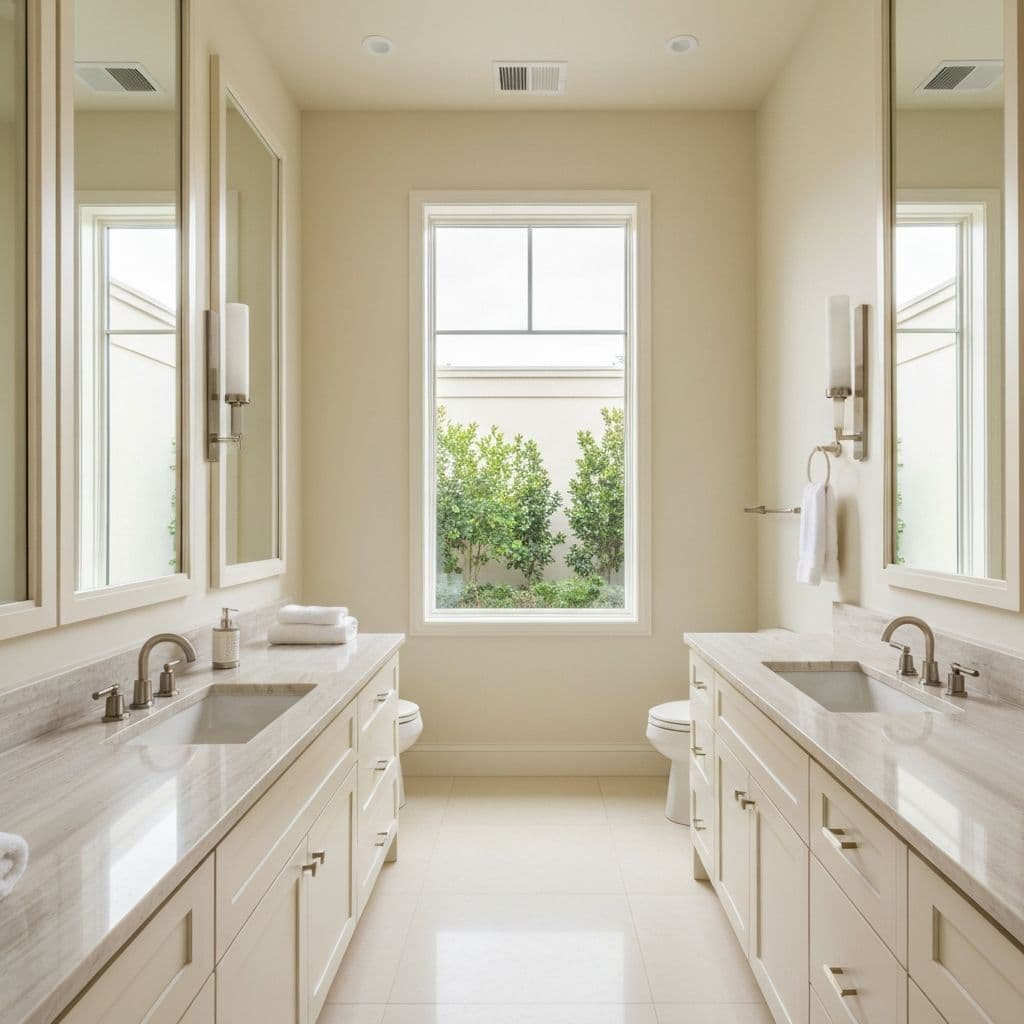
Kitchens get all the attention in countertop conversations, but here's a secret from the fabrication side: bathrooms are where stone gets to be *fun*. The vanity lives a gentle life — no cast-iron pans, no chef's knives, no splattering tomato sauce — which means materials too delicate or too dramatic for a kitchen suddenly become practical. That fragile bookmatched marble? Perfect. Translucent backlit onyx? Absolutely. The exotic slab that would blow a kitchen budget? A vanity needs only a fraction of it.
At the same time, bathrooms bring their own villains that kitchens never see: standing water around the faucet, alcohol-based perfumes and mouthwash, acetone nail polish remover, toothpaste splatter, and hair dye. Choosing bathroom vanity countertops is a different decision than choosing kitchen counters, with different winners — and this guide covers all of it: the best material for each type of bathroom, standard sizes and heights, sink styles, edge and backsplash choices, real installed costs in the Raleigh-Durham market, and the mistakes we see homeowners make most often.
Why Bathroom Counters Are a Different Decision
Start with what's *absent*. The three forces that dominate kitchen material choice — heat, knives, and food acids — essentially don't exist at a vanity. Nobody sets a 400-degree pan next to the sink, nobody dices onions on it, and lemon juice appears only in shampoo marketing. That removes the biggest weaknesses of several beautiful materials: marble's acid-etching problem largely evaporates, quartz's heat sensitivity becomes irrelevant, and softer stones stop being risky.
Now add what's *present*. Vanities live with constant water exposure around faucets and sink rims, which tests sealing and caulking more than any kitchen zone. The products that line a vanity are chemically sneaky: perfume, aftershave, and mouthwash carry alcohols; nail polish remover carries acetone (genuinely dangerous to quartz resin); whitening toothpastes carry peroxides and abrasives; and hair dye is engineered to penetrate whatever it touches. Finally, scale flips: a typical vanity runs 8–15 square feet versus a kitchen's 40–60, which shrinks every price difference. The premium slab that adds $4,000 to a kitchen adds maybe $600 to a vanity — the entire luxury-stone conversation changes.
Small note with big consequences: because vanities need so little material, they're often cut from remnants — the leftover sections of slabs from larger kitchen jobs. A good fabricator's remnant inventory is the best-kept secret in bathroom renovation: genuine premium stone at a meaningful discount, ideal for powder rooms and single vanities. Always ask.
The Best Vanity Materials, Ranked for Bathroom Life
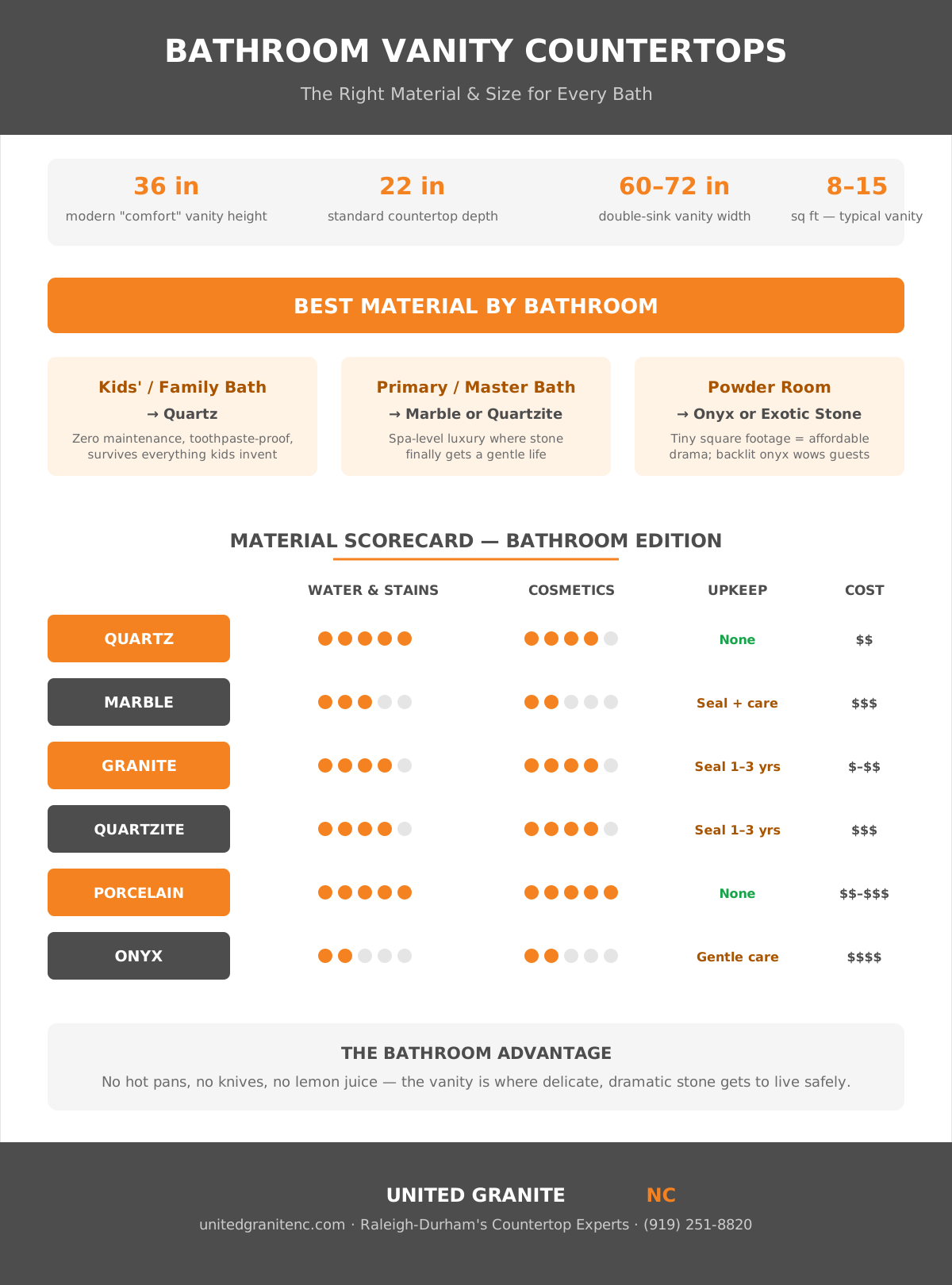
| Material | Water & Stains | Cosmetic Chemicals | Maintenance | Vanity Cost Installed |
|---|---|---|---|---|
| Quartz | Excellent — non-porous | Very good (avoid acetone) | None, ever | $400–$1,500 |
| Granite | Very good sealed | Good | Seal every 1–3 yrs | $350–$1,200 |
| Marble | Good sealed | Moderate — needs habits | Seal + gentle care | $500–$2,000 |
| Quartzite | Very good sealed | Good | Seal every 1–3 yrs | $600–$2,500 |
| Porcelain | Outstanding | Outstanding | None, ever | $500–$1,800 |
| Onyx | Fair — needs care | Fair | Gentle, sealed | $800–$3,000+ |
Quartz: The Family-Bath Default
For the bathrooms that work hardest — kids' baths, guest baths, anything shared — quartz is the answer we give most often, for the same reason it dominates kitchens: nothing gets in, nothing needs doing. Toothpaste dries harmlessly on the non-porous surface. Makeup, lotion, and soap scum wipe away with a damp cloth. There is no sealing schedule to remember for a room you barely think about. And the design range runs from budget-friendly solid whites to convincing Calacatta marble looks from Cambria, Silestone, and Caesarstone — the marble aesthetic with none of the marble anxiety.
Its one bathroom-specific enemy deserves bold print: acetone nail polish remover dissolves quartz resin. One tipped bottle can leave a permanent dull patch. If anyone in the house does their nails at the vanity, either enforce a tray rule or consider porcelain or natural stone instead — granite and quartzite genuinely don't care about acetone. That single habit question decides more quartz-vs-stone vanity debates than any other factor.
Marble: Finally, a Safe Home for the World's Most Beautiful Stone
In our kitchen materials ranking we had to be honest about marble's demands. In the bathroom, the calculation transforms. The acids that etch marble kitchens — citrus, vinegar, wine — don't visit vanities. Water spots and soap film wipe off with routine care. What remains is what made humans fall in love with this stone two thousand years ago: Bianco Carrara's soft gray clouds, Calacatta's bold golden veining, Statuario's museum whites — at vanity scale, often within reach of mid-range budgets, especially via remnants.
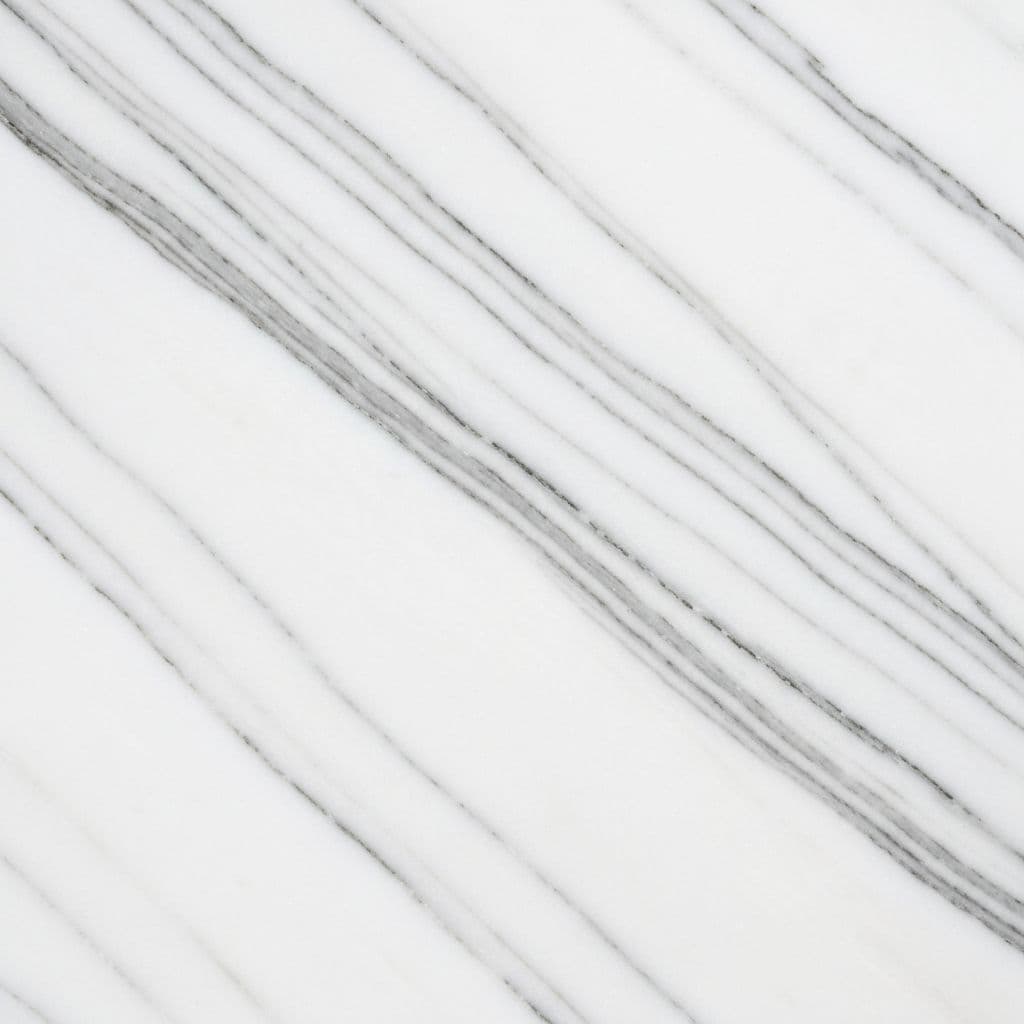
Honest caveats stay on the record: marble still wants sealing, still prefers gentle pH-neutral cleaners, and perfumes or dyes left sitting can mark it. A marble vanity suits owners who'll give it thirty seconds of wipe-down respect, not households where the counter doubles as a chemistry lab. For the look with zero obligations, marble-look quartz and porcelain are waiting. But if you've always wanted real marble somewhere in your home, the primary bath vanity is the smartest place it will ever live.
Granite & Quartzite: Natural Stone That Shrugs at Everything
Granite is the value athlete of vanity tops. Sealed granite handles bathroom chemistry better than almost anything — alcohol, acetone, dye splatter, standing water — and entry-level colors start lower than any other stone we fabricate, with vanity-sized remnants lower still. Darker granites in honed or leathered finishes hide water spots beautifully and fit the current design direction. For rental properties and flips, granite or entry quartz vanities are the no-brainer spec.
Quartzite plays the luxury-natural card: marble's soft beauty with far greater hardness and stain resistance, as we detailed in our quartzite guide. At vanity scale, the stones that strain kitchen budgets — Taj Mahal, Cristallo, blue Macaubas — become achievable statement pieces. A bookmatched quartzite double vanity, veins mirroring across both sinks, is among the most spectacular things we fabricate at any size. Both stones keep the standard natural-stone habit: a fifteen-minute sealing session every year or three, slightly more attentive around the wettest zones.
Porcelain & Onyx: The Specialists
Porcelain may quietly be the perfect bathroom material. Zero porosity beats even quartz around standing water; the fired surface ignores every chemical on a vanity shelf including acetone; and large-format slabs extend beyond the counter to clad shower walls and wet-room surfaces in the same seamless design — a spa-bathroom move that's increasingly popular in high-end Triangle renovations. Its kitchen-side weaknesses (edge chips from heavy impact, covered honestly here) barely apply in a room where the heaviest projectile is a hairbrush.
[Onyx](/products/onyx) is the showpiece. A translucent, banded, semi-precious stone that can be backlit from beneath — LED panels turning the entire counter into a glowing amber-and-honey light fixture — it makes powder rooms unforgettable. It's also soft, relatively delicate, and premium-priced, which is exactly why the powder room is its natural habitat: minimal use, minimal square footage, maximum guest reaction. We treat onyx vanities as jewelry for the house — not everyday wear, but nothing else draws the same gasp.
Matching Material to Bathroom: The Room-by-Room Playbook
- Kids' & family baths: Quartz, no contest. Toothpaste-proof, experiment-proof, zero upkeep — and mid-range colors keep budgets calm.
- Primary / master baths: This is your luxury moment. Marble or quartzite for genuine natural drama; premium marble-look quartz or porcelain for the same aesthetics maintenance-free. Double vanities reward slab-matched or bookmatched layouts.
- Powder rooms: Go bold — tiny square footage makes exotic stone, onyx, or dramatic remnants affordable, and guests actually see this room. The safest place in the house for the wildest slab.
- Guest baths: Mid-range quartz or granite; durable, handsome, forgettable in the best way.
- Rental / investment properties: Entry granite or builder-grade quartz — buyer- and tenant-recognized, hard to damage, cheap to spec via remnants.
- Laundry-bath combos: Quartz or porcelain; detergents and stain treatments are chemically rude to sealed natural stone.
Sizes & Heights: The Numbers That Make a Vanity Comfortable
Height is the spec people feel every morning without knowing why. Traditional vanities ran 30–32 inches; the modern standard, borrowed from kitchen ergonomics, is 36-inch "comfort height" — noticeably kinder to adult backs during a morning routine. Kids adapt with a step stool; adults never adapt to stooping. Custom heights are trivial when counters are fabricated anyway, so households far from average height should say so at the quote stage. If you're keeping an existing cabinet, remember the counter adds roughly 1.25 inches to whatever the box measures.
Depth and width follow the cabinet: standard vanity depth is 22 inches (against the kitchen's 25.5), and widths cluster at 24, 30, 36, 48, 60, and 72 inches. The double-sink question resolves by math: two sinks fit comfortably from 60 inches up; below that, one generous sink with counter space on both sides beats two cramped basins — a trade more designers now recommend anyway. Overhangs run slimmer than kitchens (three-quarters of an inch to an inch is typical), and floating vanities — very much part of the current look — need their stone weight checked against wall-mount hardware, one more detail a fabricator confirms at template.
The Sink Decision: Four Styles That Change Everything
The sink and counter are one decision pretending to be two, because mounting style shapes fabrication. Undermount is the modern default — the sink tucks beneath the stone, edges polish smooth around the cutout, and the counter wipes clean straight into the basin with no crumb-catching rim. Vessel sinks sit atop the counter like bowls: high drama, minimal cutout, and they free up drawer space below — but splash more and add height, so pair them with lower cabinets. Drop-in (self-rimming) sinks are the budget path and the easiest retrofit, at the cost of a rim seam that collects grime. Integrated sinks — basin and counter carved or formed from one material — deliver the seamless spa look in porcelain, solid surface, or carved stone, at custom-work prices.
Faucet planning rides along: widespread faucets need three holes, single-hole faucets one, and wall-mounted faucets need zero — an increasingly popular choice that keeps the counter unbroken and cleaning effortless. Every hole is drilled at fabrication against your exact fixture's spec sheet, which is why the faucet must be *chosen* (ideally purchased) before template day. Changing your mind after the stone is cut ranges from expensive to impossible — the same rule from our replacement-process guide, and it bites hardest in bathrooms where fixture styles vary wildly.
Edges, Backsplashes & the Details That Finish the Room
Vanity edges skew simpler than kitchens: eased and pencil edges suit contemporary baths; ogee still earns its place in traditional powder rooms; and mitered edges build the chunky-slab look on floating vanities. Since a vanity has so little edge footage, upgrading the profile costs little — one place where champagne taste carries a beer budget. (Full profile tour in our edge guide.)
Backsplashes matter more in bathrooms than almost anywhere, because faucet spray hits the wall daily. The classic 4-inch matching-stone splash is giving way to two stronger looks: tile from counter to mirror, or a full-height stone splash in the counter material — dramatic, seamless, and the easiest possible cleaning surface. On double vanities where the counter runs wall to wall, side splashes protect the perpendicular walls too. Whatever the style, insist on a properly caulked, flexible joint where counter meets splash; rigid grout there cracks with normal building movement, and that crack is where water finds the cabinet.
2026 Vanity Trends: What Designers Are Choosing Now
Bathroom counters follow the same warm turn we documented in our 2026 trends report, with a few bath-specific twists. Warm creamy stones with taupe and gold veining lead primary baths, pairing with the white-oak and walnut vanity cabinets dominating this year's designs. Matte and honed finishes matter even more here than in kitchens: polished stone under bathroom lighting shows every water spot and toothpaste fleck, while honed surfaces stay serene between cleanings — a practical trend, not just an aesthetic one. And dark drama is having a bathroom moment: charcoal soapstone-look surfaces and leathered black granite against brass fixtures and moody paint, the powder-room formula of the year.
The structural trends are just as strong. Floating vanities — wall-mounted cabinets with stone tops that seem to hover — anchor the contemporary bath, ask stone to be thinner and lighter (a natural porcelain play), and want their weight confirmed against mounting hardware at template. Full-height stone backsplashes climbing from counter to mirror line replace tile in upscale renovations. And the integrated-sink spa look — basin and counter as one uninterrupted surface — keeps growing as porcelain fabrication matures. If resale sits anywhere in your planning horizon, warm neutral stone on a floating or shaker vanity is the 2026 sweet spot: current enough to photograph beautifully, classic enough to outlive the trend cycle.
Lighting & Stone: The Detail Everyone Forgets
Bathrooms are the most artificially lit rooms in the house, and light changes stone more than any other variable. A warm 2700K sconce flatters creamy marbles and golden quartzites but muddies cool gray veining; crisp 4000K vanity lighting does the reverse. Polished surfaces bounce light and double the apparent brightness of a small bath — useful in windowless powder rooms — while honed finishes absorb glare for a softer, spa-like read. Before finalizing a slab, look at your sample under lighting close to your bathroom's actual color temperature, not just showroom daylight; it's a two-minute check that prevents the classic "it looked different in the store" moment.
Then there's stone as lighting: translucent materials — onyx above all, plus certain quartzites like Cristallo — can be backlit with LED panels beneath the counter, turning the vanity into the room's light source. It's a fabrication-stage decision (the stone needs proper support that doesn't block the glow, and access for the LED driver), spectacular in powder rooms, and one of those details that turns a bathroom from renovated to unforgettable. If backlighting tempts you at all, raise it at the quote stage so the slab and structure are chosen for it.
Accessible & Multi-Generational Vanity Design
If your household spans generations — or you're building the bathroom you'll age with — the vanity is where accessible design starts. Height splits the difference: 34 inches meets ADA guidance for seated users while staying comfortable for standing adults, and a double-vanity bath can simply run the two sides at different heights. Knee clearance under a wall-hung or open vanity accommodates a seated user; stone spans over open space need proper support panels, planned at fabrication. Edges should ease toward rounded profiles rather than sharp square corners, and lever or touch faucets beat twist handles for limited dexterity. None of this looks clinical anymore — floating vanities and curved edges are design trends anyway, which makes 2026 the easiest moment yet to build accessibility in without the bathroom announcing it.
What Vanity Countertops Cost in the Raleigh-Durham Market
Vanity pricing follows kitchen per-square-foot rates but lands at friendlier totals thanks to scale. A 24–36 inch single vanity (5–8 sq ft) typically runs $350–$900 installed in granite or entry quartz, and $500–$1,500 in premium quartz, marble, or quartzite. A 60–72 inch double vanity (10–15 sq ft) runs roughly $700–$2,500 across the same spectrum, with exotic stone and onyx above that. These figures include fabrication, standard edges, sink cutouts, and installation; the sink itself, faucet, and plumbing reconnection ride as separate lines, so compare quotes by scope — the theme of our pricing guide.
Two money-savers unique to bathrooms. First, the remnant play mentioned earlier: single vanities fit comfortably in leftover slab sections, often bringing premium stone down near entry pricing — inventory changes weekly, so ask what's in the yard. Second, bundling: adding a vanity or two to a kitchen project shares the template and installation trips, trimming meaningful cost from the combined job. If a kitchen is anywhere in your two-year plan, coordinating the projects pays; our replacement guide covers how the sequencing works.
Living With It: Bathroom-Specific Care
Daily care mirrors the kitchen routine — soap, water, soft cloth, dry the faucet zone — with the cast of enemies swapped. The full regimen lives in our cleaning and stain-removal guide; the bathroom-specific rules compress to a short list: keep a tray under perfumes and lotions (slow rings from daily micro-drips are the #1 vanity stain we see), do nails away from stone or over a towel (acetone, again), lay a towel down on hair-dye day regardless of material, and treat whitening toothpaste splatter as a wipe-now item on marble. Natural-stone vanities keep the standard sealing schedule, with the water test twice a year around the faucet — the vanity's hardest-working inch.
The Five Vanity Mistakes We See Most
- Buying the faucet after the template. Hole count and spacing are drilled to a specific fixture. Choose fixtures first; stone second-to-last; regret never.
- Two sinks jammed into 48 inches. Under 60 inches of width, one comfortable sink with real counter space beats two cramped ones — every designer will co-sign this.
- Ignoring the remnant yard. Paying full-slab pricing for an 8-square-foot vanity is voluntary. Ask about remnants before choosing from the catalog.
- Matching counter to floor tile from memory. Bathroom finishes multiply fast — tile, paint, hardware, stone. Bring physical samples together in one place before committing; undertone clashes are a bathroom specialty.
- Skipping the caulk conversation. The counter-to-splash and counter-to-wall joints are the bathroom's water frontier. Confirm flexible silicone (not grout) and check it annually — the five-dollar habit that saves cabinets.
From Idea to Installed: How It Works
Vanity projects follow the same six-step rhythm as kitchens — quote, slab or remnant selection, template, fabrication, tear-out, install — compressed by the smaller scale; full walkthrough in our replacement guide and on the process page. Practical differences: templates take minutes, single-vanity installs often complete within an hour or two, and cabinet swaps pair naturally with counter replacement since both trades touch the same box. If a plumber is refreshing fixtures anyway, aligning the schedules turns the whole bathroom in a day.
The best starting point is seeing material in person — vanity-scale decisions especially, since a small counter concentrates a pattern that would spread across a kitchen. Our showroom serves the whole Triangle, from Raleigh and Durham to Cary, Apex, Chapel Hill and beyond; browse installed projects in the portfolio, test combinations in the visualizer, or start with a free quote — for a vanity, rough cabinet width and material preference are all we need to send real numbers, usually within one business day.