Walk into any countertop showroom in the Raleigh-Durham area and the first fork in the road is almost always the same one: granite or quartz? It's the comparison homeowners search for more than any other, the one that stalls the most kitchen projects, and the one we're asked to settle in person several times a week. Both materials have loud fan clubs, and both fan clubs are right — granite and quartz are genuinely two of the best countertop surfaces money can buy.
Here's why our answer is worth reading: we fabricate and install both, every week, all year. We're not a granite importer talking down engineered stone, and we're not a quartz brand's exclusive dealer. We template, cut, and install thousands of square feet of each across the Triangle, and we see how both hold up in real kitchens five and ten years later. This guide lays out exactly how they differ, where each one wins, and how to match the right surface to the way your household actually cooks and lives.
If you want the one-sentence version to carry into the showroom: granite is a natural rock you quarry; quartz is an engineered slab you manufacture from roughly 90% ground quartz plus resin. Almost every practical difference below flows from that single distinction.
What Is Granite?
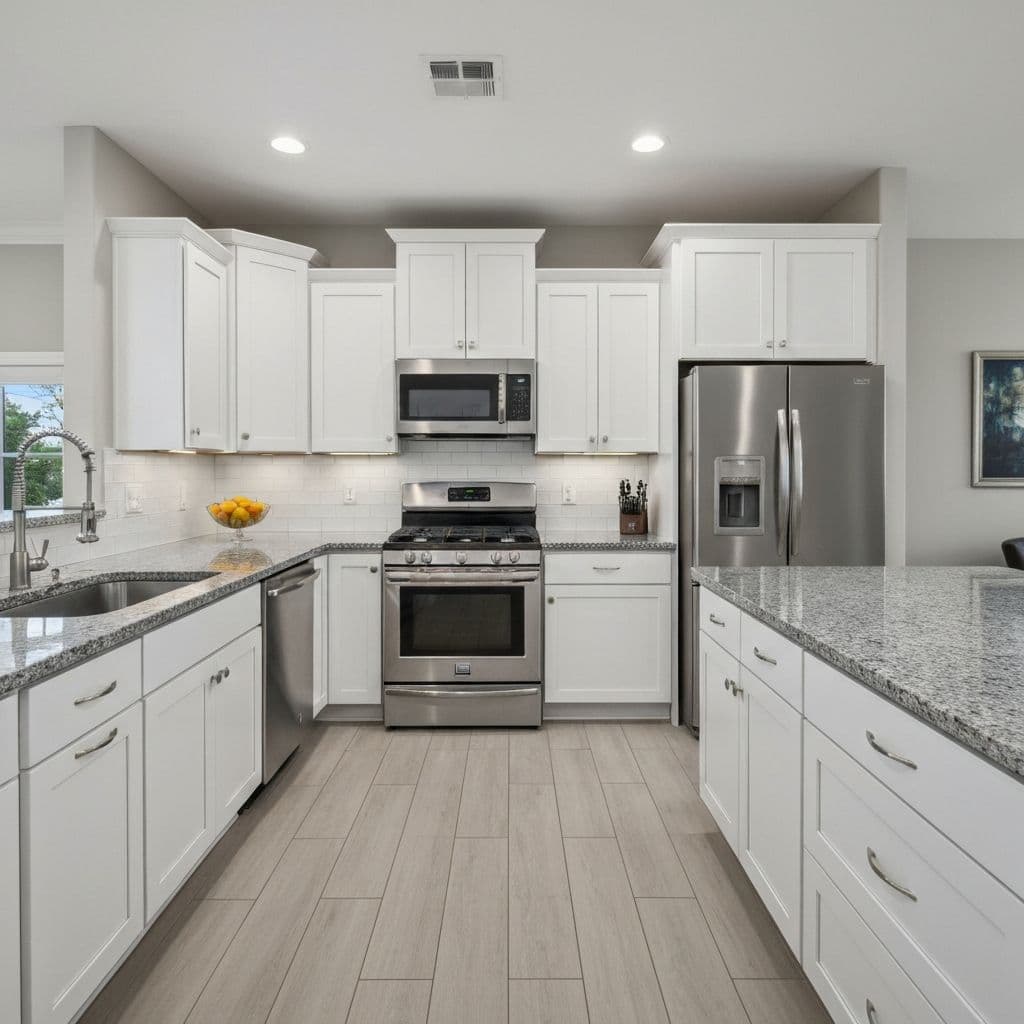
Granite is an igneous rock — molten magma that cooled slowly deep in the Earth's crust over millions of years, crystallizing into an interlocking mesh of quartz, feldspar, and mica with smaller amounts of other minerals. That crystalline structure is what makes it hard: granite typically registers 6 to 6.5 on the Mohs hardness scale, well above a steel knife blade at around 5.5. It formed under extreme heat, which is exactly why a hot pan doesn't faze it.
Because it's quarried from mountainsides around the world — Brazil, India, Italy, and beyond — every granite slab is one of a kind. The mineral mix present when that particular pocket of magma cooled determines its color and movement, so no two slabs are identical and no pattern can ever be reordered. We keep 200+ colors and 2,000+ slabs in stock at our Durham showroom, from the flowing white-and-gray of Colonial White, to the deep charcoal of Steel Gray in a leathered finish, to the near-black of Absolute Black. Our popular granite colors guide walks through the current favorites.
What Is Quartz?
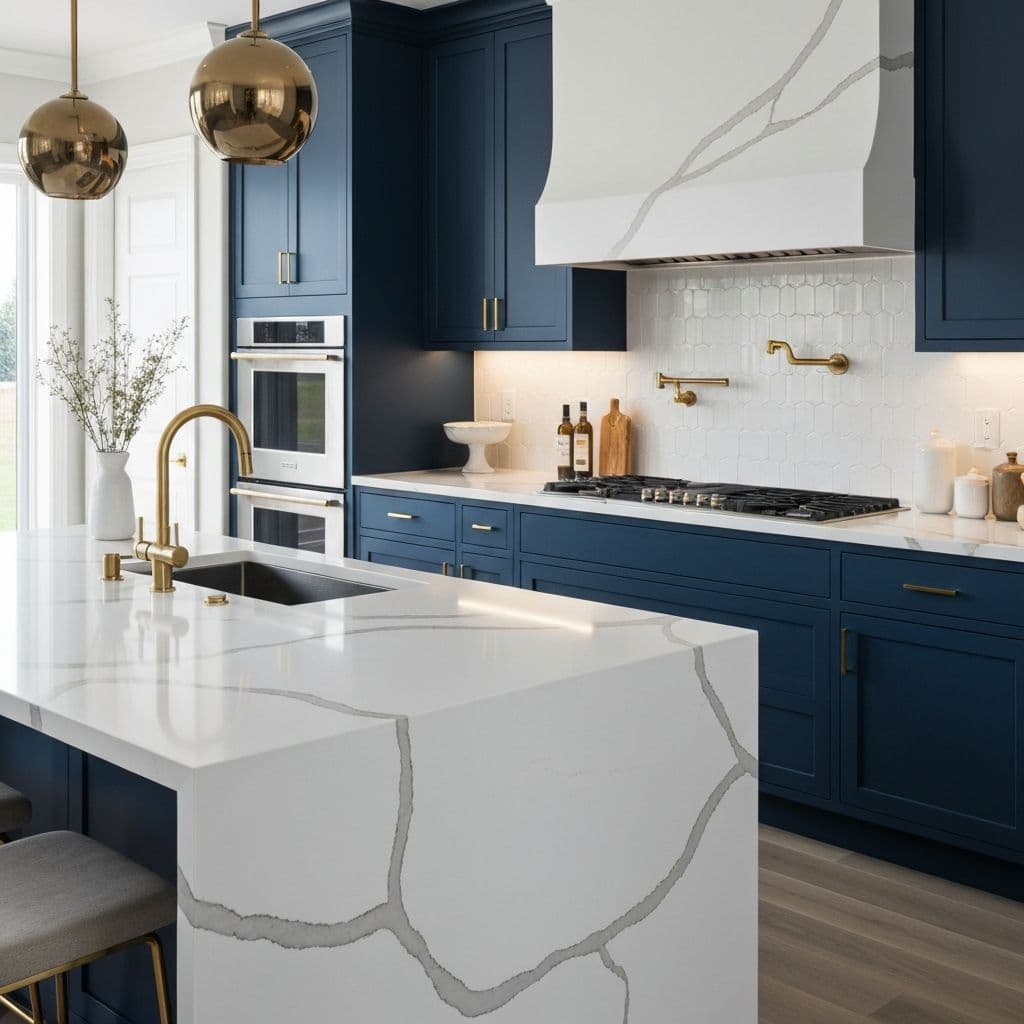
Engineered quartz is a manufactured surface: roughly 90 to 94% ground natural quartz crystals blended with about 7 to 10% polymer resin, plus pigments and sometimes recycled glass or metallic flecks. That mix is compacted under intense vibration, vacuum, and pressure, then cured into a slab — a process first patented as Bretonstone technology in Italy in the 1960s. The result is a surface that is completely non-porous and never needs sealing.
Manufacturing in a factory gives quartz its defining advantage: consistency. Slab one and slab forty of a given color are essentially identical, which makes seaming a large island, matching a backsplash, or extending the counter in a future remodel far more predictable than with natural stone. It also means the design range isn't limited to what nature produces — pure arctic whites, true blacks, concrete looks, and calibrated marble-inspired veining are all on the table. Premium lines from Cambria, Silestone, Caesarstone, and MSI Q Quartz have become remarkably convincing, and our quartz brand comparison breaks down how they differ.
The trade-off lives inside all that engineering: the resin. Those polymer binders are what make quartz forgiving and non-porous, but they are essentially plastic — and plastic doesn't love heat or ultraviolet light. Hold that thought; it drives two of the biggest differences ahead.
Granite vs Quartz: Side-by-Side
| Granite (Natural) | Quartz (Engineered) | |
|---|---|---|
| Composition | 100% natural igneous rock | ~90–94% ground quartz + resins & pigments |
| Hardness | Very hard (Mohs 6–6.5) | Hard (quartz ~7; resin binder is softer) |
| Heat resistance | Excellent — hot pans won't harm it | Moderate — resin scorches near 300°F; use trivets |
| Stain resistance | Good when sealed | Excellent — non-porous, never needs sealing |
| Maintenance | Reseal every 1–3 years | Soap and water — nothing else |
| Appearance | One-of-a-kind; every slab differs | Consistent and predictable slab to slab |
| Outdoor / UV | Stable — fine for outdoor kitchens | Not recommended — resin can yellow |
| Cost installed | $45–$100+ per sq ft | $50–$150+ per sq ft |

Appearance: One-of-a-Kind vs Consistent
This is where personality decides the vote. Granite gives you a slab nothing else on Earth will match — real depth, unrepeatable movement, mineral flecks that catch light differently as you cross the room. If you love the idea of a counter that is uniquely yours, granite delivers it in a way no factory can. The flip side: what you see on the slab is what you get, variation and all, and you have to tag your actual slabs rather than trust a 3-inch sample.
Quartz gives you exactly the sample you picked, across every square foot. For a big open kitchen with a run of counter, a waterfall island, and a full-height backsplash all in one material, that predictability is a real design advantage. Modern quartz also nails looks granite can't — the crisp white-and-gray marble aesthetic that dominates 2026 kitchens, seamless solid colors, honed matte finishes. The ceiling is that it can look a touch uniform up close, and budget lines can read flat. Our countertop trends report covers where both materials land this year.
Durability: Scratches, Chips & Cracks
Both materials will outlast the cabinets they sit on. They just earn it differently. Scratch resistance is effectively a tie — granite at Mohs 6–6.5 and quartz's quartz content at ~7 both shrug off normal kitchen contact, and neither should ever meet your knife directly because the blade loses that fight, not the stone. Dragging cast iron across quartz can leave faint marks in the softer resin that granite wouldn't show, but in practice both surfaces resist scratching far better than daily use demands.
Chip resistance leans slightly to quartz. Granite is rigid and crystalline, so a heavy pot dropped squarely on an edge or a sink-cutout corner can chip it; the resin in quartz adds a little flex that absorbs impact, making edge chips less common. When chips do happen, both repair well in place with color-matched epoxy — granite repairs tend to disappear more completely because the stone's natural variation hides them. Cracks in either material almost always trace back to fabrication or installation error, not the surface itself, which is why choosing the right shop matters as much as choosing the right stone — see our 7 questions to ask a fabricator.
Heat Resistance: Granite's Clear Win
If you remember one difference from this article, make it this one. Granite handles heat like the rock it is. It formed at temperatures far beyond anything a home kitchen produces, so a 400-degree pan set straight from the burner onto a granite counter will not scorch, discolor, or crack it. For cooks who habitually park hot cookware on the counter without reaching for a trivet, that resilience is worth real money.
Quartz is the opposite story. The resin binders start to soften and discolor around 300°F (150°C) — a threshold any skillet, Dutch oven, or air-fryer basket easily clears. Direct contact with hot cookware can leave a permanent white or yellowish scorch ring, and severe thermal shock can even crack the slab. Every quartz manufacturer's warranty excludes heat damage for exactly this reason. The fix is simple — trivets and hot pads, every single time — but it has to be a habit the whole household keeps, teenagers and holiday guests included. Be honest about whether that will actually happen in your kitchen.
Stains, Porosity & Sealing: Quartz's Clear Win
Here the tables turn completely. Quartz is non-porous — there are no microscopic channels for wine, coffee, oil, or turmeric to soak into. Spills sit on the surface until you wipe them, whether that's in ten seconds or the next morning, and there is no sealing, ever. For a busy family kitchen or a rental, that set-it-and-forget-it quality is quartz's single strongest argument.
Granite is slightly porous and needs periodic sealing — realistically every one to three years, depending on the stone and how hard the kitchen is used. Sealing is a genuinely easy job: wipe on a quart of impregnating sealer, let it sit, buff it off, done in about 15 minutes for a typical kitchen at a cost of maybe $15. To check whether yours needs it, drop a tablespoon of water on the counter and wait 15 minutes — if it beads, you're sealed; if it soaks in and darkens the stone, it's time. Denser granites like Absolute Black barely absorb anything and may go years between sealings; lighter, more crystalline stones need it more often. Either way, an unsealed granite counter doesn't fail — it just becomes more vulnerable to oil and wine stains until you re-seal. Our countertop cleaning and stain guide covers day-to-day care for both surfaces.
Everyday Cleaning
Day to day, the two are closer than people expect. Both clean with warm water, a soft cloth, and a little dish soap or a pH-neutral stone cleaner. Both dislike the same things: abrasive scrubbing pads that dull the polish, and harsh chemicals — bleach, ammonia, glass cleaner, degreasers, anything acidic — which strip granite's sealer and can dull quartz's resin over time. Neither wants a bathroom cleaner or a scouring powder anywhere near it. If you can commit to gentle cleaners, upkeep is a non-issue for both.
Cost: What You'll Actually Pay Installed
In the Raleigh-Durham market, installed granite runs roughly $45 to $100+ per square foot and installed quartz roughly $50 to $150+. Comparing like tiers, quartz usually lands $10 to $30 per square foot higher than a granite of similar visual quality — for an average 40-square-foot kitchen, that's a few hundred to around a thousand dollars of difference. Entry-level granite is the lowest-priced premium surface we sell, period.
Two things complicate the simple "granite is cheaper" rule. First, exotic granite — dramatic blues, deep reds, heavily veined lots — can climb past $100 per square foot and cost more than mid-range quartz. Second, premium designer quartz from the top brands can run well into the $100s. Price within each material is driven by slab rarity, thickness (3cm vs 2cm), edge profile, cutouts, and how much seaming your layout requires. Our pricing guide keeps current Triangle-market ranges by material, and the full granite vs quartz resource page has a side-by-side cost breakdown.
Outdoor Kitchens
This one isn't close. Granite is stable under UV and handles the temperature swings of a covered outdoor kitchen well — it's one of the two materials we recommend for grill islands (porcelain being the other). Quartz is disqualified outdoors: sustained sun exposure yellows and can eventually break down the resin binders, and every manufacturer's warranty voids for outdoor installation. If your project includes an outdoor counter, that alone may settle the decision. Our outdoor kitchen countertops guide goes deeper.
Resale Value
Both are safe resale choices — buyers recognize and search for both names, and either one reads as a genuine upgrade over laminate or tile. Quartz has become the expected standard in updated mid-market homes, so its absence can read as dated in that segment; granite still carries strong "real stone" appeal, especially with lighter, current colors rather than the busy gold-brown slabs that gave the category a decade-specific reputation. Neither will hurt your home's value. For a flip or rental, choose whichever fits the neighborhood's price point; for a forever home, choose the one you'll enjoy living with.
The Radon and Silica Questions
Two health concerns come up often enough to address directly. Radon from granite countertops: multiple studies, including work by the EPA, have found that radon emitted by granite countertops is negligible — far below levels of concern for a home. It's not a reason to avoid granite. Silica dust from cutting quartz: this is a real occupational hazard, but it affects fabrication-shop workers, not homeowners — engineered stone contains very high crystalline silica, and shops must cut it wet with proper dust control and respiratory protection to keep workers safe. A finished, installed quartz counter poses no silica risk to your family. It's worth asking any fabricator how they protect their crew; a shop that takes it seriously tends to take everything else seriously too.
Which Should You Choose?
- Busy family, minimal upkeep, spills happen: Quartz. Non-porous, no sealing, no habits to enforce beyond trivets.
- Serious cook who puts hot pans on the counter: Granite. Full heat immunity, no trivet discipline required.
- Best real-stone look for the money: Entry-level granite — the lowest-priced premium surface there is.
- Large open kitchen, waterfall island, matching backsplash: Quartz, for slab-to-slab consistency.
- Outdoor kitchen or grill island: Granite. Quartz is out — UV degrades the resin.
- You want a counter that's unmistakably one-of-a-kind: Granite. Every slab is unrepeatable.
- Prepping the house to sell in a mid-market neighborhood: Quartz, the expected standard for that buyer.
- You hate the idea of sealing anything, ever: Quartz — genuinely zero maintenance.
If we're forced to generalize: quartz is the better default for most households because its one real weakness is solved by a $10 trivet, while granite is the better choice for heavy-cooking kitchens, outdoor spaces, tight budgets, and anyone who wants genuine one-of-a-kind stone. But the honest answer depends on your kitchen, and that's a conversation and a slab yard, not a search result.
See Both in Person
Photos flatten the difference between these two materials — depth, sheen, and how a slab's movement plays across a real counter only read in person. Visit our Durham showroom to compare granite and quartz side by side, serving the entire Triangle from Raleigh and Durham to Cary, Apex, and beyond. Browse real local installations in our portfolio, test looks in the visualizer, or go straight to a free, no-obligation quote.