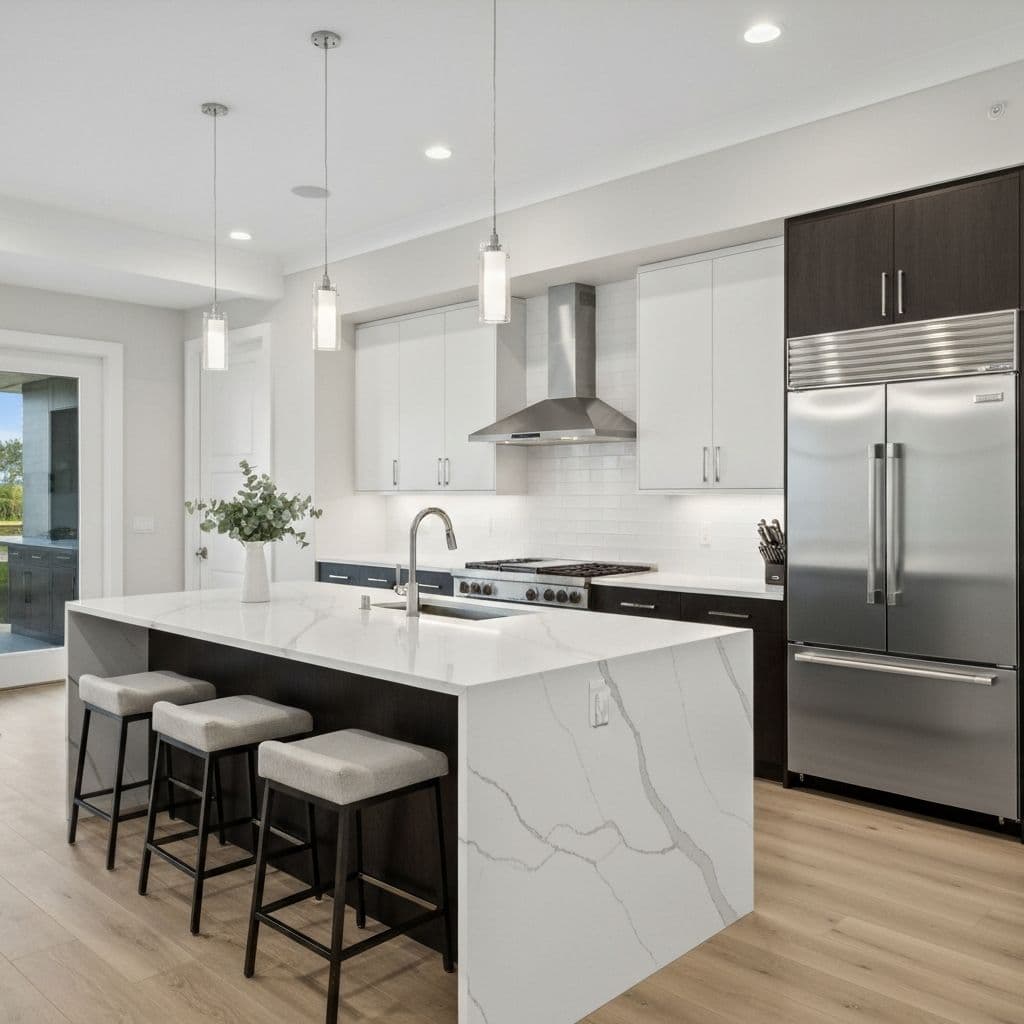
Of every decision in a kitchen countertop project, the sink gets the least thought and does the most work. It's used more times a day than the stove, it's the one fixture that has to physically integrate with the stone rather than just sit on top of it, and — this is the part that catches people off guard — it has to be chosen before the counter is cut, not after. We say this constantly during template appointments: once a sink cutout is milled to a specific model's dimensions, swapping to a different sink later ranges from awkward to impossible without re-cutting stone.
This guide walks through the decision properly: the four mounting styles and who each suits, the material options and how they actually perform over years of daily use, bowl configuration, sizing math, and how your sink choice interacts with the countertop material you've picked. If you're mid-way through a countertop replacement or planning one, read this before your template appointment — it's the cheapest design consulting available, and it prevents the one mistake that's hardest to fix after the fact.
Why Sink Choice Can't Wait Until Later
Here's the mechanical reality: for an undermount sink, the fabricator cuts a hole in the stone slab matched precisely to your specific sink model's outer dimensions, then polishes that cut edge before the sink is mounted beneath it. That cutout is permanent. A different sink — even one that looks similar in a showroom — almost always has different dimensions, mounting clips, or basin depth, meaning the original cutout won't fit it correctly. This is exactly why every countertop replacement guide and process walkthrough we publish repeats the same instruction: have your sink chosen, and ideally on-site, before the template appointment.
The same logic applies one level up to faucets: hole count and spacing are drilled to your specific faucet's spec sheet. A widespread three-hole faucet, a single-hole modern fixture, and a wall-mounted faucet each demand different (or zero) holes through the stone. Choosing the faucet after the counter is installed is the second most common regret we see after sink timing — plan both together, before fabrication begins.
Mounting Style #1: Undermount — The Modern Default
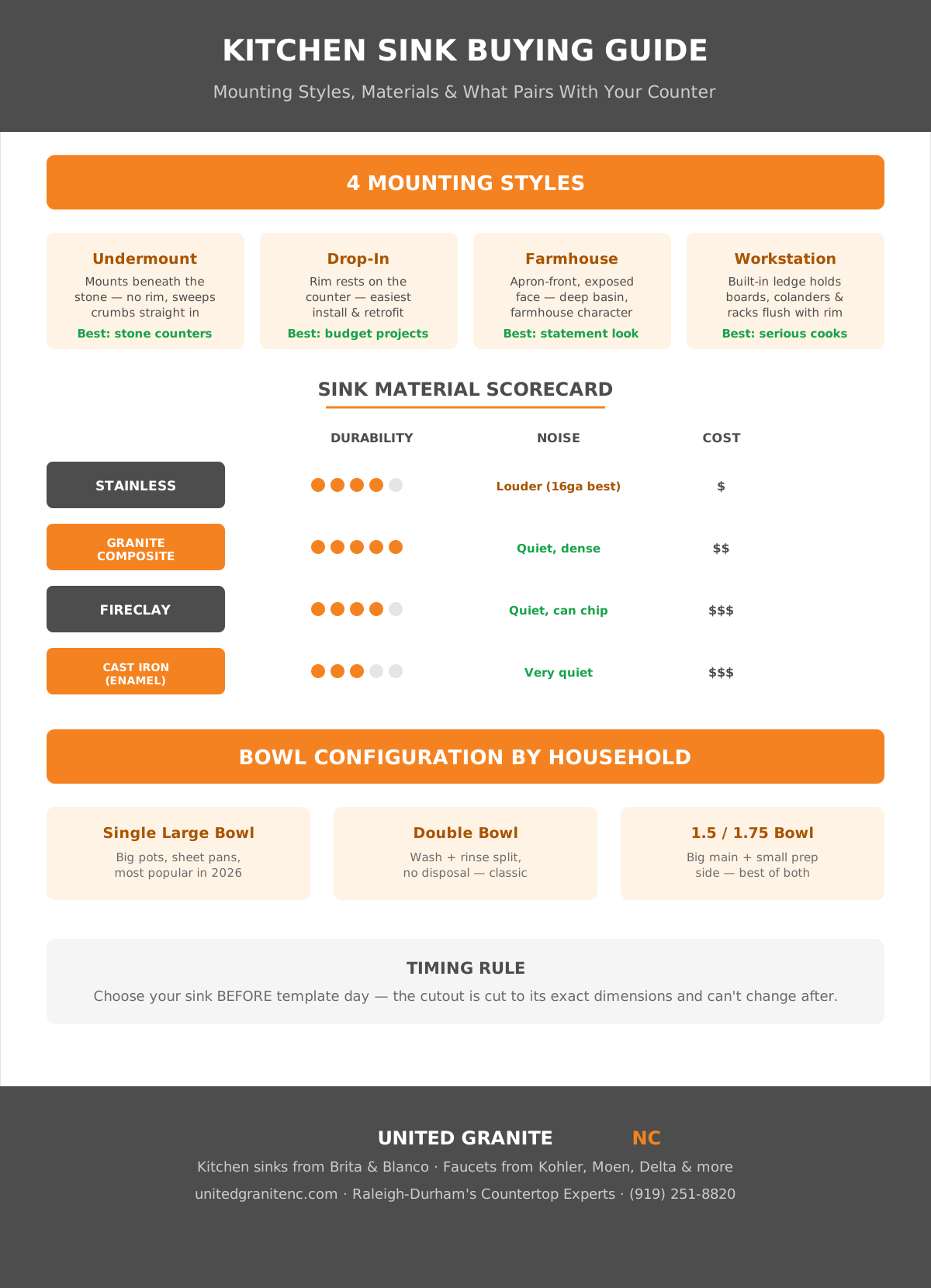
Undermount is what most homeowners picture when they imagine a modern kitchen sink, and for good reason. The sink mounts to the underside of the stone, so there's no rim interrupting the countertop surface — you can sweep crumbs and spilled liquid directly from the counter into the basin with the edge of your hand, no lip to catch debris. The stone's cut edge gets polished smooth around the opening, giving a clean, continuous look that pairs naturally with any of the materials in our countertop materials guide.
The catch: undermount sinks require a solid-surface material to mount to. They work beautifully with granite, quartz, quartzite, and porcelain, but they're not compatible with laminate, which lacks the structural integrity to support the sink's weight from below without a rim for reinforcement. This is exactly why undermount sinks are the near-universal upgrade homeowners make the moment they move from laminate to real stone — it's often the single most requested change during a countertop replacement.
Mounting Style #2: Drop-In (Self-Rimming) — Budget & Retrofit Friendly
Drop-in sinks have a visible rim that rests directly on top of the counter opening, holding the sink in place by its own weight and a bead of sealant — the simplest, most economical mounting style and the easiest to install or swap without touching the stone. It's compatible with every countertop material including laminate and tile, which makes it the default for budget renovations, rental properties, and any project where the counter itself isn't being replaced.
The tradeoff is exactly what undermount solves: that visible rim collects grime along its edge over years of use, and wiping counters into the sink means navigating around the lip rather than sweeping straight through. For a kitchen getting new stone counters, we rarely recommend drop-in purely because undermount is available and objectively easier to keep clean — but if you're not replacing the counter itself, or budget is the deciding factor, drop-in remains a perfectly functional, proven choice.
Mounting Style #3: Farmhouse (Apron-Front) — Statement & Deep Capacity
Farmhouse sinks expose their front face where cabinetry would normally be, creating a distinctive apron look that's become a design signature of modern-traditional kitchens — a strong pairing with the warm, natural-stone aesthetic covered in our 2026 trends report. Beyond looks, farmhouse basins run genuinely deep, easily swallowing stockpots, sheet pans, and oversized mixing bowls that crowd a standard sink.
Installing one is a bigger commitment than swapping a standard sink: it requires specific cabinet modifications (a lowered or notched base cabinet to accommodate the exposed apron), and it's a decision best made early in a kitchen renovation rather than added as an afterthought to existing cabinetry. If a farmhouse sink is on your wish list, raise it at the very first design conversation — it affects cabinet layout as much as countertop template.
Mounting Style #4: Workstation — Built for Serious Cooks
Workstation sinks are the newest major category, and they solve a real problem: kitchen counter space disappears fast during meal prep. A workstation sink includes a built-in ledge system, usually a set of grooves along the basin's rim, that holds accessories — cutting boards, colanders, drying racks — flush with or just below the counter's surface, effectively expanding your usable workspace over the sink itself. For anyone who cooks seriously or simply wants more functional square footage in a kitchen that can't grow physically, it's a genuine upgrade rather than a gimmick.
Workstation sinks are almost always installed undermount, combining both benefits — no rim, plus the built-in accessory system — and they pair naturally with the single-large-bowl configuration discussed below, since the ledge system needs an uninterrupted basin to span.
Sink Materials: What Actually Holds Up
| Material | Durability | Noise Level | Maintenance | Typical Cost |
|---|---|---|---|---|
| Stainless Steel | Very good (16-gauge best) | Louder without padding | Low — wipe clean | $ |
| Granite Composite | Excellent — dense, non-porous | Quiet | Low — non-porous | $$ |
| Fireclay | Excellent — glazed, chip-resistant | Quiet | Low, avoid abrasives | $$$ |
| Cast Iron (Enamel) | Good — enamel can chip over decades | Very quiet — heavy mass | Moderate — avoid scouring | $$$ |
Stainless steel remains the most popular kitchen sink material for good reason: it's affordable, hygienic, resistant to heat and stains, and available in nearly every configuration. The detail that separates a good stainless sink from a disappointing one is gauge — the lower the number, the thicker (and more expensive) the steel. 16-gauge is the standard for a quality kitchen sink; 18-gauge is acceptable for lighter use; anything higher tends to flex, dent, and resonate noisily under running water and disposal use. Sound-dampening pads on the underside, standard on quality sinks, make a real difference in day-to-day noise.
Granite composite sinks — crushed natural stone bound with resin, the same family of engineering behind engineered quartz counters — deliver a dense, non-porous surface that resists scratching, staining, and heat far better than stainless, while running significantly quieter thanks to their mass. They're an excellent pairing with stone counters aesthetically, since color-matched options let the sink disappear into the design rather than standing out as a separate fixture.
Fireclay sinks are ceramic clay fired at extremely high temperatures and finished with a glossy glaze — genuinely beautiful, classic-looking, and highly chip-resistant against everyday use, which is why they're the standard choice for farmhouse-style basins. Like any glazed ceramic, a hard, sharp impact can chip the glaze, though it takes real force. Cast iron with porcelain enamel offers similar old-world charm with even more mass and quiet operation, at a premium price point, and while the enamel coating is durable, decades of abrasive cleaning can eventually wear it thin — stick to non-abrasive cleaners, the same rule covered for stone counters in our cleaning guide.
Bowl Configuration: Single, Double, or 1.5?
- Single large bowl: The dominant choice in 2026 kitchen design — one uninterrupted basin easily fits sheet pans, stockpots, and oversized cookware that a divided sink can't accommodate. Pairs naturally with workstation accessory systems and modern minimalist counters.
- Double bowl (equal or unequal): The classic configuration, splitting wash and rinse duties or separating food prep from dishwashing. Still popular in households without garbage disposals, where one side handles food scraps separately from dishes.
- 1.5 or 1.75 bowl: A hybrid that gives you a full-size main basin plus a smaller secondary bowl for draining, prep, or handling produce — genuinely the best-of-both option for households torn between single and double configurations.
- Prep or bar sinks: A secondary smaller sink, often paired with an island or wet bar, for a second work zone during entertaining. Covered further in our bar sink options.
Sizing: The Numbers That Matter
Standard kitchen sink cabinets run 30–36 inches wide, which accommodates most single and double-bowl sinks with room for the cabinet's structural framing on either side. Basin depth has trended deeper over the past decade — 9–10 inches is now common versus the 7–8 inches once standard — deep enough to fully submerge stockpots and sheet pans without splashing over the edge, though very deep basins mean more bending for shorter members of the household, worth testing in a showroom mockup rather than judging from a spec sheet alone.
For undermount installations specifically, remember that the visible opening in your countertop is slightly smaller than the sink's actual outer dimensions, since the stone overlaps the basin's edge by roughly half an inch to an inch for structural support. This is exactly the kind of detail your fabricator accounts for at template — but it's also why sink dimensions from a spec sheet don't map directly to the hole you'll see in the finished counter, and why sending your exact chosen model (not just a size range) to your fabricator before template day matters.
Matching Your Sink to Your Countertop Material
Sink and counter make joint decisions in a few specific ways. Granite, quartz, and quartzite all support undermount installation without restriction — the main variable is simply how the sink's cutout edge is finished (a polished reveal is standard, though some designs hide the edge entirely with a specific rim detail). Porcelain, being thinner than traditional stone, occasionally needs a reinforced edge detail around the cutout for structural support — a conversation to have with your fabricator if you're pairing porcelain with undermount, covered further in our porcelain guide. Laminate and tile counters are restricted to drop-in sinks, since they lack the rigidity to support an undermount basin's weight from below without the rim's structural assistance.
One material-specific tip: light-colored stone counters (creamy quartzite, white quartz — the warm neutrals leading 2026 design trends) pair especially well with a dark or stainless sink for visual contrast, while a color-matched granite composite sink can make a dark stone counter feel even more monolithic and seamless. Neither is objectively correct — it's a design call worth making with a physical sample in hand rather than from a photo.
Faucets: The Decision That Rides Along
Faucet choice locks in alongside the sink at template, since hole count and spacing are drilled specifically for your chosen fixture. A single-hole faucet is the cleanest, most modern option and the most forgiving if you might switch faucets down the road. Widespread faucets (separate hot and cold handles with a center spout) need three holes at a specific spread, typically 8 inches. Wall-mounted faucets, increasingly popular for their minimalist look, need zero holes through the counter at all — an elegant solution for a workstation sink where deck space matters. Don't forget secondary holes: soap dispensers, filtered-water taps, and air gaps for dishwashers all need to be planned before the stone is cut, not requested afterward.
We carry faucets across kitchen, bar, and bathroom applications — browse the full range on our faucets page, and bring your chosen model (or at least its spec sheet) to your template appointment.
Corner Radius, Drain Placement & the Small Details That Add Up
Beyond the headline decisions, a handful of quieter specs shape how a sink actually feels to use for the next twenty years. Corner radius — how sharply or gently a basin's internal corners curve — affects both cleanability and capacity. Tight, nearly-square corners (a 0- or D-shaped radius) maximize usable volume and make it easier to slide a full sheet pan flat against the bottom, a detail serious cooks specifically request. Rounded, generous corners are easier to wipe clean by hand and read as softer, more traditional. Neither is wrong, but it's worth handling a floor sample rather than judging from a photo, since the difference is more tactile than visual.
Drain placement matters more than it seems. A centered drain is the traditional default and works fine for most single-bowl configurations, but an offset or rear drain — positioned toward the back of the basin — frees up storage space directly beneath the sink, since the plumbing trap sits further back in the cabinet rather than dead center. If under-sink storage is tight in your kitchen, ask specifically about rear-drain models; it's a small spec that meaningfully changes how much you can actually fit in that cabinet.
Basin texture is the last detail worth a moment's thought. Most stainless sinks come in a satin or brushed finish that hides water spots and light scratching well; a small number of premium models offer a smoother, more polished interior that shows every drop until wiped, trading practicality for a showroom-glossy look. Granite composite and fireclay sinks sidestep this entirely, since their surface texture is baked into the material rather than a separate finishing step.
Accessibility & Multi-Generational Sink Considerations
If your household spans generations or you're planning to age in place, sink choice carries some of the same considerations we cover in our bathroom vanity guide. A shallower basin (7–8 inches rather than the deeper 9–10 inch trend) reduces bending and reaching for shorter users or anyone with limited mobility, while a single-lever or touchless faucet beats a two-handle widespread design for users with limited hand strength or dexterity. Pull-down or pull-out faucet heads add flexibility for filling tall pots without lifting them to the spout, a small feature that matters more than it sounds like on paper. None of these choices compromise a kitchen's design — touchless and single-lever faucets are already mainstream in contemporary kitchens — which makes this an easy category to build in without the kitchen announcing an accessibility agenda.
Common Sink-Buying Mistakes
- Choosing the sink after the counter is templated. The cutout is cut to one specific model's dimensions — this is the single most expensive mistake to fix after fabrication.
- Assuming any undermount sink fits any stone counter. Porcelain and very thin engineered slabs sometimes need reinforced cutout details — confirm compatibility before falling in love with a specific model.
- Underestimating basin depth in a showroom. A sink that looks reasonably deep on a display can feel shallow or excessively deep once installed at your actual counter height — check dimensions against your own comfort, not just the spec sheet.
- Skipping the faucet-hole conversation. Deciding on a wall-mounted faucet after a three-hole widespread faucet's holes are already drilled means living with unused holes or an expensive stone repair.
- Choosing thin-gauge stainless to save money. An 18- or 20-gauge sink flexes and resonates noticeably more than 16-gauge — a small cost difference with a daily, permanent noise consequence.
- Picking a farmhouse sink without checking cabinet compatibility. The apron front requires specific cabinet modifications; confirm this early if the counter and cabinets aren't both being replaced together.
Bringing It Together: Sink Choice as Part of Your Countertop Project
The sink isn't a separate purchase from your countertop — it's one integrated decision that happens to involve two different products. The right sequence: choose your countertop material using our materials comparison, choose your sink and faucet using this guide, then bring both to your quote and template appointments so everything gets fabricated correctly the first time. If you're planning a full countertop replacement or bathroom vanity project, this is exactly the homework that makes template day fast and mistake-free.
Browse our full range of kitchen sinks, bathroom sinks, bar sinks, and faucets, or visit the showroom to see sink and countertop pairings in person — we serve the entire Triangle, from Raleigh and Durham to Cary, Apex, Chapel Hill, and beyond. Ready to move forward? Start with a free quote and mention your sink preferences up front — it's the detail that keeps your project on schedule.