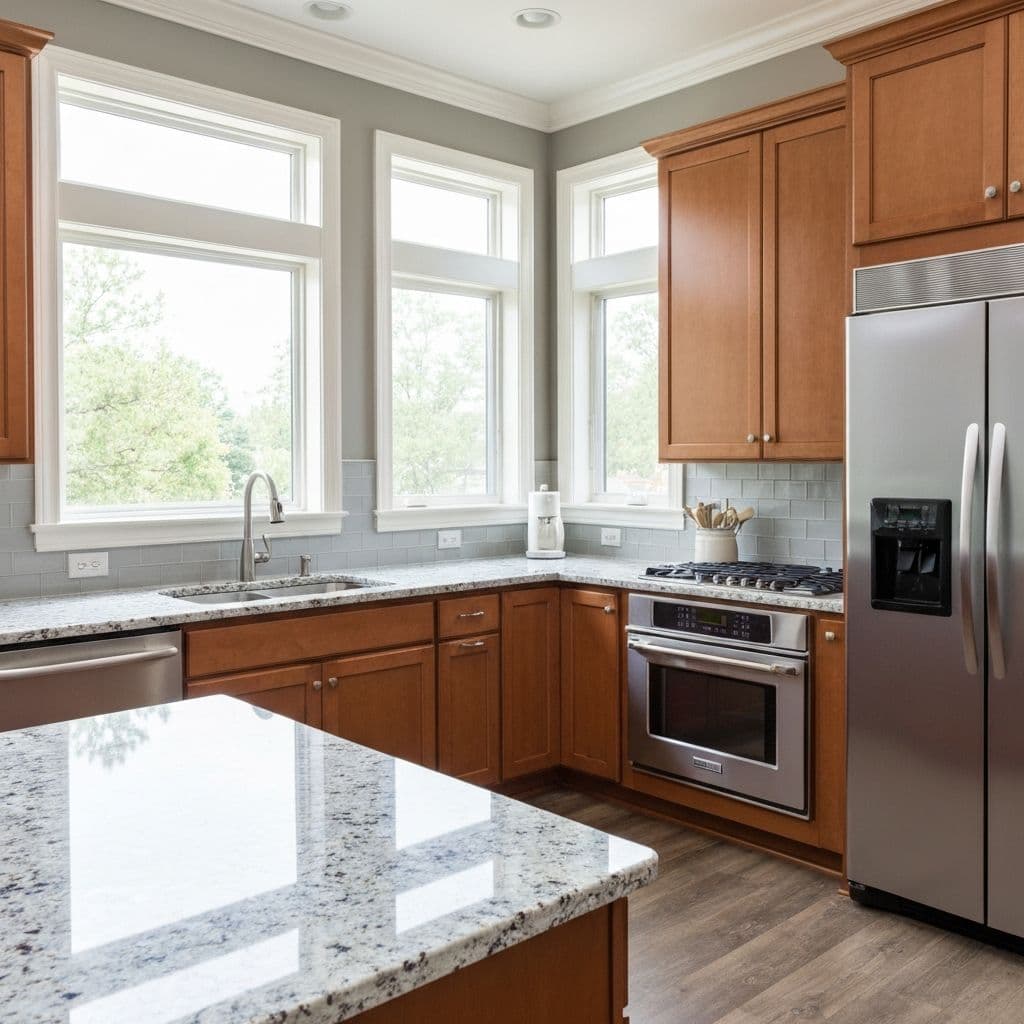
Countertop shopping throws a lot of vocabulary at you fast: igneous, metamorphic, non-porous, Mohs, sintered, honed, 3cm, mitered. Salespeople assume you know it; brochures don't explain it. This guide is the primer we wish every homeowner had before their first showroom visit — a plain-English rundown of what each major countertop material actually is, how it's made, and how it behaves in a real kitchen.
We fabricate and install all of these surfaces in our Durham shop, so this isn't a pitch for one of them. Think of it as the map you read before picking a route. Once the materials make sense, our best kitchen countertop materials ranking compares them head to head, and our granite vs quartz comparison settles the most common matchup.
The Two Big Families: Natural vs Engineered
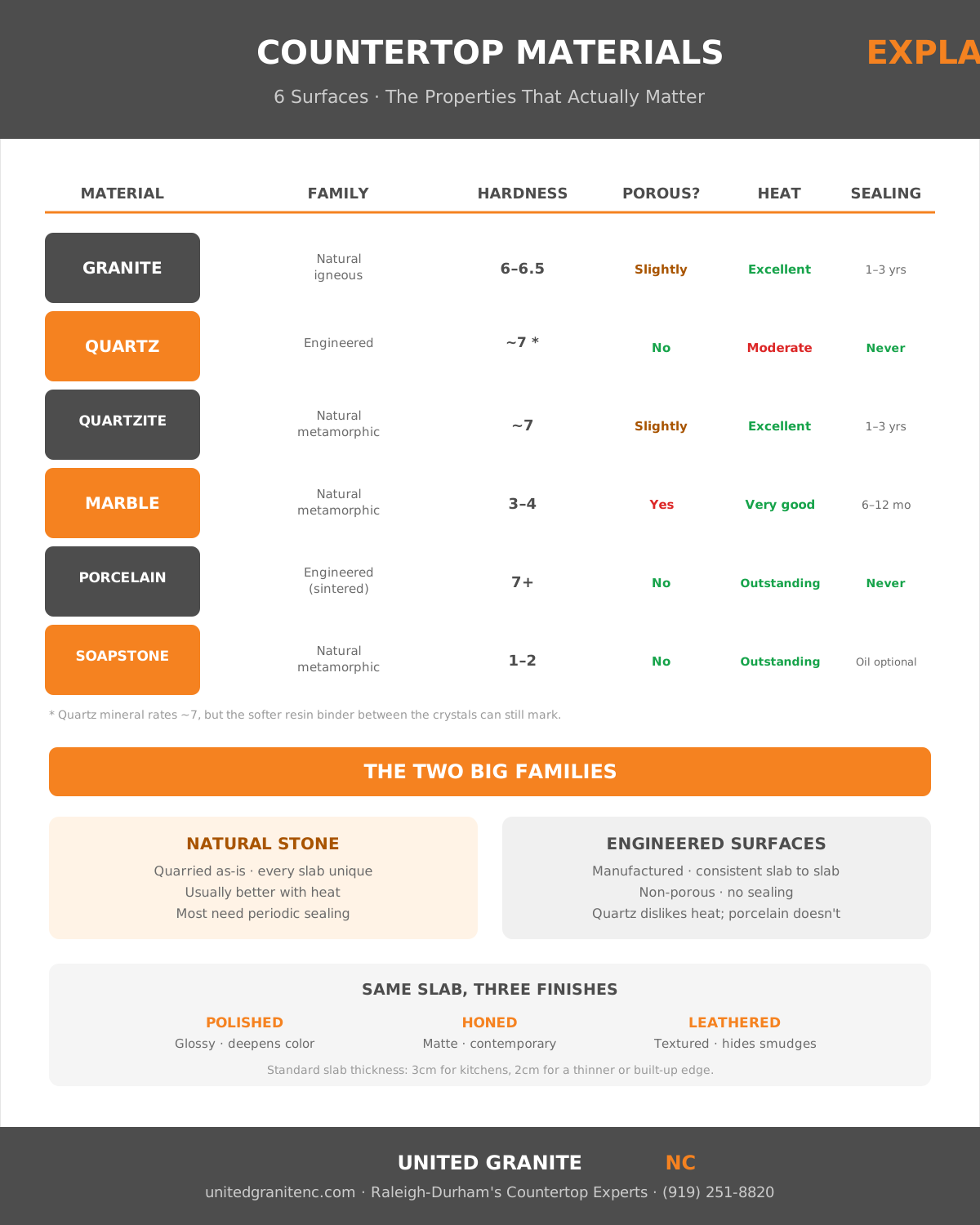
Almost every countertop material belongs to one of two families. Natural stone — granite, quartzite, marble, soapstone, onyx — is quarried from the earth as-is and cut into slabs. Each slab is unique, formed over millions of years, and its properties are whatever geology gave it. Engineered surfaces — quartz and porcelain (also called sintered stone) — are manufactured: raw materials are ground up, combined with binders or fired at high heat, and pressed into slabs with controlled, repeatable properties.
The trade-off between the families is consistent: natural stone gives you one-of-a-kind beauty and, usually, better heat resistance, at the cost of some maintenance and slab-to-slab variation. Engineered surfaces give you predictability and low maintenance, at the cost of individuality and — for quartz specifically — heat sensitivity.
How to Read a Material's "Spec Sheet"
Six properties tell you almost everything about how a countertop will live in your kitchen. Learn these and you can evaluate any slab:
- Composition & origin: what it's made of and whether it's quarried or manufactured. This drives everything else.
- Hardness (Mohs scale): a 1–10 measure of scratch resistance. A steel knife is about 5.5, so anything above that can't be scratched by a blade. Granite is 6–6.5, quartzite and quartz around 7, marble 3–4, soapstone 1–2.
- Porosity: whether liquids can soak in. Porous surfaces need sealing to resist stains; non-porous ones never do.
- Heat tolerance: whether you can set a hot pan directly on it. Natural stone generally yes; anything with polymer resin (quartz) generally no.
- UV stability: whether sunlight fades or degrades it. Matters for sunny kitchens and rules out some materials for outdoor use.
- Cost installed: the real number, including fabrication and installation, in your local market — not the raw slab price.
| Material | Family | Mohs | Porous? | Heat | Sealing |
|---|---|---|---|---|---|
| Granite | Natural igneous | 6–6.5 | Slightly | Excellent | Every 1–3 yrs |
| Quartz | Engineered | ~7 (softer resin) | No | Moderate | Never |
| Quartzite | Natural metamorphic | ~7 | Slightly | Excellent | Every 1–3 yrs |
| Marble | Natural metamorphic | 3–4 | Yes | Very good | Every 6–12 mo |
| Porcelain | Engineered (sintered) | 7+ | No | Outstanding | Never |
| Soapstone | Natural metamorphic | 1–2 | No | Outstanding | Never (oil optional) |
Granite
Granite is an igneous rock — magma that cooled slowly underground and crystallized into a hard mesh of quartz, feldspar, and mica. It rates 6 to 6.5 on the Mohs scale, resists heat completely because it formed in heat, and is slightly porous, so it takes a sealer every one to three years. Every slab is unique; colors range from near-white to deep black with hundreds of variations in between. Granite is the value benchmark for real natural stone and the widest in-stock selection we carry.
Quartz (Engineered Stone)
Quartz is a manufactured slab: about 90–94% ground natural quartz crystals bound with 7–10% polymer resin, plus pigment, pressed and cured into a non-porous surface. It never needs sealing and can't stain. Its quartz content makes it hard (~7 Mohs), but the resin binder is softer and — critically — heat-sensitive, softening and discoloring around 300°F. Because it's made rather than quarried, color is perfectly consistent slab to slab, and the design range includes looks nature doesn't offer. Brands like Cambria, Silestone, and Caesarstone are all engineered quartz with different warranties and finishes.
Quartzite
Quartzite is natural sandstone that heat and pressure fused into an extremely hard metamorphic rock — around 7 on the Mohs scale, harder than granite and harder than a knife. It's fully heatproof, UV-stable enough for outdoor use, and delivers flowing marble-like veining in genuinely one-of-a-kind slabs, which is why designers have crowned it a material of the moment. Like granite, it's slightly porous and needs periodic sealing. One buyer beware: because "quartzite" commands premium prices, softer dolomitic marbles sometimes get mislabeled as quartzite — true quartzite won't scratch with a knife or etch with lemon juice. Our quartzite vs quartz guide explains the full difference between the natural stone and its engineered near-namesake.
Marble
Marble is metamorphosed limestone — the same transformation that makes quartzite, but starting from calcite instead of quartz. That calcite chemistry is the whole story: at Mohs 3–4 it scratches relatively easily, it's genuinely porous, and — the part marketing glosses over — acids like lemon juice, vinegar, and wine chemically *etch* it, leaving dull marks that sealing cannot prevent because etching is a reaction, not absorption. Marble is still the most beautiful surface humans build with (Carrara, Calacatta, Statuario), and for owners who love patina, the way it ages is the appeal. For everyone else, marble-look quartzite, quartz, or porcelain deliver the aesthetic without the fragility.
Porcelain (Sintered Stone)
Porcelain countertops are made from refined clay and natural minerals fired at around 1,200°C — a process called sintering that fuses the particles into an ultra-dense, glass-hard slab. The result has arguably the best raw surface performance of any material: zero porosity (nothing stains, nothing seals), complete heat resistance, full UV stability for outdoor use, and any printed aesthetic from marble to concrete. Slabs come in thin 12mm profiles for a modern architectural look. The caveats: most patterns are printed on the surface rather than running through the slab, edges and corners can chip under sharp impact, and results depend heavily on fabricator skill. Our porcelain countertops guide covers every strength and weakness.
Soapstone
Soapstone is a talc-rich metamorphic stone in charcoals and deep greens with a soft, almost warm feel. Its talc content makes it soft — Mohs 1–2, so it scratches and dents more easily than anything else here — but that same composition makes it naturally non-porous (no sealing ever), completely heatproof, and chemically inert, which is why laboratory counters have been soapstone for a century. Scratches sand out with fine paper and blend into the deepening patina that soapstone owners often enhance deliberately with mineral oil. It's the pick for people who want character and a stone they can maintain themselves forever.
Onyx
Onyx is a translucent natural stone — banded, dramatic, and capable of being backlit so the slab glows from within. It's soft and acid-sensitive like marble, so it's a specialty surface: stunning on a bar face, a powder-room vanity, or a backlit feature wall, not a material for a hard-working kitchen. Worth knowing about, rarely the right call for a primary counter.
The Materials We Don't Fabricate
For completeness, the surfaces outside the stone-and-engineered world: laminate is a printed surface over particleboard — the budget floor, much better-looking than a decade ago, but no heat or knife tolerance. Butcher block is solid wood — warm and repairable, but it needs oiling and vigilance around water. Concrete is poured and sealed — great for a custom industrial look, prone to hairline cracking. Tile has grout lines that never stop being a maintenance point. Stainless steel is the commercial-kitchen choice — hygienic and heatproof, but it scratches and dents and shows every fingerprint. Each has its place; none matches the durability-per-dollar of entry granite.
Finishes: Polished, Honed & Leathered
The same slab looks and feels different depending on how its surface is finished. Polished is the glossy, reflective finish most people picture — it deepens color, resists staining best, and shows water spots and fingerprints most. Honed is a smooth matte finish with no shine — softer and more contemporary, hides etching and wear better, but on lighter porous stones it can absorb stains a little more readily. Leathered (sometimes called brushed or antiqued) has a subtle textured feel with a low sheen — increasingly popular on dark granites like Steel Gray and Absolute Black because it hides fingerprints and smudges almost entirely. Finish is a choice you make per slab, and it changes the room as much as the color does.
Slab Thickness: 2cm vs 3cm
Stone slabs come in two standard thicknesses. 3cm (about 1¼ inch) is the current default for kitchens — strong enough to span most cabinet runs without plywood support and to carry a simple eased or bullnose edge on its own. 2cm (about ¾ inch) is thinner and lighter, common on porcelain and on some quartz, and often used with a laminated (built-up) edge to look like 3cm, or left thin for a deliberately minimal modern profile. Thicker isn't automatically better — it's a look and a structural choice. Your fabricator will recommend based on your layout, overhangs, and the material.
Edge Profiles
The edge is shaped after the slab is cut, and it changes both the look and the price. A simple eased or pencil-round edge is clean and modern and usually included; a beveled edge reads crisp and contemporary; ogee and bullnose profiles are more traditional and cost more to fabricate; a mitered edge folds the material down at the corner for a thick, seamless, waterfall-style look. Decide this early — it affects the quote and the timeline. Our countertop edge profiles guide shows each one.
Why You Should See Full Slabs, Not Samples
A 3-inch sample tells you a material's color family and finish and almost nothing else. Natural stone varies enormously across a single slab — a sample might show tight, calm veining while the full slab has a dramatic river of movement through the middle. Even engineered quartz looks different at scale than it does in your hand. Always view and tag the actual slabs going into your kitchen, especially for granite, quartzite, and marble. It's the single best way to avoid an install-day surprise, and it's exactly what a showroom visit is for.
Putting It Together
Now that the materials make sense, the decision gets easier: match a surface's real properties to how your household cooks, cleans, and lives. For the head-to-head ranking, read our best kitchen countertop materials guide; for the most common single decision, our granite vs quartz comparison; for the full buying process, the countertop buying guide. Then come see and touch every one of these surfaces at our Durham showroom — serving Raleigh, Durham, and the whole Triangle — or start with a free quote.