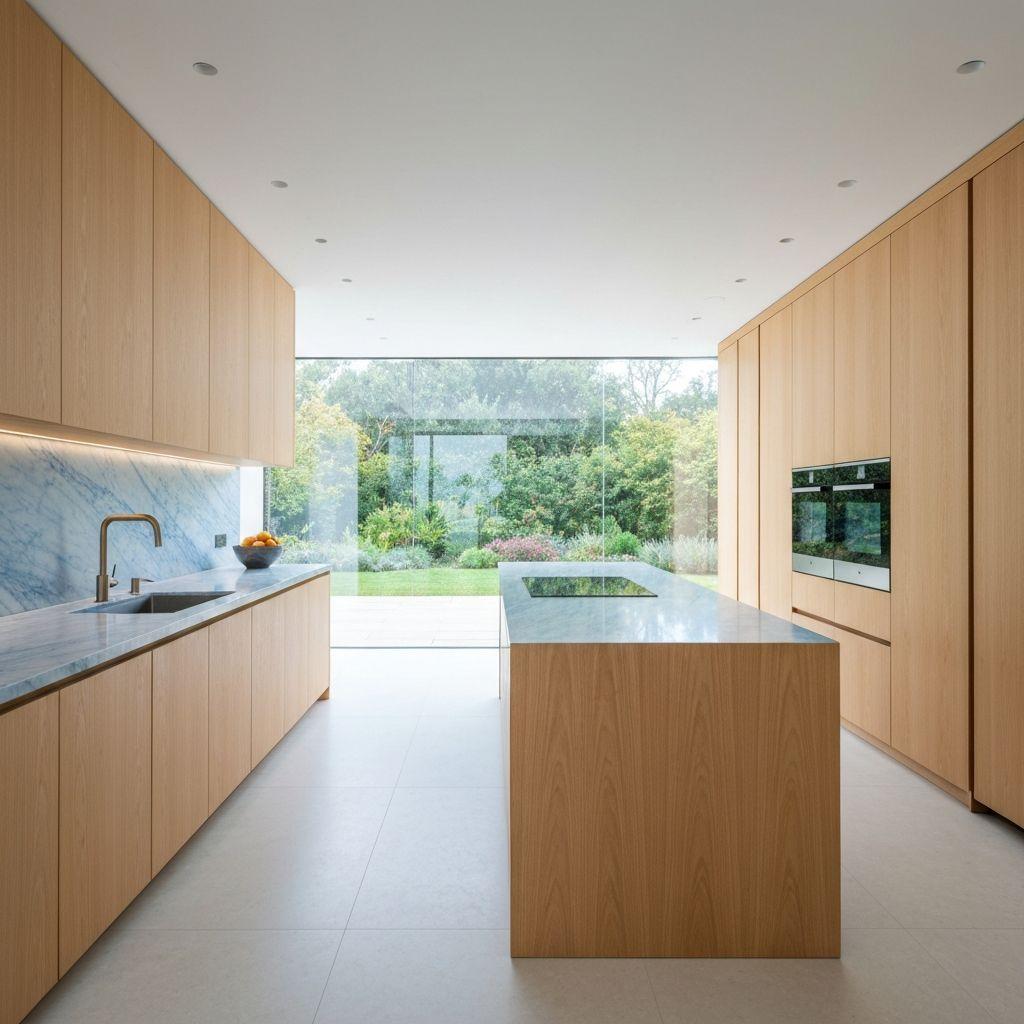
A like-for-like countertop replacement in a Durham or Raleigh single-family home can fall under North Carolina's permit exemption for work that costs $40,000 or less, if the job does not involve the exceptions in G.S. 160D-1110. Moving a sink, changing electrical wiring, or altering a load-bearing structure can still require a permit. Confirm the scope with the office that has jurisdiction over your address before you start.
Key takeaways
- G.S. 160D-1110(c) says no permit issued under Article 9 of Chapter 143 is required for construction, installation, repair, replacement, or alteration costing $40,000 or less in a single-family residence, when the work is performed in accordance with the current North Carolina State Building Code, unless one of the statute's listed exceptions applies.
- Those exceptions include load-bearing work, an addition or change in the design of plumbing, and an addition, replacement, or change in the design of heating, air-conditioning, or electrical systems, with limited like-kind replacements described in the statute.
- The City of Raleigh's residential permit page cites the same statute and states that project cost alone does not determine whether a permit is required.
- Wake County Permits and Inspections serves unincorporated Wake County. Its FAQ describes nonstructural work in a single-family residence, under its stated cost threshold, as not requiring a permit unless new or altered plumbing, mechanical, or electrical systems are involved. Confirm your address on Wake's iMaps tool (planning jurisdiction 'WC' means Wake County). The same FAQ says Wake County also conducts permitting and inspection services for the towns of Rolesville, Wendell, Knightdale, and Zebulon; if you live within those corporate limits, you apply for permits through the town, and Wake County provides the services. Do not assume another municipality is served by the county unless you have confirmed it on iMaps or with the town.
- For a quote on a countertop package, visit United Granite LLC at 2436 S Miami Blvd #200-7, Durham, NC 27703, or request a quote. Permit decisions belong to the building department, not to a showroom visit.
When does North Carolina require a permit for a countertop job?
The starting point is the official text of G.S. 160D-1110, the statewide building-permit statute. Subsection (c) states that no permit issued under Article 9 of Chapter 143 of the General Statutes is required for any construction, installation, repair, replacement, or alteration costing forty thousand dollars ($40,000) or less, performed in accordance with the current edition of the North Carolina State Building Code, in any single-family residence, farm building, or commercial building, unless the work involves one of the items listed in that subsection.
The listed exceptions, in the statute's own categories, include:
- The addition, repair, or replacement of load-bearing structures, with a narrower exemption in the same paragraph for certain window, door, siding, and porch or deck replacements that otherwise meet the subsection.
- The addition or change in the design of plumbing, with a narrower exemption for replacements that do not change size or capacity and that otherwise meet the subsection.
- The addition, replacement, or change in the design of heating, air-conditioning, or electrical wiring, devices, appliances, or equipment, other than like-kind replacement of electrical devices and lighting fixtures.
- The use of materials not permitted by the North Carolina State Building Code.
- The addition of roofing, excluding replacement.
- Any changes to which the North Carolina Fire Code applies.
A countertop replacement that is only a new surface on the existing cabinets, with no plumbing move, no electrical change, and no structural alteration, is the kind of replacement the statute's cost threshold is written to cover, so long as none of those exceptions apply and the work meets the current code. That is a reading of the official categories, not a determination for your house. If the same project also moves a sink, adds an electrical circuit, or opens a load-bearing wall, treat those parts as the items the statute lists, and ask the local office before you bid the job as a no-permit project.
| Official source (opened November 11, 2026) | What it says that matters on a countertop job | How to use it |
|---|---|---|
| G.S. 160D-1110(c) | No permit under Article 9 of Chapter 143 for work costing $40,000 or less in a single-family residence, if it meets the current code and does not involve the listed exceptions | Read the full subsection, including the plumbing and electrical exceptions, before you assume a surface swap is exempt |
| City of Raleigh, Permits - Residential | Permit requirements are based on G.S. 160D-1110, the North Carolina State Building Code, and Raleigh's UDO. Some repair and replacement work may not require a permit when specific conditions are met. Project cost alone does not determine whether a permit is required. Work costing $40,000 or less can still require a permit when it involves load-bearing structures or certain plumbing, heating and cooling, electrical, roofing, or Fire Code-related work | Use this page if the house is inside Raleigh. Call or ask the city if the scope is larger than a surface replacement |
| Wake County Permits and Inspections FAQ | Wake County provides permitting for unincorporated areas of Wake County. The same FAQ says Wake also conducts permitting and inspection services for Rolesville, Wendell, Knightdale, and Zebulon. The FAQ says a permit is not required for nonstructural work where the cost is less than $40,000 in a single-family residence, unless the work involves new or altered plumbing, mechanical, or electrical systems. A plumbing permit is not required for minor repairs or replacements of plumbing fixtures that do not disrupt the original water supply, waste, or ventilation system | Confirm jurisdiction on iMaps (planning jurisdiction 'WC' means Wake County). If you live in Rolesville, Wendell, Knightdale, or Zebulon, you apply through the town, and Wake County provides the services. Note that the FAQ wording is "less than $40,000," while the statute says "$40,000 or less." Ask the department if your cost is at that line |
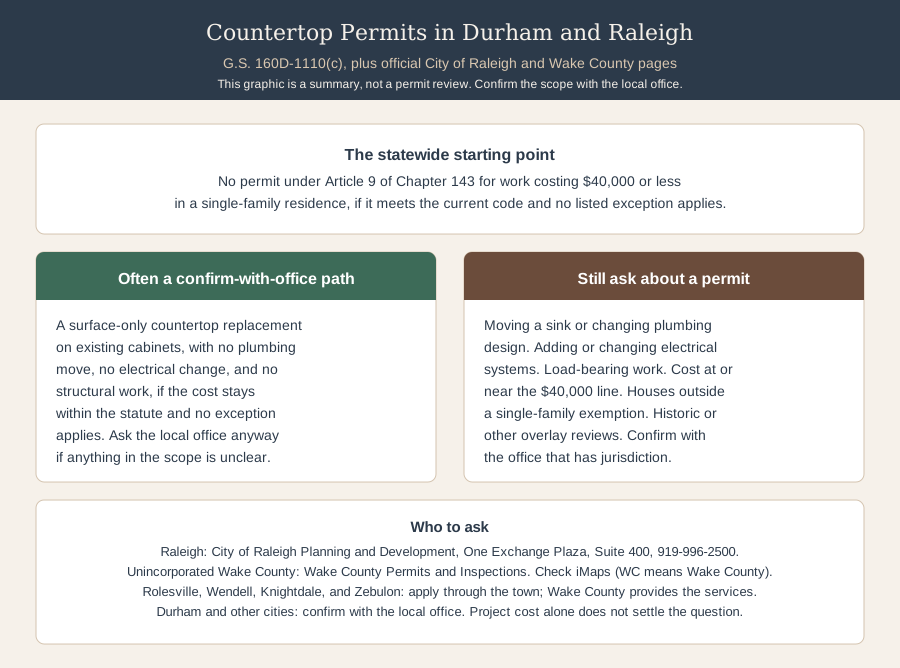
The statute and the Wake FAQ do not use identical wording at the $40,000 line. Do not collapse them. If a quote is at or near that figure, or if any trade work is in the scope, confirm with the office that will actually issue the permit.
Who issues the permit in the Triangle?
Jurisdiction follows the property, not the mailing address and not the showroom you visit.
- If the house is in the City of Raleigh, the City of Raleigh Planning and Development department is the office described on the official residential permit page. That page lists the Planning and Development Customer Service Center at One Exchange Plaza, Suite 400, Raleigh, NC 27601, and the phone number 919-996-2500. It also points questions to Ask Raleigh and applications to the Permit and Development Portal.
- If the house is in unincorporated Wake County, Wake County Permits and Inspections is the department described on the official FAQ. That page tells you to confirm jurisdiction by looking up the property on Wake's iMaps tool. The same FAQ states that Wake County also conducts permitting and inspection services for the towns of Rolesville, Wendell, Knightdale, and Zebulon. If you live within those corporate limits, you apply for permits through the town, and Wake County provides the permitting and inspection services. Do not assume another municipality is served by the county. Confirm the office on iMaps or with the town.
- If the house is in Durham or in another city or county, confirm with the inspections office that has jurisdiction there. The statewide statute still applies, but local intake, portals, and trade-permit practices differ. The official Durham City-County Building & Safety page could not be retrieved on November 11, 2026, so this guide does not quote a Durham-only rule.
Historic districts, neighborhood-protection overlays, and rental or commercial buildings can add reviews that a typical single-family surface replacement does not face. Those questions go to the planning or inspections office for the address, not to a countertop quote.
What should you put in the project scope?
Write the permit assumption into the plan the same way you would write the material and the edge.
- If the scope is a countertop replacement only, on the existing cabinets, with no plumbing, electrical, or structural change, say that the bid assumes the work may fall under G.S. 160D-1110(c) if the cost stays within the statute's threshold and no exception applies, and that the assumption changes if the scope grows.
- If the client wants the sink moved, an island added with new plumbing or wiring, or a wall opened, treat those items as permit questions and as schedule items, not as surprises after the slab is cut.
- Do not treat a countertop quote as a permit review. United Granite LLC can discuss the stone, the layout, and the showroom samples. The building department issues the permit.
If you are still choosing a material, see Granite vs quartz countertops. If you are planning seams or thickness, see How to plan seams on granite and quartz countertops and 2cm vs 3cm countertops.
Questions about a slab or a layout can go to the Durham showroom. United Granite LLC, 2436 S Miami Blvd #200-7, Durham, NC 27703. Monday through Friday from 8 AM to 5 PM; Saturday from 8 AM to 4 PM; Sunday closed. Call (919) 251-8820 or request a quote.