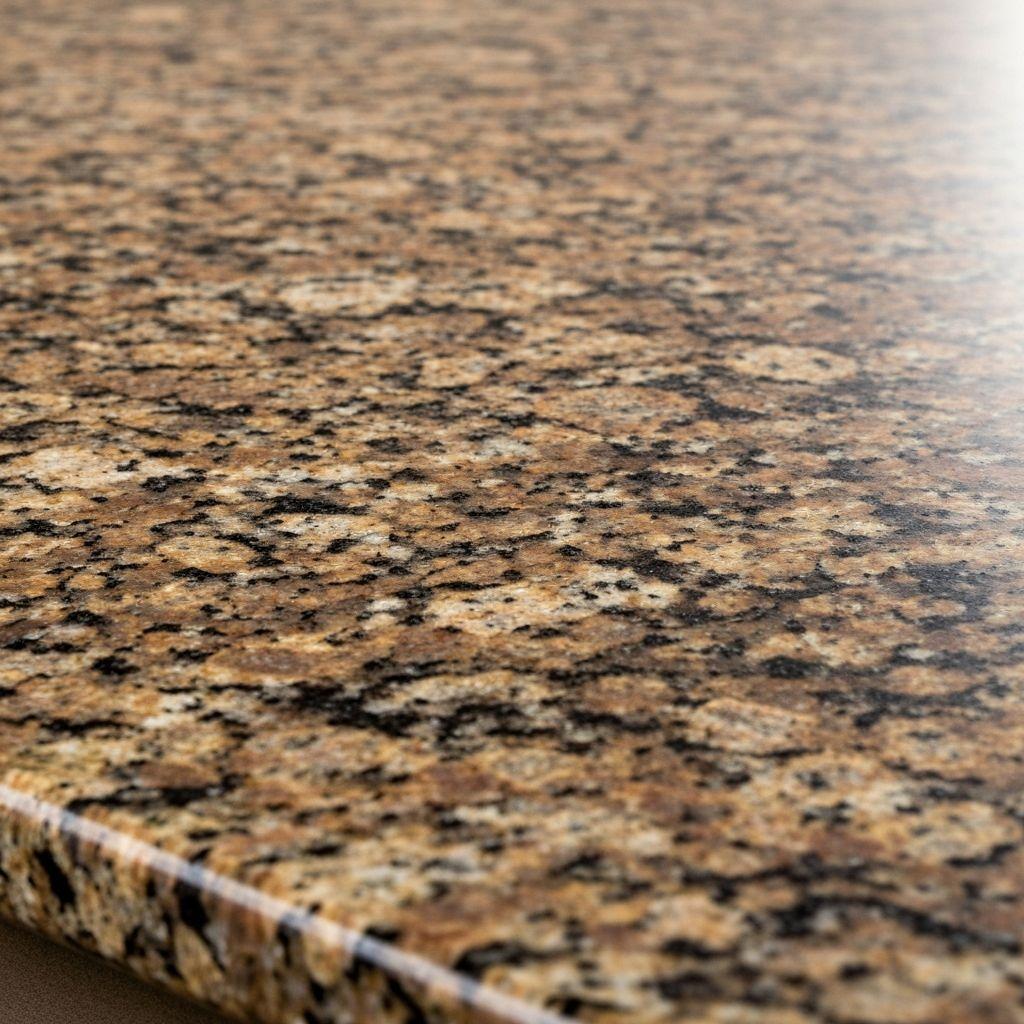
Countertop thickness is a construction choice. A 3cm slab (about 1 3/16 inches) is a common full-thickness option that can often sit on the cabinets with a simple edge. A 2cm slab (about 3/4 inch) is thinner and usually needs a clearer support and edge plan. United Granite LLC can show both options in the Durham showroom. Choose the thickness with the actual stone in front of you, not from a chip alone.
Key takeaways
- 3cm and 2cm describe the slab thickness. They are not brand names, and they are not a quality ranking.
- A 3cm edge is often a single, full-thickness profile. A 2cm edge is often built up, laminated, or mitered so the finished front can still read as a thicker edge if you want that look.
- Support, overhang, and seam plans change with thickness. Ask the fabricator how the chosen thickness will be carried on your cabinets, and do not rely on generic inch limits from an unrelated website.
- Thickness is one cost factor among many. It is not a substitute for a quote, and no installed price is published in this guide.
- Compare 2cm and 3cm samples, and finished edges, at 2436 S Miami Blvd #200-7, Durham, NC 27703, then request a quote.
What is the difference between 2cm and 3cm countertops?
The numbers are the thickness of the slab, in centimeters. A 3cm slab is thicker and heavier than a 2cm slab of the same stone. That difference shows up in the edge, in how the slab is supported, and in how the front of the counter reads from a chair or from the kitchen doorway.
A 3cm kitchen counter is often fabricated from a single thickness, with the edge profile cut into that thickness. A 2cm counter can still have a visually thicker edge if the fabricator laminates a strip to the front or builds a mitered edge. It can also be left at 2cm when a thin profile is the goal, or when the stone is used as a cladding or a vanity top with a different support plan. Those are construction options, not automatic upgrades.
| Topic | 3cm slab | 2cm slab |
|---|---|---|
| What you are choosing | A thicker slab, commonly used for kitchen worktops | A thinner slab, used for worktops, cladding, or tops with a planned buildup |
| Typical edge | Often a single-thickness profile (for example eased or bullnose cut from the slab) | Often a laminated or mitered edge if you want a thicker finished front, or a slim 2cm edge if that is the design |
| Support | Still needs a cabinet run that can carry the stone; ask how long spans and overhangs will be carried | Often needs a more specific support or buildup plan; ask before you assume it can span the same opening as a 3cm slab |
| Weight and handling | Heavier, which matters at stairs, tight kitchens, and large islands | Lighter, which can help on some installs and on vertical pieces |
| Look | A thicker visible edge unless the profile is very simple | A thinner visible edge unless the edge is built up |
| Cost | Thickness is one factor in a quote, not a published price by itself | Same. A 2cm slab is not automatically the lower-cost job once edges, support, and labor are included |
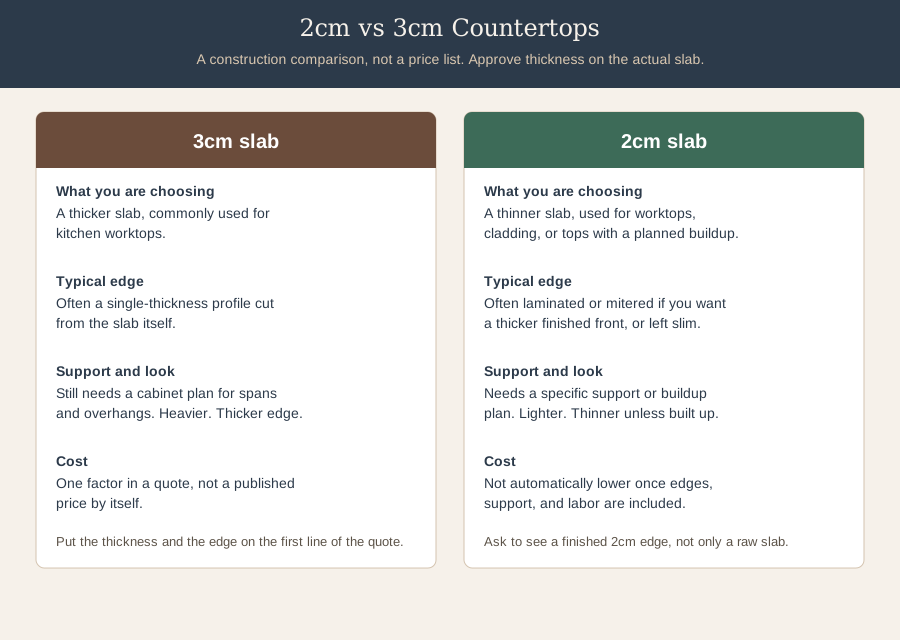
This table is a construction comparison, not a price list and not a test report. The right thickness still depends on the stone, the cabinets, the overhangs, and the edge you want.
When is a 3cm slab the more practical specification?
A 3cm slab is often the more practical specification when you want a full-thickness kitchen edge without a laminated front, and when the cabinet layout is a straightforward run or island that the fabricator is comfortable carrying at that thickness. It is also a familiar request in many Triangle kitchens, which can make it easier to compare samples side by side.
Specify 3cm clearly when:
- You want the edge thickness to come from the slab itself, not from a built-up strip.
- The design has overhangs or a long island, and you want the fabricator to plan support around a thicker slab.
- You are pairing the top with a standard cabinet height and you want the finished counter to match other 3cm work in the house, if that is already the look.
Still ask how seams, sink cutouts, and cooktop cutouts will be handled. Thickness does not remove the need for a layout review. For that step, use How to plan seams on granite and quartz countertops.
When does a 2cm specification make more sense?
A 2cm slab makes more sense when the design intent is a thinner edge, a wrapped or waterfall panel, a vanity or bar top, or a laminated or mitered edge that is planned as part of the look. It can also be the slab that is actually available in a color you have already chosen, which is a practical reason, not a compromise you have to hide.
Specify 2cm clearly when:
- You want a slim contemporary edge, or you have agreed on a laminated or mitered edge that will be built from 2cm material.
- Part of the job is a vertical panel, a cladding, or a top that will be fully supported in a way the fabricator has described to you.
- The slab you want is supplied in 2cm, and you are prepared to design the edge and the support around that thickness.
Do not assume a 2cm top can copy a 3cm overhang or a 3cm span without a support discussion. Ask the fabricator to put that plan in the quote. Do not use a generic inch limit from another market or another website as if it were a code requirement for your kitchen.
What should you compare in the showroom?
Bring the cabinet plan, or at least wall-to-wall measurements and photos, and look at thickness in person.
- Stand a 2cm piece and a 3cm piece next to each other, in the same or a similar color, and look at the edge from a standing height and from a seated height.
- Ask to see a laminated or mitered 2cm edge if that is under consideration, not only a raw 2cm edge.
- Confirm whether the color you like is actually stocked or quoted in the thickness you want. Availability is a fact for that slab, not a general rule.
- Walk through overhangs, cooktop and sink cutouts, and seams with the same thickness you intend to buy.
- If you are still choosing granite or quartz, use Granite vs quartz countertops. For the shape of the edge itself, use the edge profiles guide.
If the kitchen scope also moves plumbing or a wall, read Countertop permits in Durham and Raleigh before you treat the job as a surface-only replacement.
Compare both thicknesses before you lock the material. United Granite LLC is at 2436 S Miami Blvd #200-7, Durham, NC 27703, Monday through Friday from 8 AM to 5 PM and Saturday from 8 AM to 4 PM. Call (919) 251-8820 or request a quote.
How should you write thickness into the quote?
Put the thickness on the first line, next to the stone and the edge, not in a footnote.
- Stone and thickness: for example, "3cm granite, eased edge" or "2cm quartz, mitered edge," or whatever the actual specification is.
- How overhangs and spans will be supported.
- Whether a 2cm edge is raw, laminated, or mitered.
- Seam and cutout notes that match the layout you approved.
A quote that says only "quartz" or only "granite," with no thickness, is incomplete. Thickness changes the edge, the weight, and the support plan. It should be visible in the paperwork the same way the color is visible.