Granite or quartz can surround a fireplace, but the stone has to satisfy two sets of rules: the building code and fireplace listing, and the stone maker's own heat guidance. In North Carolina, a masonry fireplace needs a hearth extension at least 16 inches in front and 8 inches beyond each side of the opening. Quartz makers such as Cambria say their product must never sit against, on or over the firebox.
Key takeaways
- Know your fireplace type first. Masonry fireplaces follow the code tables; factory-built units follow their listing.
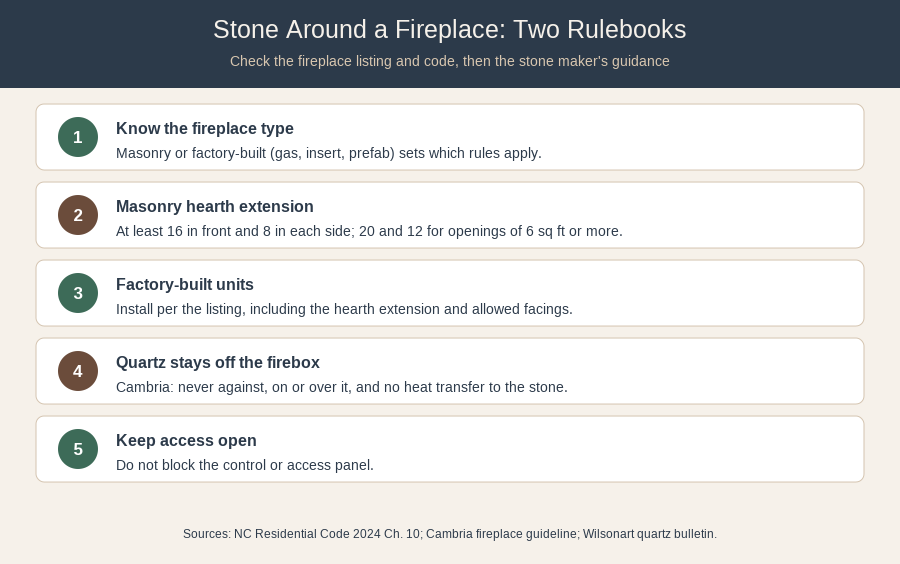
- The hearth extension has minimum sizes. 16 inches in front and 8 inches each side, or 20 and 12 for openings of 6 square feet or more.
- Quartz stays off the firebox. Cambria says heat must not transfer to the stone.
- Heat resistant is not heat proof. Wilsonart uses those words for its quartz.
- Your inspector has the final word. Code details vary by fireplace and by local amendment.
What are the two rulebooks for stone around a fireplace?
The two rulebooks are the fireplace rules and the stone maker's rules. The fireplace rules are the building code plus, for factory-built units, the manufacturer's listing and installation manual. The stone rules come from the countertop maker and say how close its material can go to heat. A stone surround has to pass both, so start with the fireplace and then check the stone.
What does the North Carolina code say?
The North Carolina Residential Code 2024, Chapter 10, sets hearth and trim distances for masonry fireplaces and sends factory-built units to their listing. Here is a summary of the sections that touch a stone surround or hearth:
Table 1. North Carolina Residential Code 2024, Chapter 10 summary
| Section | Applies to | What it says |
|---|---|---|
| R1001.9 | Masonry fireplaces | Hearths and hearth extensions are concrete or masonry, supported by noncombustible materials |
| R1001.10 | Masonry fireplaces | Hearth extension at least 16 in in front and 8 in beyond each side of the opening; 20 in and 12 in where the opening is 6 sq ft or larger |
| R1001.11 | Masonry fireplaces | Combustible mantels or trim not within 6 in of the opening; within 12 in, combustible material may project no more than 1/8 in for each 1 in of distance |
| R1004.1 | Factory-built fireplaces | Listed and labeled, tested to UL 127, installed per the listing |
| R1004.2 | Factory-built fireplaces | Hearth extension per the listing, readily distinguishable from the floor; listed extensions comply with UL 1618 |
This is a summary, not the full code. Your local building inspector decides how it applies to your home.
Masonry or factory-built? A site-built brick or block fireplace is masonry. Most gas fireplaces, inserts and prefab wood units are factory-built, and their installation manual lists the facing materials allowed and how close they can go to the opening. Find that manual, or the label on the unit, before you choose stone.
What do quartz makers allow near a fireplace?
Quartz makers allow surrounds with clear limits, and each brand publishes its own. Two examples:
Table 2. Two quartz makers' fireplace guidance
| Point | Cambria | Wilsonart Quartz |
|---|---|---|
| Use around fireplaces | Yes, installed per its guideline and the fireplace maker's instructions | Yes, for surrounds and mantels |
| Contact with the firebox | Never against, on or over the firebox | Use pads or heat shields against extreme heat |
| Heat limit wording | Heat must not transfer to the Cambria surface | Heat resistant, not heat proof; caution at 194 to 212 F (90 to 100 C) or above |
| Codes | Check building code requirements | Comply with NFPA 211 and local codes |
| High-heat units | Install as a combustible material under the fireplace maker's guidelines | Contact Wilsonart for review |
| Warranty | Not stated in the guideline | No warranty for this application |
The Cambria fireplace guideline also says the stone must not block access to the fireplace control panel, and that if the fireplace sits below the plane of the hearth, a different material is used there. The Wilsonart bulletin warns that long exposure to heat can discolor the surface. If your quartz is another brand, ask the fabricator for that maker's fireplace document.
We cover kitchen heat on quartz in can you put hot pans on quartz.
What about granite and other natural stone?
Granite has no single brand rulebook, so the fireplace listing and the code carry more weight. Cambria's guideline notes that natural stone surfaces, especially near the edges, can be damaged by sudden or rapid temperature changes and by direct or sustained heating. Keep the stone out of direct flame contact, follow the fireplace manual's facing rules, and ask your fabricator to look at the slab for fissures near where the opening will be cut.
Choosing a slab? Compare options on our granite, quartz and marble pages.
How thick should a stone fireplace surround be?
Surround thickness depends on whether the stone is a wall finish or a surface people step on. Cambria's product specification sheet lists 1 cm material for surface finishes such as walls and fireplaces, and 2 cm and 3 cm for countertops. A hearth that people sit or step on is a horizontal surface and needs full support underneath. Our 2 cm vs 3 cm guide explains how thickness changes the look and the support plan.
Before you order stone for a fireplace
- Fireplace type: masonry or factory-built
- Installation manual or listing label in hand
- Opening size measured, hearth extension size worked out
- Stone brand's fireplace guidance checked
- Control or access panel location marked
- Permit and inspection questions answered by your local building department
Planning a stone surround or hearth? Request a quote or call (919) 251-8820.